The Tiny 3D Printers Of Maker Faire

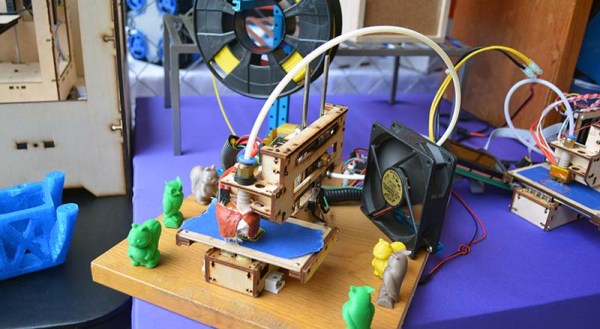
Building a big 3D printer has its own challenges. The strength of materials does not scale linearly, of course, and long axes have a tendency to wobble. That said, building a bigbot isn’t hard – stepper motors and aluminum extrusion are made for industry, and you can always get a larger beam or a more powerful motor. [James] is going in the opposite direction. He’s building tiny, half-scale printers. They’re small, they’re adorable, and they have design challenges all their own.

At this year’s New York Maker Faire, [James] is showing off his continuing project of building baby 3D printers. He has a half-scale wooden Printrbot, a half-ish scale Mendel Max, a tiny Makerbot Replicator, and a baby delta and baby Ultimaker in the works.

Click past the break for a gallery, and more info on [James’s] tiny creations.

Continue reading “The Tiny 3D Printers Of Maker Faire”

3D Print Your Garden

How would you go about sculpting a garden in the 21st century? One answer, perhaps predictably, is with a 3D printer. Gone are the days of the Chia pet. Thanks to a team of students out of University of Maribor in Slovenia, today we can 3D print living sculptures of our own design.

PrintGREEN traces its roots to an art project undertaken by Maja Petek, Tina Zidanšek, Urška Skaza, Danica Rženičnik, and Simon Tržan — an engineering student who worked on the project’s 3D printer — all mentored by professor Dušan Zidar. It uses a modified CNC machine to print layers of clay soil, water, and grass seeds that germinate and sprout in short order.

The goal of the project was to meld art, technology, and nature. Hard to argue with the results. With the rising necessity of  environmentally-conscious technologies in all areas, even gardening it seems, is not lacking for innovation.

If you’re looking to implement some more tech into your gardening, check out this homemade watering controller, as well as some space-saving solutions for urban gardening.


How To Have An Above Average Time With A Cheap Horizontal Bandsaw

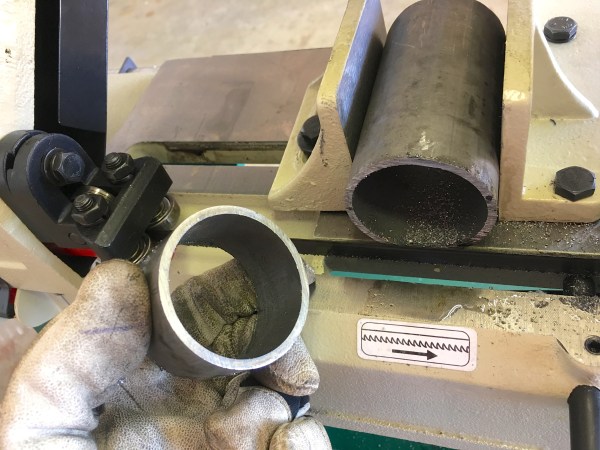
[Quinn Dunki] has brought yet another wayward import tool into her garage. This one, all covered in cosmoline and radiating formaldehyde fumes, is a horizontal bandsaw.

Now, many of us have all have some experience with this particular model of horizontal saw. It waits for us at our work’s machine shop, daring us to rely on it during crunch time. It lingers in the corner of our hackerspace’s metalworking area, permanently stuck in the vertical position; at least until someone finally removes that stripped screw. Either that or it’s been cannibalized for its motor, the castings moldering in a corner of the boneyard.

This article follows on the heels of [Quinn]’s other work, a treatise on the calibration of a drill press, and it outlines all the steps one has to take to bring one of these misunderstood tools into consistent and reliable operation. It starts with cultivating a healthy distrust of the factory’s assurances that this device is, “calibrated,” and needs, “no further attention.” It is not, and it does. Guides have to be percussively maintained out of the blade’s way. Screws have to be loosened and adjusted. It takes some effort to get the machine running right and compromises will have to be made.

In the end though, with a high quality blade on, the machine performs quite well. Producing clean and quality cuts in a variety of materials. A welcome addition to the shop.

Home-Made Metal Brake

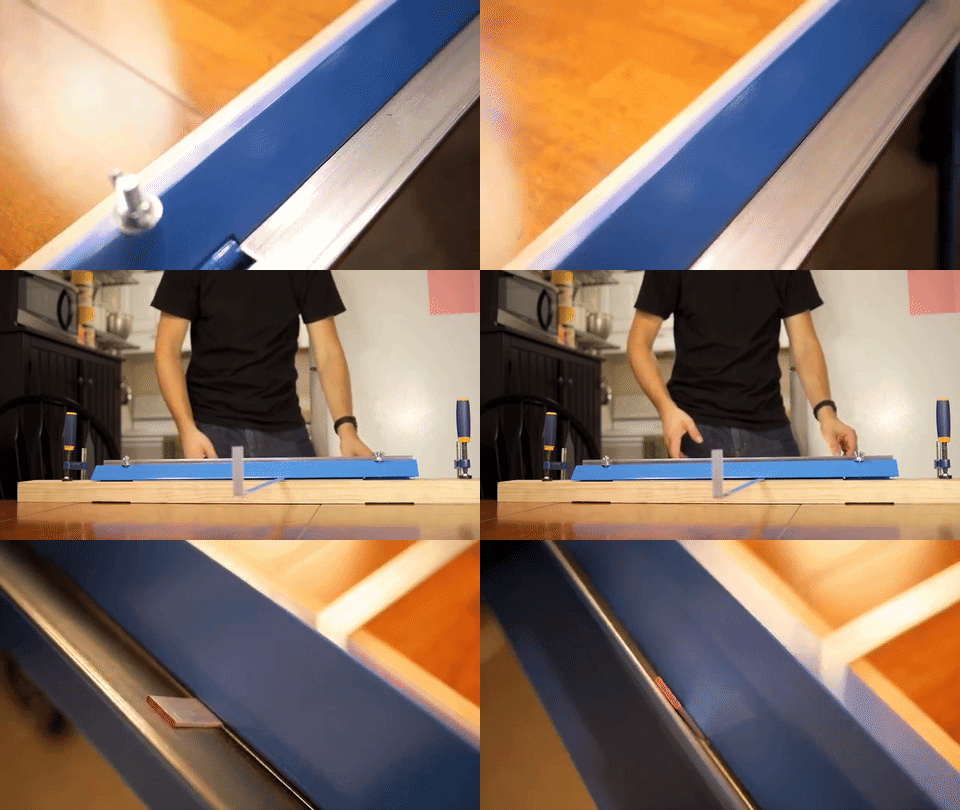
Sometimes, the appropriate application of force is the necessary action to solve a problem. Inelegant, perhaps, but bending a piece of metal with precision is difficult without a tool for it. That said, where a maker faces a problem, building a solution swiftly follows; and — if you lack a metal brake like YouTuber [makjosher] — building one of your own can be accomplished in short order.

Drawing from numerous online sources, [makjosher]’s brake is built from 1/8″ steel bar, as well as 1/8″ steel angle. The angle is secured to a 3/4″ wood mounting plate. Displaying tenacity in cutting all this metal with only a hacksaw, [makjosher] carved slots out of the steel to mount the hinges, which were originally flush with the wood. He belatedly realized that they needed to be flush with the bending surface. This resulted in some backtracking and re-cutting. [Makjosher] then screwed the pivoting parts to the wood mount. A Box tube serves as a handle. A coat of paint  finished the project, and adding another tool to this maker’s kit.

Continue reading “Home-Made Metal Brake”

Conductive Paint Turns Pizza Box Into DJ Mixing Station

Conductive paints and inks have been around for quite sometime, and the internet abounds with examples of cool projects you can use them for. They’re well suited to quick and fun prototypes, educational workshops, and temporary toys. But, as cool as conductive paint is, it’s not usually the kind of thing that gets people excited at parties.

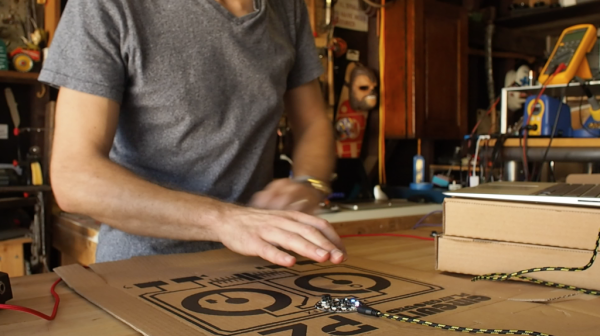
Well, until now that is. Adafruit has published a dope guide for building a bomb-diggity DJ mixing station out of a pizza box, conductive paint, and a Circuit Playground board. The guide walks you through how to properly apply the conductive paint (in this case using a stencil to lay it onto a cardboard pizza box), wire it up using the Circuit Playground, and integrate it into popular DJ software.

Sure, your sister’s “professional” DJ boyfriend may scoff at it, but it’ll still let you lay down some boss beats. And, when the bass drops nobody will care that you’re scratching a Domino’s box. Of course, there are other options out there if you want a more permanent solution.

Hackaday Prize Entry: The GECK

The Garden of Eden Creation Kit, or GECK, is the MacGuffan of Fallout 3 and the name of the modding tool for the same game. In the game, the GECK is a terraforming tool designed to turn the wasteland of Washington DC into its more natural form — an inhospitable swamp teeming with mosquitos.

A device to automatically terraform any environment is improbable now as it was in Wrath of Khan, but a “Garden of Eden Kit” is still a really great name. For their Hackaday Prize entry, [atheros] is building a simplified version of this terraforming device. Instead of turning the Tidal Basin into potable water or turning a nebula into a verdant planet, [atheros]’s Garden of Eden Watering Kit turns empty potted plants into a lush harvest of herbs.

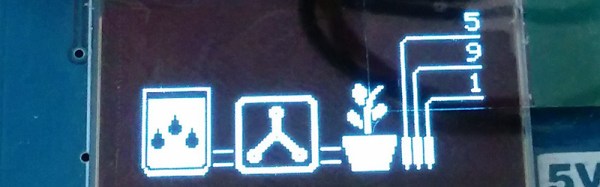
The device, like most home gardening solutions presented in this year’s Hackaday Prize, isn’t geared towards irrigating acres of crops. This is just a simple, small device meant to water a few herbs growing in a pot on a balcony. The hardware consists of a Teensy LC and a small OLED for command and control. A soil moisture sensor goes into each pot, and a few 12V peristaltic pumps water the plants from a bucket reservoir.

For the home gardener, it’s the perfect setup to grow some herbs, some chilis, or a cherry tomato plant that produces a year’s worth of tomatoes every week.  It’s a great adaptation of off the shelf tech, and a great entry for the Hackaday Prize.

Hack An 8085 Like It’s 1985

If you have been building electronic hardware for several decades, do you still have any projects from your distant past? Do they work? An audio amplifier perhaps, or a bench power supply.

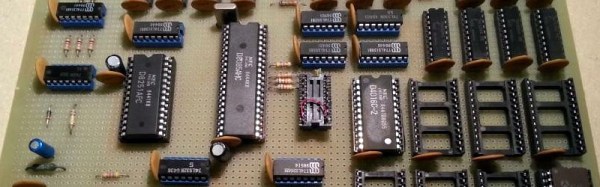
[Just4Fun] made a rather special computer in the 1980s, and it definitely still works. Describing it as “An 8085 single board computer with an EPROM emulator” though, does not convey just how special it is. This is not the modern sense of a single board computer with an SoC and a few support components. Instead it is a full system in the manner of the day in which processor, memory and peripherals are all separate components surrounded by 74 series glue logic. The whole system is wire-wrapped on a piece of perfboard and mounted very neatly in a rack. The EPROM emulator is a separate unit in a console case with hexadecimal keyboard and 7-segment display.

As the video below the break of an LED flashing demo shows, the EPROM emulator allows 8085 machine code to be entered byte by byte instead of having to be burned into a real EPROM.

[Just4Fun] leaves us with plans to replace the period EPROM emulator with a modern alternative, an EEPROM on a PCB designed to fit in the original bank of EPROM sockets. In this he suggests he might fit a bootloader and a BASIC interpreter, something entirely possible back in the day with conventional EPROMs, but probably not as cheaply.

Continue reading “Hack An 8085 Like It’s 1985”