Testing The Speed-of-Light Conspiracy

There are a number of ways to measure the speed of light. If you’ve got an oscilloscope and a few spare parts, you can build your own apparatus for just a few bucks. Don’t believe the “lies” that “they” tell you: measure it yourself!

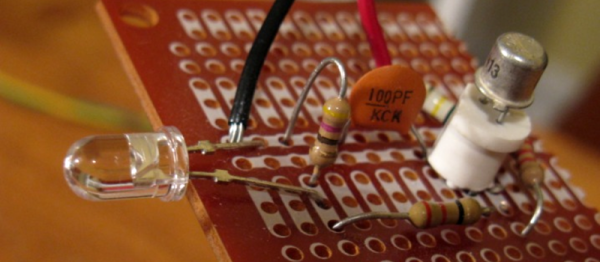
OK, we’re pretty sure that conspiracy theories weren’t the motivation that got [Michael Gallant] to build his own speed-of-light measurement rig, but the result is a great writeup, and a project that includes one of our favorite circuits, the avalanche transistor pulse generator.
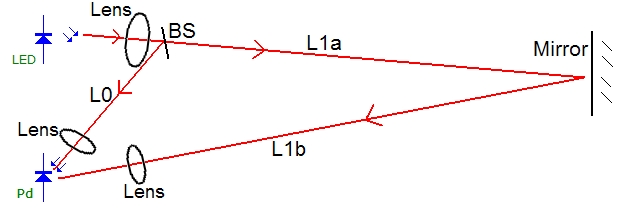
setupThe apparatus starts off with a very quickly pulsed IR LED, a lens, and a beam-splitter. One half of the beam takes a shortcut, and the other bounces off a mirror that is farther away. A simple op-amp circuit amplifies the resulting pulses after they are detected by a photodiode. The delay is measured on an oscilloscope, and the path difference measured with a tape measure.

If you happen to have a photomultiplier tube in your junk box, you can do away with the amplifier stage. Or if you have some really fast logic circuits, here’s another project that might interest you. But if you just want the most direct measurement we can think of that’s astoundingly accurate for something lashed up on breadboards, you can’t beat [Michael]’s lash-up.

Oh and PS: He got 299,000 (+/- 5,000) km/sec.
Creating A PCB In Everything: Eagle DRC And Gerber Files

For the next post in the Creating A PCB series, we’re going to continue our explorations of Eagle. In Part 1,  I went over how to create a part from scratch in Eagle. In Part 2, we used this part to create the small example board from the Introduction.

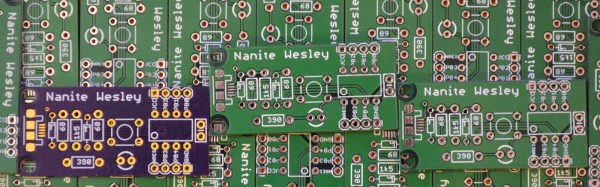
This time around I’ll be going over Design Rule Check (DRC) — or making sure your board house can actually fabricate what you’ve designed. I’ll also be covering the creation of Gerber files (so you can get the PCB fabbed anywhere you want), and putting real art into the silkscreen and soldermask layers of your boards.

The idea behind this series is to explore different EDA suites and PCB design tools by designing the same circuit in each. You can check out the rest of the posts in this series right here.

Continue reading “Creating A PCB In Everything: Eagle DRC And Gerber Files”

Taking A U2F Hardware Key From Design To Production

Building a circuit from prototyping to printed circuit board assembly is within the reach of pretty much anyone with the will to get the job done. If that turns out to be something that everyone else wants, though, the job gets suddenly much more complex. This is what happened to [Conor], who started with an idea to create two-factor authentication tokens and ended up manufacturing an selling them on Amazon. He documented his trials and tribulations along the way, it’s both an interesting and perhaps cautionary tale.

[Conor]’s tokens themselves are interesting in their simplicity: they use an Atmel ATECC508A specifically designed for P-256 signatures and keys, a the cheapest USB-enabled microcontroller he could find: a Silicon Labs EFM8UB1. His original idea was to solder all of the tokens over the course of one night, which is of course overly optimistic. Instead, he had the tokens fabricated and assembled before being shipped to him for programming.

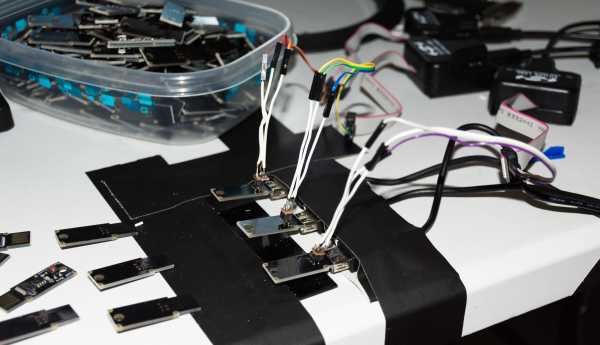
Normally the programming step would be straightforward, but using identical pieces of software for every token would compromise their security. He wrote a script based on the Atmel chip and creates a unique attestation certificate for each one. He was able to cut a significant amount of time off of the programming step by using the computed values with a programming jig he built to flash three units concurrently. This follows the same testing and programming path that [Bob Baddeley] advocated for in his Tools of the Trade series.

From there [Conor] just needed to get set up with Amazon. This was a process worthy of its own novel, with Amazon requiring an interesting amount of paperwork from [Conor] before he was able to proceed. Then there was an issue of an import tariff, but all-in-all everything seems to have gone pretty smoothly.

Creating a product from scratch like this can be an involved process. In this case it sounds like [Conor] extracted value from having gone through the entire process himself. But he also talks about a best-case-scenario margin of about 43%. That’s a tough bottom line but a good lesson anyone looking at building low-cost electronics.

Distributed Censorship Or Extortion? The IoT Vs Brian Krebs

Now it’s official. The particular website that was hit by a record-breaking distributed denial of service (DDOS) attack that we covered a few days ago was that of white-hat security journalist [Brian Krebs]: Krebs on Security.

During the DDOS attack, his site got 600 Gigabits per second of traffic. It didn’t involve amplification or reflection attacks, but rather a distributed network of zombie domestic appliances: routers, IP webcams, and digital video recorders (DVRs). All they did was create HTTP requests for his site, but there were well in excess of 100,000 of these bots.

In the end, [Krebs’] ISP, Akamai, had to drop him. He was getting pro bono service from them to start with, and while they’ve defended him against DDOS attacks in the past, it was costing them too much to continue in this case. An Akamai exec estimates it would have cost them millions to continue defending, and [Brian] doesn’t blame them. But when Akamai dropped the shields, his hosting provider would get slammed. [Krebs] told Akamai to redirect his domain to localhost and then he went dark.

Continue reading “Distributed Censorship Or Extortion? The IoT Vs Brian Krebs”

Homebrew Powerwall Sitting At 20kWh

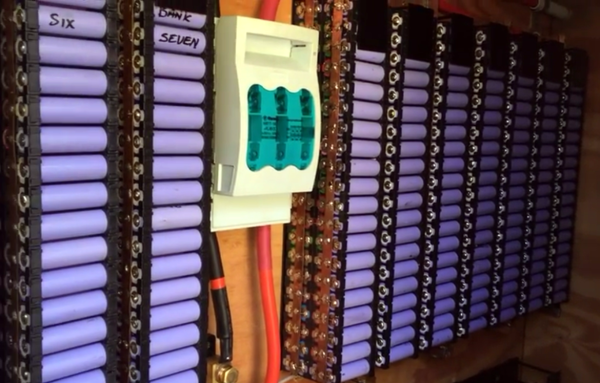
Every now and then a hacker gets started on a project and forgets to stop. That’s the impression we get from [HBPowerwall]’s channel anyway. He’s working on adding a huge number of 18650 Lithium cells to his home’s power grid and posting about his adventures along the way. This week he gave us a look at the balancing process he uses to get all of these cells to work well together. Last month he gave a great overview of the installed system.

His channel starts off innocently enough. It’s all riding small motor bikes around and having a regular good time.  Then he experiments a bit with the light stuff, like a few solar panels on the roof.  However, it seems like one day he was watching a news brief about the Powerwall (Tesla’s whole-home battery storage system) and was like, “hey, I can do that.”

After some initial work with the new substance it wasn’t long before he was begging, borrowing, and haggling for every used 18650 lithium battery cell the local universe in Brisbane, Australia could sell him. There are a ton of videos documenting his madness, but he’s all the way up to a partly off-grid house with a 20kWh battery bank, for which he has expansion plans.

There’s a lot of marketing flim flam and general technical pitfalls in the process of generating your own non-grid electricity. But for hackers in sunny areas who want to dump those rays into local storage this is an interesting blueprint to start with.

Continue reading “Homebrew Powerwall Sitting At 20kWh”

3D Printing A Stop Motion Animation

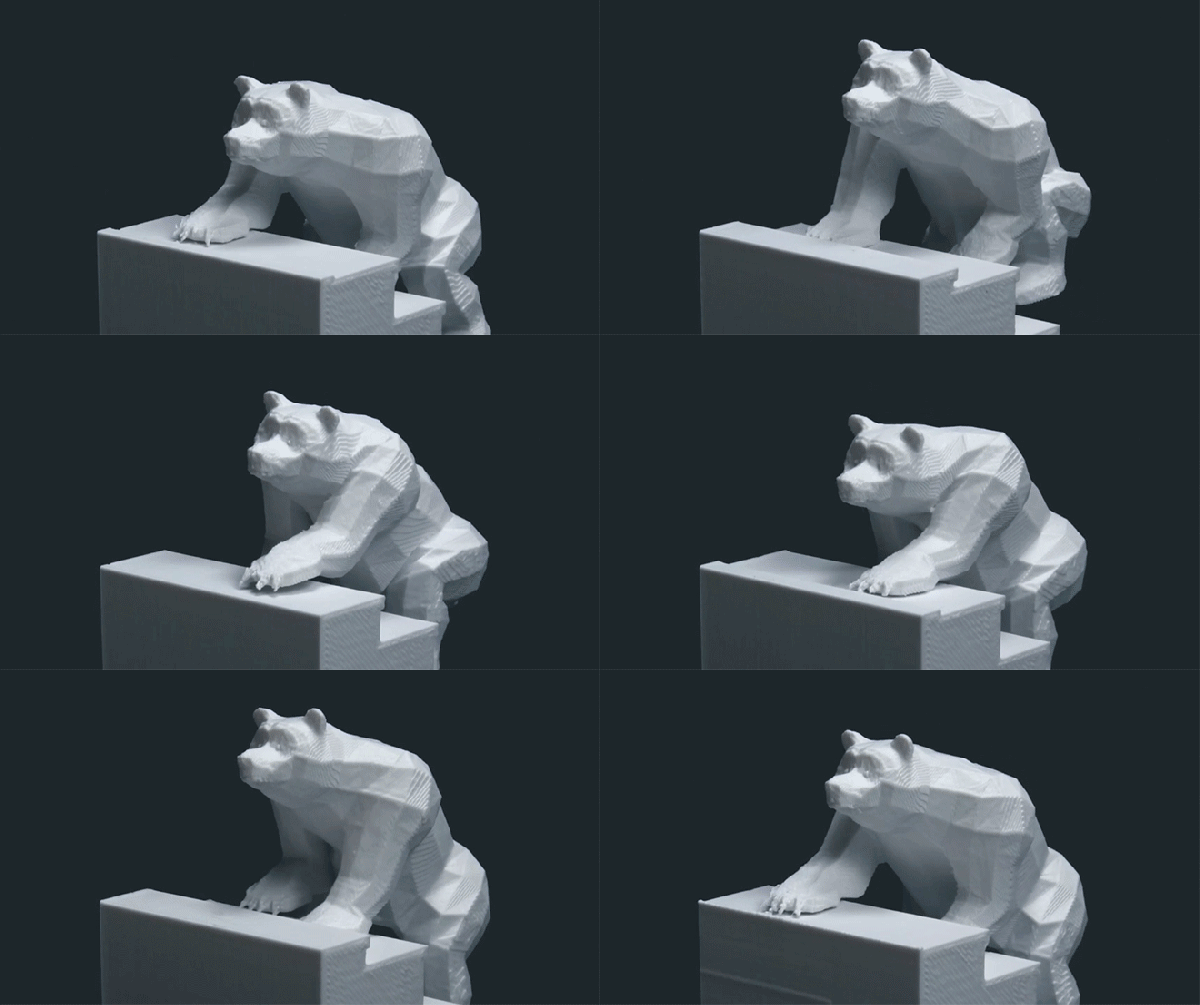
How much access do you have to a 3D printer? What would you do if you had weeks of time on your hands and a couple spools of filament lying around? Perhaps you would make a two second stop-motion animation called Bears on Stairs.

An in-house development by London’s DBLG — a creative design studio — shows a smooth animation of a bear — well — climbing stairs, which at first glance appears animated. In reality, 50 printed sculptures each show an instance of the bear’s looping ascent. The entire process took four weeks of printing, sculpture trimming, and the special diligence that comes with making a stop-motion film.

Continue reading “3D Printing A Stop Motion Animation”

Hackaday Prize Entry: Bypassing TV Broadcasting Restrictions

It’s a common problem faced by TV viewers, the programming they want to watch is being broadcast, but not to their location. TV content has traditionally been licensed for transmission by geography, and this has sometimes put viewers at odds with broadcasters.

The viewing public have not always taken this restriction of their programming choice lying down, and have adopted a variety of inventive solutions with varying degrees of legality and success. Many years ago you might have seen extreme-length UHF antennas to catch faraway transmitters, more recently these efforts have been in the digital domain. It was said in the 1990s that Sky’s Videocrypt satellite TV smart cards were cracked because German Star Trek Next Generation fans were unable to buy subscriptions for non-UK addresses, for example. You can argue in the comments over whether [Patrick Stewart] et al being indirectly responsible for a decryption coup is an urban legend, but it is undeniable that serial smart card emulators and dodgy DOS software for Sky decryption were sold all over Europe at the time.

Modern-day efforts to break the geographic wall on TV broadcasting have turned to the Internet. Services such as the ill-fated Aereo and the Slingbox set-top streaming products have taken the TV broadcast in a particular area and transported it to other locations for viewing online. But they are not the only Internet self-streaming option, if the idea of paying a subscription or tying yourself to a commercial service does not appeal then you can build an off-air streamer for yourself.

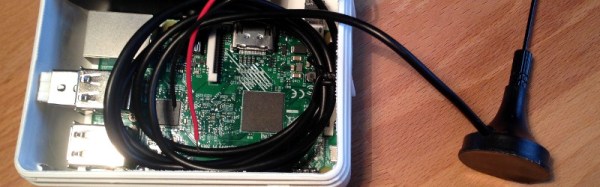
[Solenoid]’s project is an off-air streamer using a Raspberry Pi 3 with a USB DVB-T tuner. It uses Tvheadend to power the streaming, and OpenVPN to provide security. His build logs detail his efforts to ensure that power consumption is not too high and that the Pi is not running too hot, and provides instructions on how to set up and use the software. It’s not an overly complex piece of hardware, but it could provide a useful service for any of you who wish to keep up-to-date with your home TV when you are off on your travels.