IPhone Polarizing Camera Solves Filter Orientation Problem Using Flash

One of last year’s Hackaday Prize finalists was the DOLPi, [Dave Prutchi]’s polarimetric camera which used an LCD sheet from a welder’s mask placed in front of a Raspberry Pi camera. Multiple images were taken by the DOLPi at different polarizations and used to compute images designed to show the polarization of the light in each pixel and convey it to the viewer through color.
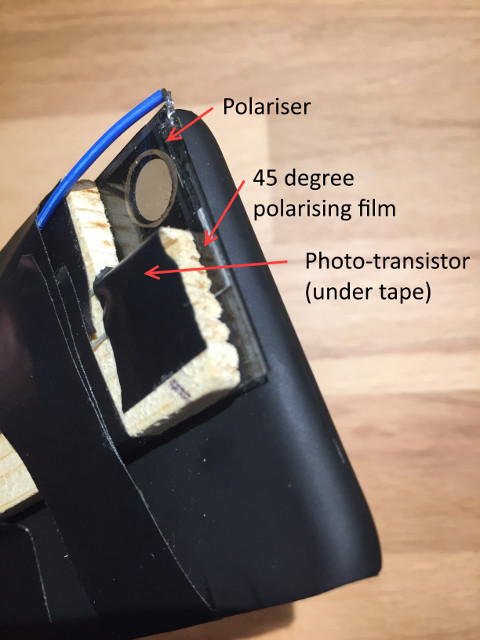
The polarizer and phototransistor taped to the iPhone.

[Dave] wrote to tip us off about [Paul Wallace]’s take on the same idea, a DOLPi-inspired polarimetric camera using an iPhone with an ingenious solution to the problem of calibrating the device to the correct polarization angle for each image that does not require any electrical connection between phone and camera hardware. [Paul]’s camera is calibrated using the iPhone’s flash. The light coming from the flash through the LCD is measured by a phototransistor and Arduino Mini which sets the LCD to the correct polarization. The whole setup is taped to the back of the iPhone, though we suspect a 3D-printed holder could be made without too many problems. He provides full details as well as code for the iPhone app that controls the camera and computes the images on his blog post.

We covered the DOLPi in detail last year as part of our 2015 Hackaday Prize finalist coverage. You can also find its page on Hackaday.io, and [Dave]’s own write-up on his blog.

 

Looptaggr: Endless Graffiti

If your problem is how to put out a maximum amount of repetitive graffiti with a minimum amount of effort, we’ve got your solution. Or rather, [Ariel Schlesinger] and [Aram Bartholl] had your solution way back in 2010. The banner image says it all.

Of course, it doesn’t have to be graffiti that you’re spraying. This idea could be easily adapted to stencil that repeating floral pattern that my grandmother had on her walls too. It’s like a patterned paint roller, but for a spray can.

There’s room for improvements here. For instance, we can’t cut out stencils to save our life but we know where to find a laser cutter. From the look of things, they could use a slightly bigger stencil and something to catch the drips. There’s probably an optimal size for this gizmo, which calls for experimentation.

We’re somewhat obsessed with graffiti machines. Whether it’s a graffiti quadcopter or the elegant and non-permanent sidewalk-chalker style bots, we like machines that make “art”. What’s your favorite graffiti hack?

Thanks [n0p;n0p;n0p;] for the (archival) tip!

Hackaday Prize Entry: Dtto Modular Robot

A robot to explore the unknown and automate tomorrow’s tasks and the ones after them needs to be extremely versatile. Ideally, it was capable of being any size, any shape, and any functionality, shapeless like water, flexible and smart. For his Hackaday Prize entry, [Alberto] is building such a modular, self-reconfiguring robot: Dtto.

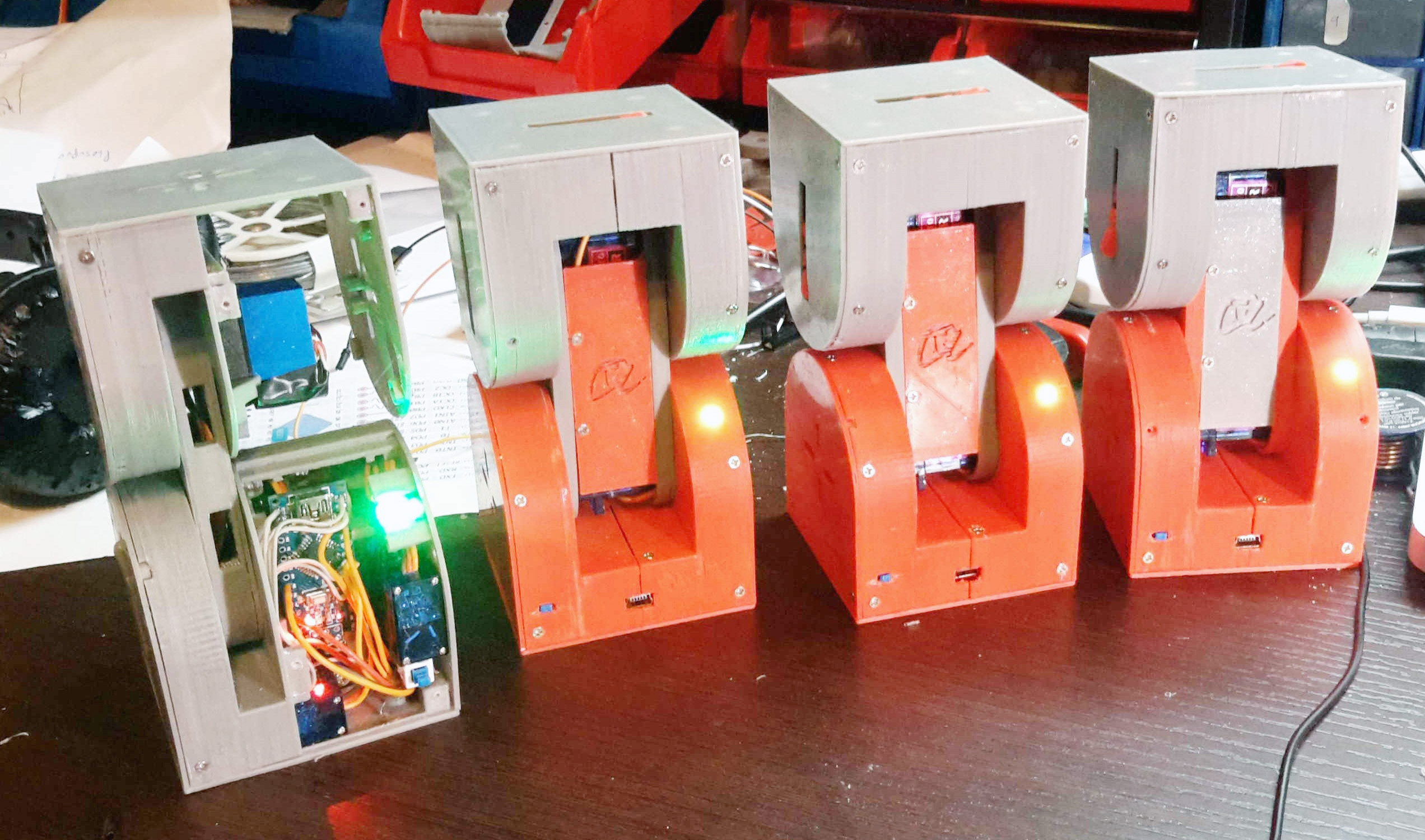
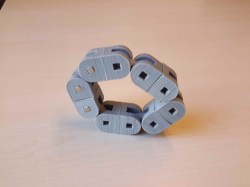
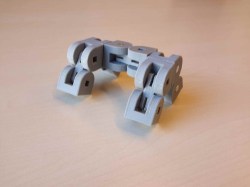
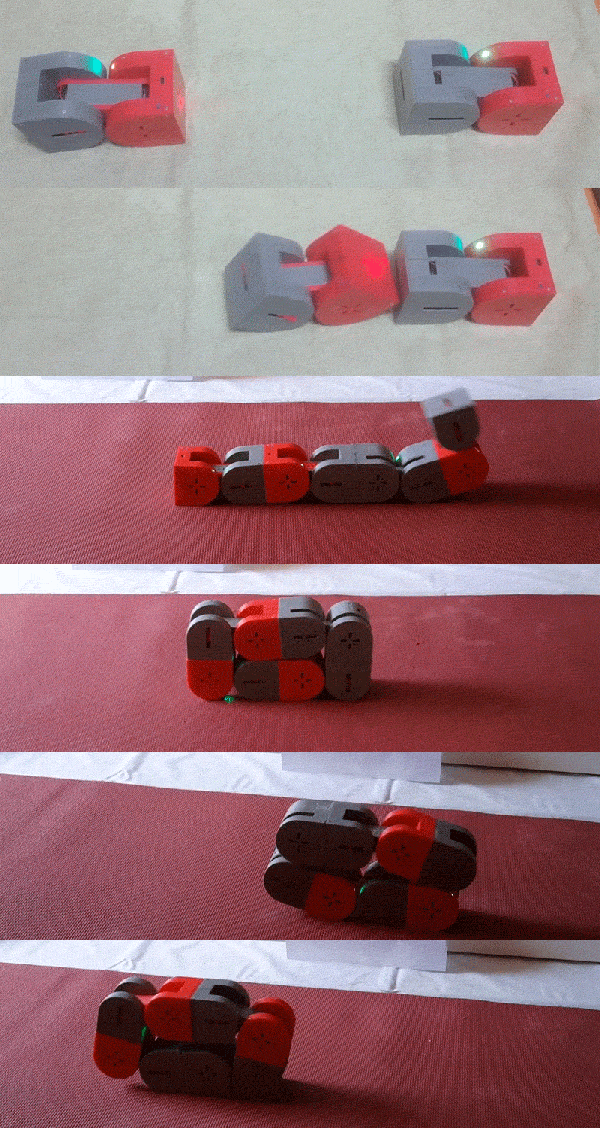
ditto_family To achieve the highest possible reconfigurability, [Alberto’s] robot is designed to be the building block of a larger, mechanical organism. Inspired by the similar MTRAN III, individual robots feature two actuated hinges that give them flexibility and the ability to move on their own. A coupling mechanism on both ends of the robot allows the little crawlers to self-assemble in various configurations and carry out complex tasks together. They can chain together to form a snake, turn into a wheel and even become four (or more) legged walkers. With six coupling faces on each robot, that allow for connections in four orientations, virtually any topology is possible.

Each robot contains two strong servos for the hinges and three smaller ones for the coupling mechanism. Alignment magnets help the robots to index against each other before a latch locks them in place. The clever mechanism doubles as an ejector, so connections can be undone against the force of the alignment magnets. Most of the electronics, including an Arduino Nano, a Bluetooth and a NRF24L01+ module, are densely mounted inside one end of the robot, while the other end can be used to add additional features, such as a camera module, an accelerometer and more. The following video shows four Dtto robots in a snake configuration crawling through a tube.

Continue reading “Hackaday Prize Entry: Dtto Modular Robot”

Distributed, Open Source Chat With Vector And Matrix

When it comes to chat, you have many choices. Facebook Messenger, Google Talk, Whatsapp, Kik, and Slack are all viable options. However, all of these choices are proprietary, and require you to use servers that you can’t run yourself. They’re highly centralized, closed source tools.

In the open source world, IRC has been the go to solution for chat for many years, and for good reason. Anyone can run a server, there’s many clients, and it’s built on open standards. But IRC comes from a pre-mobile world, and relies on clients to maintain persistent connections to the server. It’s not the best experience on a phone.

Matrix.org and Vector.im aim to be a modern solution to chat. Matrix is a standard for passing messages around, and Vector is a chat solution built on top, with support for iOS, Android, and your browser.

What makes this solution different is the concept of Homeservers. A Homeserver manages messages for users, recording them when they are received and providing them to users when they connect. Homeservers also “federate” to communicate amongst each other. This means anyone can run a Homeserver and connect it to the greater network of Matrix, providing a distributed approach to building a chat network.

Under the hood, Matrix is just HTTP. You send messages into the network with POST requests, and receive new messages by polling with GET requests. This means no persistent connections are required, which is perfect for mobile and low power devices.

On the topic of devices, Matrix is designed for general purpose messaging, not just chat. It should be pretty simple to connect hardware up to Matrix, which would provide a simple way to get data in and out of connected devices. Since it’s all HTTP, a device based on the ESP8266 could hop into your chat room with relative ease.

Matrix and Vector are very much in beta, but are definitely usable and worth a try. To get started, you can create an account on Vector.im and start chatting. We’re awaiting some of the features in the works, including end-to-end encryption, and hope to see some future hacks talking to the Matrix infrastructure.

Hackaday Links: July 3, 2016

This week, Popular Mechanics published cutaway diagrams of ships that will be seen in Star Trek: Beyond, released later this month. This is your cue for spoilers for the remainder of this paragraph. The USS Franklin looks suspiciously like – and was likely built after – the NX-01, the titular ship of Star Trek: Enterprise. The Abrams-verse Franklin was the first Warp 4 ship, yet the prime universe NX-01 was the first Warp 5 ship, with previous ships having trouble reaching Warp 2. We must now consider the Abrams-verse Trek is not a parallel universe to prime-universe Trek and should therefore be considered a completely separate canon (yes, even the destruction of Vulcan. If you see the new Star Trek movie, the NX-01 launched in 2151, and your suggested viewing beforehand is ST:ENT, S02E24, First Flight.

The Mechaduino is a Hackaday Prize entry that turns steppers into closed-loop servos. It’s a phenomenal idea, and now it’s a Kickstarter.

Walk into a dollar store, and you’ll find stupid solar powered electronic flower pots. They’re bits of plastic that shake a plastic flower back and forth when placed in the sun. They’re selling millions, and I have no idea why. [Scott] put a jolly wrencher on one of these flower pots. Really, this is just an exercise in 3D printing, but [Scott] printed the jolly wrencher. We don’t see a lot of that, due to how difficult it is to render the wrencher in OpenSCAD.

In just a few hours, Juno will perform an insertion burn around Jupiter. Does this mean pretty pictures? Not quite yet. This is the closest a spacecraft has ever gotten to Jupiter, and over thirty or forty orbits, Juno will fly between Jupiter’s massive radiation belts. Here’s the NASA trailer.

This video recently caught the Internet’s attention. It’s squares and circles that when put next to a mirror look like circles and squares. Yes, it’s weird. People have 3D printers, so of course these ambiguous objects were quickly reverse engineered and printed. Here’s how they work

It looks like Brexit has caught up to Mouser. Here’s their country select dialog for eu.mouser.com. Thanks [Tom] for the screencap.

Improving 3D Printed Gears With… Hot Water

Being able to print out custom gears is one area where 3D printing can really shine, and [Karl Lew] has been busy doing exactly that with pinion gears printed in PLA and mounted to stepper motor shafts, but there are tradeoffs. Pinion gears need to grip a motor shaft tightly – normally done with a screw through the gear and onto the motor shaft. But a motor and its shaft can get quite warm when doing a lot of work, and a tight screw on a hot motor’s shaft will transmit that heat into the PLA, which can then deform.

[Karl Lew] managed to improve things in an unusual way: using a hot water bath to anneal the gear while it is attached to the stepper shaft. Annealing PLA has the effect of increasing the crystallinity of the material, which – according to an article going into some detail about the process of annealing PLA – increases stiffness, strength, and heat deflection. The annealing process also shrinks the part slightly, which happens to result in a very tight joint made between the gear and the slotted stepper shaft if the gear is annealed while connected to the motor.

Continue reading “Improving 3D Printed Gears With… Hot Water”

Bringing A Teletype Into The 21st Century

Before modern CRTs with ancient VGA connectors, and before fancy video terminals, the display for computers large and slightly smaller was the Teletype. While many of these Teletypes were connected directly, they were designed to be a remote terminal, connected through Ma Bell’s network. [NeXT] over on the Vintage Computer Forums is bringing the iconic ASR33 Teletype into the 21st century by giving this old display a modern way to connect to the outside world.

If you ever see a Teletype in action, it will be connected to a local machine. This was certainly not always the case. The Teletype was designed to connect to remote systems. [NeXT]’s Teletype came with a Call Control Unit designed for Telex lines, which do not exist anymore. Modems for the ASR33 existed, but good luck finding one. Lucky for [NeXT], nearly every modem ever made is backwards-compatible with the Bell Dataphone, one of the standard ways of plugging a Teletype into a phone line. All [NeXT] had to do was put a modem inside this Teletype.

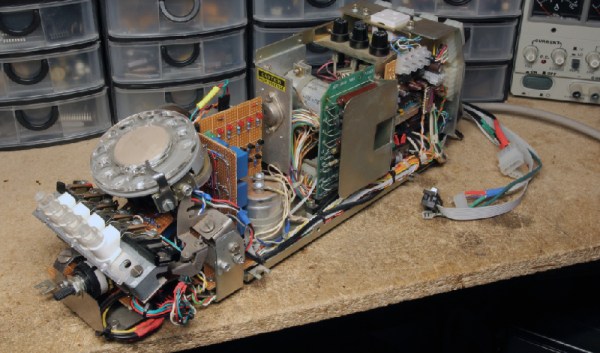
With relays, transistors, LEDs, and a lot of perfboard, [NeXT] successfully built a circuit that would interface the Teletype’s Call Control Unit to a Hayes Smartmodem tucked away inside the stand. Believe it or not, this is an exceptionally useful build; if you ever find a Teletype tucked away in the back of an old office, in a surplus shop, or on Craigslist, odds are it won’t be compatible with any modern electronics. That’s not to say land lines are particularly modern, but since there’s a microcontroller included in the new circuitry, it’s relatively easy to add a USB port to this ancient terminal.