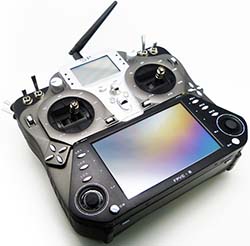
 With few exceptions, most of The Hackaday Prize are things we really haven’t seen much of before: base-3 computers that have been relegated to the history books, extremely odd 3D printers, and fancy, new IoT devices are the norm. The OSRC is not a new project to us. (UPDATE: Looks like they deleted their project page. Here is a snapshot of it from the Internet Archive) We saw it once in 2011 and again a year later. What makes the OSRC an interesting project for The Hackaday Prize isn’t the fact that it’s the most advanced RC transmitter ever created. Creating that was evidently the easy part. The OSRC could use a big financial kick in the pants, and if [Demetris] wins, we’d guess he wouldn’t be taking that ride to space. Rather, he’d be taking the cash prize to get his ultimate transmitter into large-scale manufacturing and out into the wild.
While at first glance the base model OSRC seems expensive at about $6-700 USD, consider this: a six-channel transmitter from an excellent brand costs about $120 USD. Nine channels will run you about $400. The OSRC is a forty channel radio. The sticks are capable of force feedback, and of course the ‘pro’ model of the OSRC has that wonderful screen, capable of displaying video from an FPV camera, a GPS/map overlay, or an incredibly extensive telemetry display. There are multi-thousand dollar avionics for real airplanes out there that have a smaller feature set, and that’s not hyperbole.
A few months ago, [Demetris] was interviewed by the awesome people at Flite Test. That (highly suggested) video is embedded below.
 The project featured in this post is an entry in The Hackaday Prize. Build something awesome and win a trip to space or hundreds of other prizes.
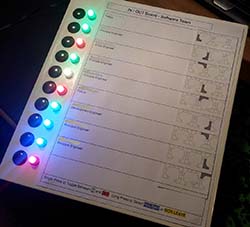 Before this project, [David]’s office had a fairly terrible system to tell everyone who was in the office, who was out, and who wasn’t coming in today. Velcro and whiteboards will do the job, but arcade buttons and LEDs called to [David], leading him to create this

 There’s a problem with products geared towards building the Internet of Things. Everyone building hardware needs investors, and thus some way to monetize their platform. This means all your data is pushed to ‘the cloud’, i.e. a server you don’t own. This is obviously not ideal for the Hackaday crowd. Yes, IoT can be done with a few cheap radios and a hacked router, but then you don’t get all the cool features of a real Things project – mesh networking and a well designed network.