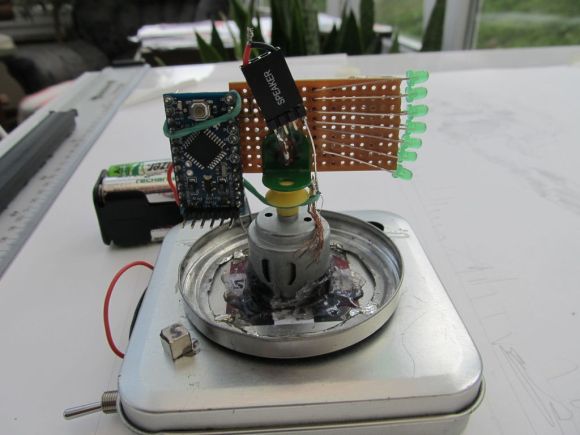
[Sholto] hacked together this ultra low-budget spinning display. He calls it a zoetrope, but we think it’s actually an LED based Persistence Of Vision (POV) affair. We’ve seen plenty of POV devices in the past, but this one proves that a hack doesn’t have to be expensive or pretty to work!
The major parts of the POV display were things that [Sholto] had lying around. A couple of candy tins, a simple brushed hobby motor, an Arduino Pro Mini, 7 green LEDs, and an old hall effect sensor were all that were required. Fancy displays might use commercial slip rings to transfer power, but [Sholto] made it work on the cheap!
The two tins provide a base for the display and the negative supply for the Arduino. The tins are soldered together and insulated from the motor, which is hot glued into the lower tin. A paper clip contacts the inside of the lid, making the entire assembly a slip ring for the negative side of the Arduino’s power supply. Some copper braid rubbing on the motor’s metal case forms the positive side.
[Sholto] chose his resistors to slightly overdrive his green LEDs. This makes the display appear brighter in POV use. During normal operation, the LEDs won’t be driven long enough to cause damage. If the software locks up with LEDs on though, all bets are off!
[Sholto] includes software for a pretty darn cool looking “saw wave” demo, and a simple numeric display. With a bit more work this could make a pretty cool POV clock, at least for as long as the motor brushes hold up!





 Simple machines are wonderful in their own right and serve as the cornerstones of many technological advances. This is certainly true for the humble lever and the role it plays in manual transmissions as evidenced in this week’s Retrotechtacular installment,
 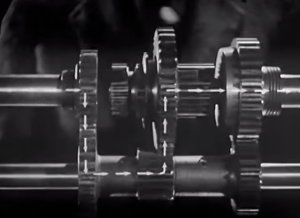 Next, we are shown how engine power is transferred to the rear wheels: it travels from a gear on the engine shaft to a gear on the drive shaft through gears on the countershaft. At low speeds, we let the smallest gear on the countershaft turn the largest gear on the drive shaft. When the engine is turning 90 RPM, the rear wheel turns at 30 RPM. At high speeds using high gears, the power goes directly from the engine shaft to the drive shaft and the RPM on both is equal. The film goes on to explain how the gearbox handles reverse, and the vast improvements to transmission life made possible through synchromesh gearing.