DIY Laser Cutter Built To Make Stencils

It was time for some new T-shirts so [Andreas Hölldorfer] built a laser cutter. Wait, what? That’s the excuse he’s going with, and in the end this scratch built laser cutter did come in handy by cutting stencils to use when decorating his garments.

The first thing we thought when looking at the cutter is where’s the tube? [Andreas] didn’t use a CO2 laser, so this ends up being rather low-powered. The cutting head is a 1W blue laser diode which manages to slice the three-ring binder separator pages he’s using for the stencils. The two-axis machine is mounted inside a wooden box to protect his eyes while it’s cutting. He plans to add a drawer later on so that the cutting bed will slide in and out to swap out material for the next project. He already does a lot of 3D printing work and had an old RepRap driver board on hand to use for this projects. He designed and printed the red mounting brackets which make all of the junk-bin components work together. Not bad!

If you’d like to try this out on a smaller scale try using optical drive parts for the axes.

Life Meter Gives A Real Life Measure Of Video Game Health

water-light-health-bar

This hack makes the virtual real by displaying your video game character’s health meter as a column of illuminated water.

The build video, which you’ll find embedded after the break, is really quite remarkable. The column is a clear piece of pipe anchored at one end by hand-tightened plumbing drain fittings. This allows [Bfayer] to attach a flexible bladder which he constructed for the project. An actuator pushes a hinged board up against the bladder to raise and lower the water level in the tube.

Alone that’s pretty impressive, but [Bfayer] went the extra mile and then some. He uses a four-way fitting at the bottom of the meter. One fork connects to the bladder, another allows air to be injected using an aquarium pump. The bottom of the fitting has a clear window so that an RGB LED array can shine into the water which was doped with highlighter ink to pick up the colored glow. To pull the whole thing together he coded the custom control interface seen above.

Continue reading “Life Meter Gives A Real Life Measure Of Video Game Health”

Bluetooth Stepper Motor Driver

bluetooth-stepper-motor-driver

[Dan] salvaged some parts from an old printer a while back and finally found some time to play with them. One of the things he was most interested in is the geared stepper motor seen above. He was able to get it running with an Arduino in no time so he decided to take the project a little bit further. What he ended up with is a stepper motor driver which can be controlled over Bluetooth.

The motor can’t be driven directly, but with a simple motor driver like the L293 chip [Dan] used it’s not hard to interface them with your control hardware of choice. From there he added an ATtiny85 which will take care of the stepping protocol necessary to move the motor. The Bluetooth module he’s using functions as a serial device, making it really simple to interface with the uC. [Dan] uses a pin header to connect the module, so switching to a different type of serial device in the future will be quick and painless.

After the break you can see him sending step commands to the driver board.

Continue reading “Bluetooth Stepper Motor Driver”

Retrotechtacular: History Of The U.S. Antiballistic Missile Systems

retrotechtacular-missle-defense

On this installment of Retrotechtacular we’re taking a look at the history of the United States Antiballistic Missile System. The cold war was a huge driver of technological development, and this missile defense is a good example. At its most basic this is a radar system capable of tracking objects in three dimensions. It utilizes separate transmitters and receivers which are synchronized to rotate at the same time.

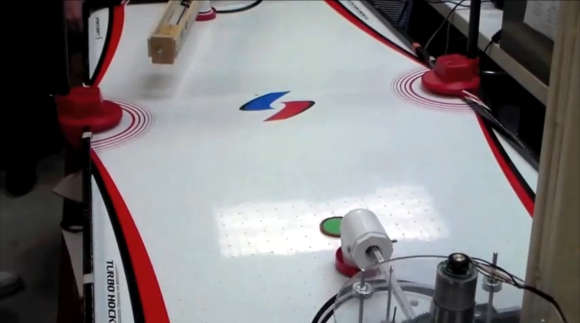
The movie, which is about forty-five minutes, came to our attention because of [Dammitd’s] interest in the Luneburg Lens used by the system. At about 11:10 into the video after the break this component is discussed. Inside a dome like the one seen above is a reflector made of blocks of polystyrene foam which has been laced with bits of metal. This lens is stationary, with the receiver rotating around it to collect the transmitter’s waves as the echos bouncing off an object in the sky are focused by the lens.

Continue reading “Retrotechtacular: History Of The U.S. Antiballistic Missile Systems”

Sump Pump Alarm Sends Text Message As Water Rises

sump-pump-monitor

We’ve got some friends who have two sump pumps. One is a backup and sounds an alarm when it is switched on. But this only works as long as they’re home to hear it. [Felix Rusu] came up with a solution what will text him if the sump pump fails. This way he can head home, or call someone to check in on the problem if he’s away.

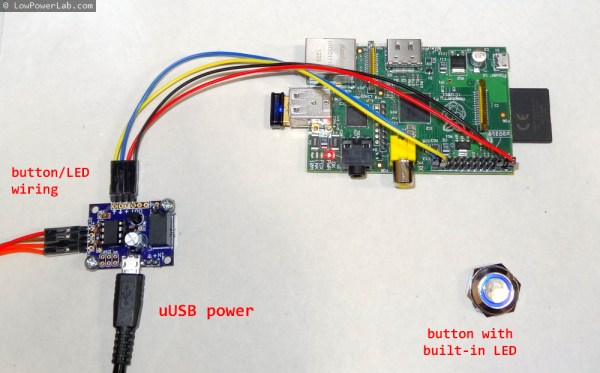
We saw a pretty complicated monitoring system back in January. This one uses a single ultrasonic rangefinder which we think is much simpler. It’s accurate to about 1cm and is simple to use — it’s very popular with the hobby electronics crowd which helps with price and availability of sample code. We hem and haw about the use of a Raspberry Pi board with the project. On the one hand it’s a cheap way to get the sensor on the network and provides the infrastructure you need to send any number of alerts. On the other hand, it’s a lot of power for this particular application. But we figure it can be extended to monitor other utilities in [Felix’s] home, like a sensor to alert him of a leaking water heater. And we think everyone can argue that a monitor like this is well worth the time and effort he spent to develop it.

Scratch-built 3D Printer Shows Rock-solid Performance

scratch-built-3d-printer

These days it’s super-easy (not super-cheap) to go out and buy a 3D printer. But if you’ve got the mad skills like [Mario Lukas] maybe you can build a 3D print using a bunch of scavenged parts (translated). He’s published six posts on the build, and put together an overview video which you can watch after the break.

A pile of salvaged parts were found in a scanner and four different printers. He’s also powering the thing with an old PC PSU. The hot bed and extruder are brand new, which is a wise investment. We’re not sure about the threaded rod and bearings but we’d bet those are new as well. When it came time to work on the electronics he chose an Arduino board as the go-between for the printer and computer. It uses four stepper motor driver boards to drive the axes. Connections can be a bit complicated and he actually ‘smoked’ one of the boards during the development phase.

One of the mechanical build posts shows a belt routed in a T-shape. We wonder if it’s function is similar to what this H-bot style printer uses?

Continue reading “Scratch-built 3D Printer Shows Rock-solid Performance”

Sega Controller Houses Auto-launch Emulator

[Joe’s] wife grew up playing Sega games and he wanted to help her unwind by reliving the experience. Since the work computer she uses when travelling isn’t a good place to install emulators he built this plug-and-play emulator inside of a Sega controller.

We’ve seen this type of thing a few times before (even with XBMC in a SNES controller) but there is one thing we hadn’t thought of lately. Newer versions of Windows have auto-launch disabled for USB drives. But [Joe] knew that there were still some USB sticks that manage to auto-launch anyway so he researched how those work. It turns out that they have two partitions, one is formatted as a CDFS which looks like a CD-ROM to Windows and allows auto-launch. He used this method of partitioning a USB stick, storing the ROMs on the mass storage partition and the emulator and the CDFS partition. To finish the hack he cracked open the controller and found room for a USB hub and the PCB from the thumb drive.

If you still have cartridges lying around you can pull the ROMs off of them over USB.