Apple MagSafe Cord Repair

[Tommy Ward] had a big problem with the cord for his laptop power supply. This thing’s not cheap so he figured out a way to fix the frayed cord on his Apple MagSafe. He asserts that the shortened rubber collar on the plug end of the cord is to blame for this type of damage. We think rough use may have something to do with it too, but having had to repair our own feline-damaged power cords we’re not about to start pointing fingers.

To pull off an appropriate fix [Tommy] pries apart the case housing the power converter. This lets him get at the solder connections of the cord. After removing it from the circuit board he clips off the damaged portion of the cable. To reuse the strain relief grommet he drilled out the old portion of wire and insulation, making room for the undamaged cable to pass through, adding a cable tie on the inside to aide in strain relief. The last part of the fix involves gluing everything back together.

If your power supply problems have to do with the computer connector itself there’s a fix for that too.

Hackerspace Security System Brings RFID, Video Feedback, And Automatic Doors

rfid-hackerspace-door-lock

[Will] has been hard at work on a replacement system for his Hackerspace’s RFID door lock. The original is now several years old and he’s decided to upgrade to a much more powerful processor, adding some bells and whistles along the way.

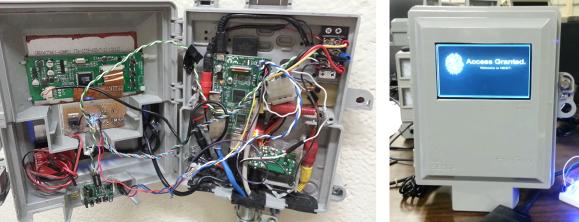
The control box seen above is the exterior component of the system. It’s a telephone service box like you’d find on the back of most houses in the US. They had a few of these lying around and they are a perfect choice because… well… they’re meant to be locking enclosures that brave the elements. [Will] made the jump from an Arduino which has run the locks for the last three years to a Raspberry Pi board. This gives him a lot of extra power to work with and he took advantage of that by adding a vehicle backup LCD screen for visual feedback. You can see it giving the ‘Access Granted’ message he used during testing but the demo video after the break shows that they plan to do some image scripting to display a head shot of the RFID tag owner whenever a tag is read.

There are several other features included as well. The system Tweets whenever a tag is read, helping the members keep tabs on who is hanging out at the space right now. It also patches into a sliding door which one of the members automated using a garage door opener motor.

Continue reading “Hackerspace Security System Brings RFID, Video Feedback, And Automatic Doors”

Hacked Together Mac Isn’t A Hackintosh

hacked-together-macintosh

Check out this 20″ iMac. Notice anything peculiar? Look closely at the branding above the Apple logo. The only thing that tips you off that this iMac is a hacked together unit is that Acer logo on the replacement screen.

As we’ve so often been caught doing, [Flippy] was browsing eBay for deals. It’s a dangerous activity because you end up falling into purchases like an Aluminum iMac for $35. That led to the purchase of a very slim LED LCD monitor to use as the display. It fits perfectly behind the iMac’s glass bezel, which has a tiny chip in the upper right corner that doesn’t bother [Flippy]. It’s thin enough that this actually left room for him to add in the guts of a MacBook Pro which he had sitting in his unused parts pile. With all of the main components accounted for the rest is really just logistics like routing all of the cable connectors and adding openings for USB ports. What he ended up with is a high-end computer for a low-end price.

Building A Kegerator With Visual Style

Let’s face it, most kegerator builds go something like this: acquire old refrigerator, drill hole for tap, profit. But [GiveMeMyNickelback] recently had the opportunity to do better and he delivered. Above you can see the stylish chest freezer mod that serves up six beers on tap.

Chest freezers are perfect for these builds as their top door design helps keep the cold air inside to boost the efficiency. The trick is to modify them without messing up the insulating properties of the appliance housing. [GMMN’s] approach is a common one, build a cuff to go in between the lid and the body of the freezer. He started by building a wooden box open at both the top and the bottom. Many would have stopped there but to bring the bling he tiled the sides and front of that cuff, leaving an empty spot for the shank of each tap. With that taken care of he glued insulation to the inside of the cuff, and added weather-stripping to the bottom to seal with the top of the case. He used the holes from the lid hinge brackets to attach his add-on so that the freeze can be converted back to stock without any sign of his alterations.

We’d love to see a Bluetooth or Wifi add-on that monitors the beer volume in each keg.

[via Reddit]

Tube Radio Husk Gets A Web Radio Transplant

[Dominic Buchstaller] found this German Greatz tube radio at a flea market. It only cost him about €35 and was in a bit more rough condition than the finished product you see above. He also found that a portion of the original circuitry was missing, making it completely non-function. He cleaned up the case to improve the wife-acceptance-factor, and outfitted it with hardware to make it a web radio.

Adding modern speakers was pretty easy as he was already replacing the original cloth bezel which has several holes and tears in it. A set of elements from some Logitech computer speakers served as the organ donors for this step in the process. As he was trying to keep a stock look he came up with a really neat hack to use the original knobs. The station select happens to have a large metal wheel on the inside which is about a centimeter wide. [Dominic] used the optical sensor from a mouse to monitor the turning of the dial by aiming the sensor at this wheel. Internet connectivity was provided by a wireless router he had on hand. This way he can stream music or play from an SD card he also used in the retrofit.

Original Hardware For Fifteen Consoles Jammed Into Recently Completed Project Unity

project_unity_finished

This boxy monstrosity is big for a reason. It lets you play games on the original hardware of fifteen different gaming consoles. That’s right, we said original hardware. One of the main goals of Project Unity was to keep the stock equipment by making any type of emulation — hardware or otherwise — taboo. The size of the case is a function of how much stuff is actually crammed in there. But the final shape was dictated by the available opening in [Bacteria’s] living room entertainment center.

The video after the break walks us through each aspect of the build. We’re floored by the quote of 3,500 hours of build time. But as you get a look at the wiring-hell of each different module it’s easy to understand why it didn’t just build itself. One power supply and one controller make for the least complicated user experience possible. We already looked at a giant switching mechanism that selects one console at a time and the singular controller unit. But [Bacteria] has a lot of other tricks up his sleeve which make this gold mine of a hacking reference piece.

Continue reading “Original Hardware For Fifteen Consoles Jammed Into Recently Completed Project Unity”

[FlorianH] Shows Off MinimaBL, The Next Generation Of His Quadcopter Project

minimabl

[FlorianH] has all kinds of new features to show off with this generation of his quadcopter project. Just about everything has seen an upgrade or some other kind of tweak since we looked in on the last version of the aircraft.

You’ll find some outdoor flight demo clips after the break. Right off the bat we’re impressed at the rock solid stability of the quadrotor while in flight. Even indoors the last version had a hint of a wobble as the control loop calculated stabilization. Here he borrowed some code from the open source Aeroquad project which helps account for this improvement. But the hardware choices lend a hand too. He moved from an ATmega32 up to an STM32F405RG processor. That’s an ARM chip which he programs using one of STM’s Discovery boards. The motors have all been upgraded as well (if you listen in the demo videos for both models you can hear a difference) and he redesigned the frame, which combines carbon tube with 3D printed parts to keep it light yet strong. The upgrade is every bit as impressive as the original build!

Continue reading “[FlorianH] Shows Off MinimaBL, The Next Generation Of His Quadcopter Project”