Reverse Geocache Features UI And Is Reprogrammable


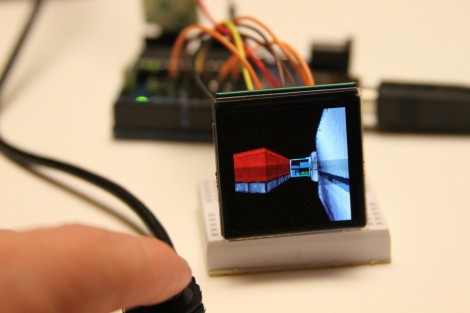
If you’ve ever thought of utilizing a small and inexpensive OLED display in your project [Rossum] has the details you need to get started. In the past we’ve seen him take a tour of available LCD screens and this is much the same, detailing his look at three different models. In the video after the break each is connected to a driver board that he made. The boards have two important components, the first is a boost driver for the 12-16V input the screens need, the second is an octal buffer necessary if you are using a 5V microcontroller. These take care of the hardware considerations, making it simple to drive them with a chip of your choosing.

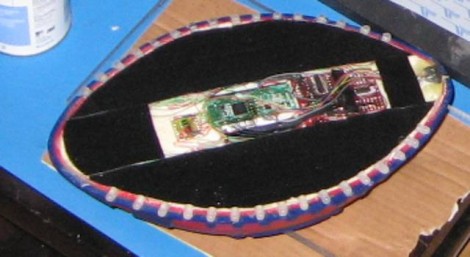
[Ben Kokes] threw together a hardware package to capture data from a football. In the center of a Nerf football he made room for an accelerometer, gyroscope, and an electronic compass. All three can capture 3-axis data and, along with the LEDs ringing the circumference, they’ve controlled by an XMEGA192 microcontroller.
This makes us think back to a time when baseballs with a built-in speed sensor first hit the market… does this hack have mass marketing potential? Perhaps, but only if the $225 sensor price tag were greatly reduced. When we first started reading the description we hoped that [Ben] had coded an interpreter that would render 3D playback video from the data. He hasn’t done that, but from the data graphs he did assemble we don’t think that functionality is out of the question. We’ll keep our fingers crossed.

Usually we don’t like to feature projects that have zero build details, saving them instead for a links post. But this steam-powered bicycle is too… peculiar to pass up. In between the rider’s legs is the firebox that contains a wood-fueled fire. Watch the clip after the break and you’ll find just how noisy this contraption can be. In addition to the mid-range “chug-a chug-a” there’s also the constant whistle we’d attribute to the pressure regulator. It’s surprising that the whole bike doesn’t heat up, but it must not be all that bad since the test pilot isn’t wearing asbestos pants. All kidding aside, it looks like this beast has no problem getting up to a running pace (based on the movements of the camera) and that’s thanks to a renewable energy source.
We’d be much more comfortable seeing this in a mechanized tandem form factor since we just can’t get over having a fire between our legs.
Continue reading “Steam Cycle Feels Like Your Pants Are On Fire”

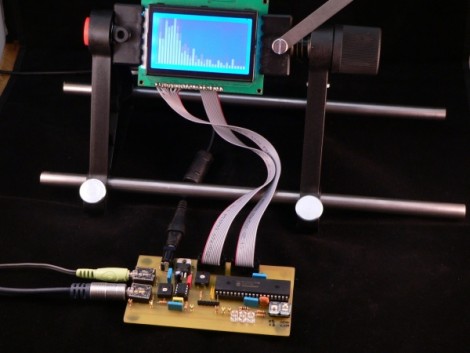
[Simon Inns] just rolled out his latest project, a PIC based spectrum analyzer. He’s using a Fast Fourier Transform routine crafted in C to run as efficiently as possible on the 8-bit chip. The video after the break shows that the results are quite pleasing, with just a bit of noticeable lag between the sound and the waveform representation on the graphic LCD. We found his notes about using an audio amplifier chip to be interesting. He utilizes the properties of an LM386 to move the input signals from a range of -0.5V to +0.5V into a very ADC friendly range of 0-5V.
Continue reading “PIC Spectrum Analyzer Uses Fast Fourier Transform Routine”

[Zach] enjoys playing the game Catch Phrase, but the complexity of the words makes this game a no-go for the little ones. We remember that the game used to be mechanical, using paper disks with the words on them. Those would be easy to recreate with your own dictionary set, but since it has transitioned to an electronic unit that option is out the window. So [Zach] decided to build his own version of the game that lets you use custom word sets after drawing inspiration from another Catch Phrase hack.
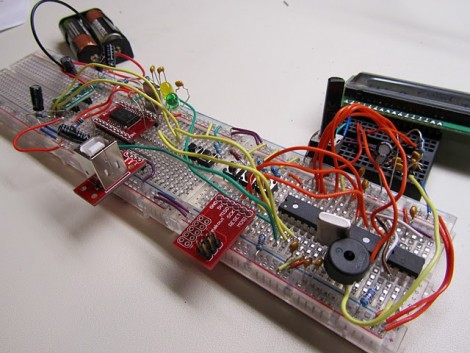
He’s calling it AVRphrase since it uses an AVR ATmega328. You’ll also find five buttons, a piezo buzzer, and a character LCD included in the design. He saw the project all the way through to the end, having a PCB manufactured, and installing it in a project box. A demonstration of the finished game can be seen after the break. [Zach] ended up with 9 working units at a cost of about $30 each.

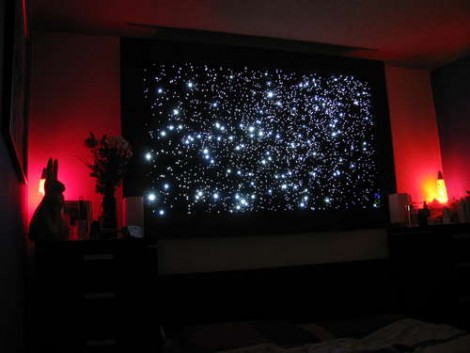
So you manged to get a great deal on a fake tree during the after Christmas sales, but what should you do with your old one? If it was lighted with fiber optics you can reuse the strands to create your own star map. [Mr Trick] shows how to disassemble one of these trees, grouping the fibers by length. He built a wood frame, then covered it with a layer of cardboard and another of black fabric. From there the painstaking process of routing the fibers in a way to looks convincing starts.[Mr Trick’s] final product uses multiple LED light sources and even includes RF control.
Think this project is large and time-consuming? Check out the same idea built into a bedroom ceiling.