IPad Arcade Dock Has Hidden Projector

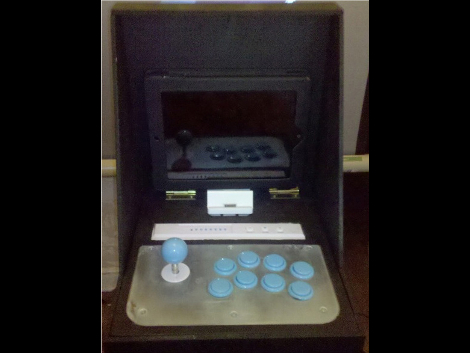
This iPad dock is a well-executed gaming accessory. [Linkreincarnate] used a Hori Wii fighting stick as the controller. In his hardware explanation he outlines several benefits of this choice including built-in support in most of the iPad emulators, as well as foregoing the need for a wired connection. Just above the controls there is a standard docking connector which holds the iPad in place and patches through the audio to some external speakers. But  that’s not all that is included in the build, the final touch is a pico projector that can be used if you want a larger gaming experience. Video of the hardware and a gaming demonstration can be found after the break.


Continue reading “IPad Arcade Dock Has Hidden Projector” →

Hands-free Input

This is a concept input device that [Tech B] built for disabled users. The device uses an accelerometer along with a piezo sensor (right click) and a push button (left click) to function as a mouse. The Arduino that resides in a breadboard on the side of the hat communicates with the computer over a serial connection, using PySerial to translate the microcontroller data into cursor commands with the power and ease of the Python programming language.

During development [Tech B] made a proof-of-concept video using a Basic Stamp which you can watch after the break. He found that this input device was less complicated, more accurate, and much less resource intensive than his webcam IR tracking system.

4-player SNES And More

[Mr.X] added support for four controllers to his Super Nintendo (Google translated) by internalizing the multi-player adapter. In the video after the break you’ll notice that he also added some bling to the case by positioning the power LED beneath the logo and adding a two-digit display. There is a switch on the back that allows him to choose PAL or NTSC standards with the current setting shown on that display. While most people are going with emulators, [Mr.X] ended up with a custom piece of hardware with a clean finish.

Continue reading “4-player SNES And More” →

Wifi Hotspot Powered By Wind Turbine And Solar Panel

[youtube=http://www.youtube.com/watch?v=z-MZmQqxrYM]

Students at the Rochester Institute of technology have put together this WiFi hotspot that is powered by a wind turbine and a solar panel. It gets its signal through a parabolic antenna pointed at a near by building and repeats it for use in the vicinity. They are using a 30W solar panel, along with a 1/4 horse power 90V DC motor to charge two 6V batteries in series. On a windy day, the turbine has yielded 120W. Something interesting to note is a comment they made about blades. Though the ultimately decided to mimic a commercial design for wind turbines, they found the most efficient to be a single wood prop. Unfortunately, that prop was destroyed.

[via HackedGadgets]

AVR Guardian Filters Out Dogs

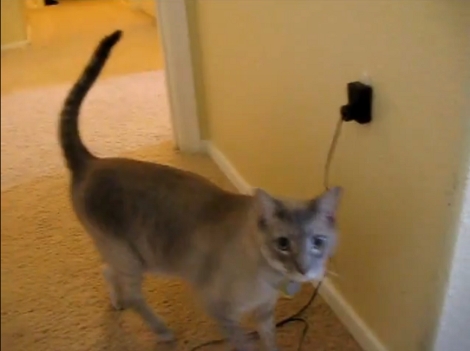
Cats and dogs can get along quite nicely when they are raised up together. The problem with this type of arrangement tends to be keeping dogs out of the cat box and away from the cat food. [Ryan Meuth] tried out a simple electronic barrier to keep the dog away. It uses an IR transmitter and receiver to shine a beam of invisible light across the doorway to his cat room. In the demo after the break you’ll see that he took steps to make sure the cats don’t set off the alarm. The beam of light is set high enough that their bodies don’t get in the way, and the firmware measures the amount of time the beam was broken in order to avoid false positives caused by the cats’ tails. If the dog does try to get into the room it will break the beam and set off a high-pitched alarm sound.

It’s interesting that the dog doesn’t like the sound but the cat’s don’t seem to be scared of it. Also, we’ve got a less-than-ferocious feline that would love to chew on the cord that connects the two modules. Still, it’s a solution that works for [Ryan] and could be incorporated into an automatic feeder to keep the dog away from feedings while you’re out of the house.

Continue reading “AVR Guardian Filters Out Dogs” →

PIC Based Picture Frame

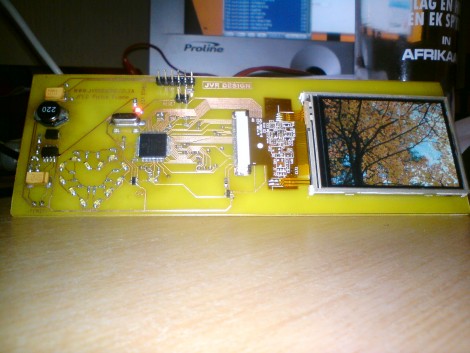
Take a PIC 24HJ256GP206 processor and add a dash of knock-off touchscreen and a pinch of SD card compatibility for a DIY digital picture frame. [Daniel] wrote his own driver for the HX8347 controlled LCD that can achieve 15 FPS at 320×240 resolution with 16-bit color. As this was a gift for his wife, [Daniel] included a heart-shaped ring of LEDs that fade in and out like an electronic pulse. He notes that the JPEG decoder runs rather slow but that’s mostly because of the bottleneck caused when accessing data from the SD card. We’ve got more pictures and a link to the source code after the break.

Continue reading “PIC Based Picture Frame” →

Nixie Sudoku: A Look At The Hardware

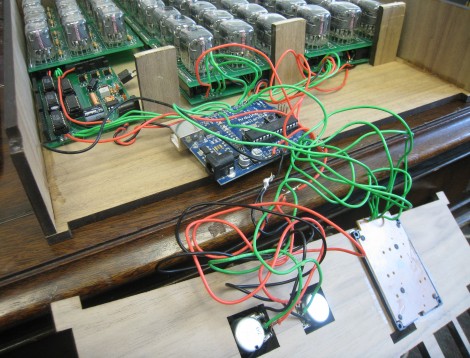
We’re always happy to receive a tour of the guts that make things work. [John Sarik] posted several pictures and descriptions of the hardware that makes up his Nixie Sudoku build. The modular design uses professionally made circuit boards which greatly improve the durability of a large set of circuits such as this.

The design draws on good ideas from similar hardware. The Nixie Duo kit from Ogi Lumen allows tubes to be mounted on top of driver boards with cascading shift registers for control of up to 8 tubes. The ArduiNIX shield makes the high voltages needed for Nixies easy to control with an Arduino. No, [John] didn’t just order these kits and plug them into each other. He designed his own boards to suit his needs. Each driver board can control 9 tubes in a 3×3 grid, all on one PCB. His high voltage board can supply enough juice for the whole system which is tied together with a single Arduino board.

His writeup is quite interesting so do take a look. He also filmed a walk through video which we’ve embedded after the break. It clears up some questions, such as showing the use of a blinking decimal point to indicate the current cursor position.

Continue reading “Nixie Sudoku: A Look At The Hardware” →