Python IR Tracking For The Handicapped

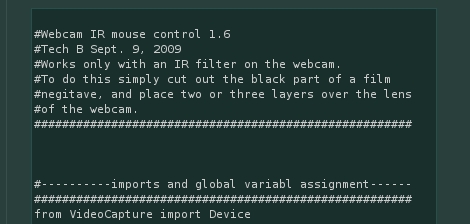
[Techb] had a friend who was paralyzed after an accident and could no long use a computer. He rigged up an amazingly simple mouse interface using python to implement infrared tracking. The controller was built from an old hat by adding an IR LED and wireless mouse modified so that the button could be clicked by the user’s mouth. A webcam with exposed film used as a filter can track the IR LED and take input from the wireless mouse buttons.

This setup, which draws inspiration from Wii Remote white boards,  is much simpler than the Eyewriter (and doesn’t shine an IR LED into your eye). Although [Techb] wants to add facial recognition to the system, there’s something to be said for such a simple implementation.

[Thanks Wolfmankurd]
RoboThespian: Chuck E. Cheese Entertainment Comes Home

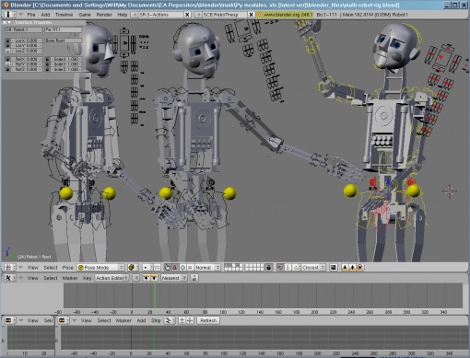
Remember your eighth birthday party when the animatronic band at Chuck E. Cheese sang happy birthday just for you? Now you can enjoy this any day of the year with RoboThespian. The complete animatronic platform has been modeled in Blender 3D. Animating the robot is as easy as producing an animation from its digital model. Lip syncing is generated automatically, with the handles to the right of the model’s head controlling facial expression.

Using Blender as a choreography tools is brilliant.  We’re hoping someone will incorporate this technique in their Halloween shows this year.

[Thanks Rob via BlenderNation]

Shiftbrite Coffee Table

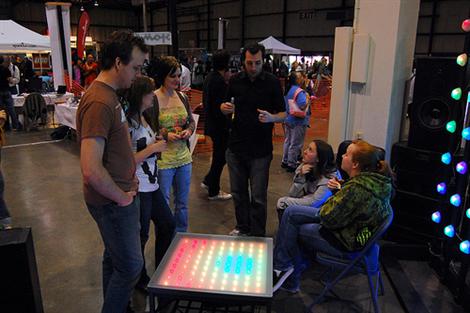
Here’s a project we’ve been wanting to do for a while. Over at macetech.com they’ve posted an LED coffee table that uses a 9×9 RGB LED grid. For the LEDs, they used the shiftbrite modules we’ve seen before. The table is capable of displaying pre written patterns as well as accepting patterns from a computer via bluetooth. They’ve set it up to connect to a twitter feed and display to a live cam on their site. Though we would love to reproduce this, we need a little more justification than “ooooh, shiny”  for the funds involved. Anyone want to donate 100 shiftbrights?

10-bit Rotary Precision For Servos

[Antonb] added 10-bit encoding to a standard servo. He’s removed the potentiometer, separated its shaft and used it to rotate a small magnet. By sandwiching an AS5040 rotatory encoder IC into the servo’s housing he can now measure the precise orientation of the servo horn. This is made easier by his tiny breakout board for the chip. If you want to layout your own PCB you can download the EagleCAD files for this device. Take a look at the final product in the clip after the break.

Continue reading “10-bit Rotary Precision For Servos”

A Second Life For Dead Hard Drives

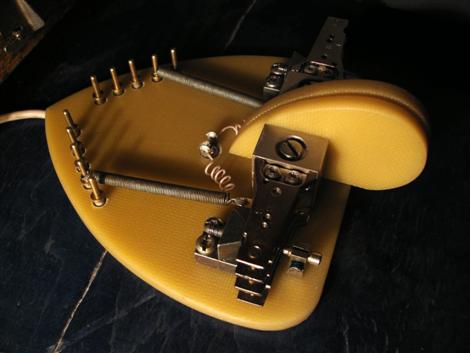
[AndyUU1CC] has put together directions on how he built an Iambic Paddle out of some old hard drives. The iambic paddle is a device for telegraphy. More specifically, it is that piece that you always see people clicking with their finger when they send a telegraph. We hadn’t seen an iambic or “dual lever” style before, but we now know that this is not an uncommon design. While it is ultimately just a fancy set of switches, we can’t help but be impressed with the looks of it.

[via instructables]

Bring The Crane Game Home

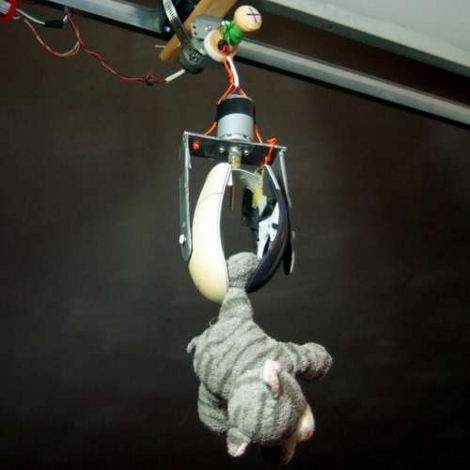
Everyone’s familiar with the quarter gobbling crane games. More often than not there’s a child nearby begging a parent for more quarters so they can try their hand at the toy-snatching claw. [Marc.Cryan] put his quarters to a better use by building a home version of the crane game.

[Marc] installed a gantry in an archway of his house.  The crane trolley rides on this gantry and uses a spool to raise or lower the tether for the claw. Winning copious style-points, he used the case of an old mouse to form the claw. An Arduino controls the different motors in the system and a toy was repurposed to act as the controller. As you can see after the break, it’s more fun than the cinema-lobby version of the game and your kids can play with it for free.

Continue reading “Bring The Crane Game Home”

Oscilloscope Doubles As A Serial Terminal

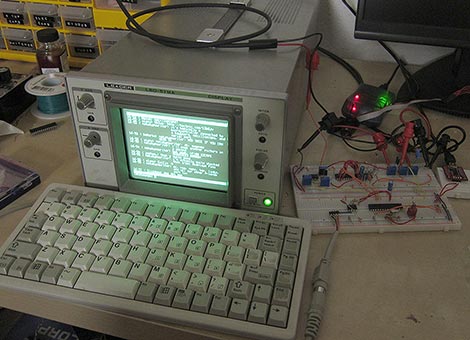
PC-based USB oscilloscopes are fast becoming all the rage. [Matt Sarnoff’s] Terminalscope takes the reverse approach, adapting an oscilloscope into a full serial terminal. You may have seen something similar before in the Dutchtronix/SparkFun O-Clock, but [Matt’s] project goes one further by adding a PS/2 keyboard port for full bidirectional serial communication, and with much sharper display resolution to boot.

The mostly VT-100 compatible Terminalscope is built around two AVR microcontrollers: an ATmega328P runs full-tilt to generate the video signal and handle serial I/O, while an ATtiny45 handles keyboard input to avoid interrupting the ’328’s duties. Rather than vector trace each character, a raster-scanning approach is used: the beam follows a fixed X/Y path (like a television), while modulating the Z input (beam intensity) to form an image. The device can be connected to a PC via serial port or USB-to-TTY adapter, or directly to another microcontroller to debug serial output.

We recently showed an oscilloscope being used as a multichannel digital logic display. The Terminalscope provides yet another use for this essential bench tool and could nicely round out a “poor man’s” testing setup. The schematic and full source code are available for download.