These Midi Controllers Stink!

BeatShoes-midi-controller

Well, maybe saying it stinks is too harsh. But if you build a midi controller out of an old pair of skate shoes you can be certain that they smell. [Thobson] put odor issues aside and added four force sensitive resistors to his shoes (one in each heel and one under the ball of each foot) for a creation he calls BeatSneaks. As force is applied to the resistors, they become less resistive. This change in resistance is measured by the ADC inputs on an Arduino and used to trigger midi events via USB. There’s video after the break, and [Thobson’s] has provided the schematic and code that he used for his addition to a growing family of unusual musical interfaces.

Does this make tap dancing cool again?

Continue reading “These Midi Controllers Stink!” →

Piecax The Poltergeist Reinvents The Knock Block

piecax-the-poltergeist

[AndyGadget] built a haunted box as part of his Halloween preparations. This follows in the footsteps of the Knock Block we saw earlier this month but makes several hardware changes. He’s replaced the solenoid with a DC motor that rotates an arm to do the knocking. He’s avoided any CNC work by using a softwood box from a craft store as the enclosure. For control circuitry he’s used an 8-pin PICAXE Microcontroller that ‘listens’ for knocking on the box via a piezo buzzer. It will mimic knocks back to you, and if it hears the right combination The Addams Family theme song is played. This useless machine will make a great office conversation piece and with this simplified design it’s much easier to build than the Knock Block. See it perform after the break.

Continue reading “Piecax The Poltergeist Reinvents The Knock Block” →

BigDog’s Bipedal Brother

[youtube=http://www.youtube.com/watch?v=67CUudkjEG4]

Boston Dynamics is at it again. This time, they’ve created a creepy biped with a natural gait. It may look very similar to BigDog, because it really is almost the same system. Named PETMAN, this biped system is being designed to help test chemical protection suits. This bot can stress the suit by walking, running, and even crawling in a room filled with poison gas. Not only can PETMAN walk, run, and crawl, but it can also sweat and change its temperature.  That’s pretty cool. Like BigDog, the most impressive part is when they give it a shove and it recovers with a motion that seems almost organic.

Digital Tuner Reverse Engineering

hvr-1600-i2c-sniffing

Hackaday alum [Ian Lesnet] tipped us off about some reverse engineering of the HVR-1600, an analog and digital television encoder/tuner. The project was spawned when [Devin] noticed his Hauppauge HVR-1600 didn’t tune channels in Linux quite as well as it did in Windows. He had a hunch this was due to improper initialization settings for either the tuner chip or the demodulator.

To fix this he used two test points on the board to tap into the I2C bus. Using a logic analyzer he captured the command traffic from the bus while running Linux, then while running Windows. By filtering the results with a bit of Perl, and comparing them by using diff, he tracks down and finds the variation in the commands being sent by the two drivers. After a bit of poking around in the Linux source and making the necessary changes, he improved the tuning ability of the Linux package.

[Devin’s] work looks simple enough, and it is. The difficult part of this process is being smart enough to know what you’re looking for, and what you’ve got once you’ve found it.

Parts: ChronoDot RTC Module (DS3231)

ChronoDot

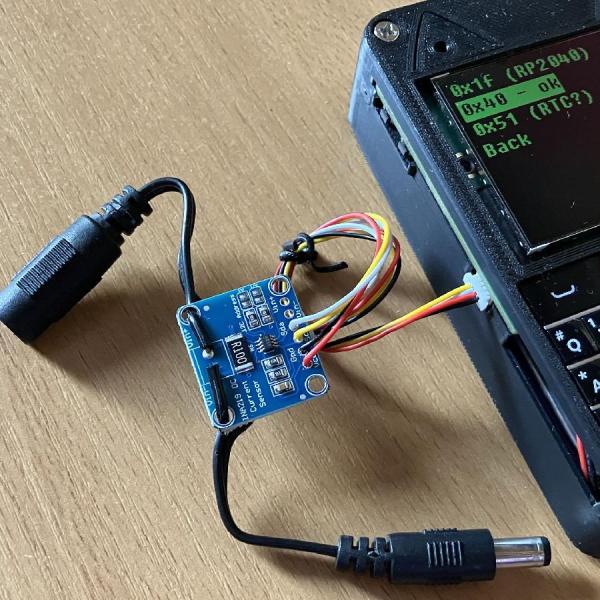
Macetech’s ChronoDot is a Real Time Clock module for projects requiring highly accurate time keeping and measurement. The ChronoDot uses the DS3231 chip, which features a TCXO to compensate for variations in temperature which affect normal oscillators, like the ones in most microcontrollers. The DS3231 uses simple I2C commands and registers for storing and retrieving time, but also features a variable output that goes all the way down to 1.000 hz for low power, interrupt style timekeeping applications. With the provided watch battery, the ChronoDot can keep time in idle mode for up to 8 years.

Normally the ChronoDot comes mostly assembled, requiring you to only solder on the watch battery. However, due to a manufacturing mistake, Macetech is selling a version with the header pins on the wrong side they call the ChronoDoh. This module is currently nearly half off the regular price of $14.99, which makes it a great low cost addition to a project. Macetech has sent us a couple of these modules to demonstrate how functional they still are.

Continue reading “Parts: ChronoDot RTC Module (DS3231)” →

Head-mounted Computer With Spit, Bailing Wire

[youtube=http://www.youtube.com/watch?v=QyrjBMAa6xE]

Oh, for crying out loud! While we were all giddy reporting on yesterday’s wonderfully done head-mounted computer, [Andrew Lim] of recombu.com comes along and essentially does the same thing with an HTC Magic handset and three dollars worth of Harbor Freight crap. Linux kernel, WiFi, accelerometer, the whole nine yards. Consider our collective ass handed to us.

Funny thing is, either of these could be considered The Consummate Hack. One flaunting the creator’s know-how with its custom-designed parts and delicate engineering, the other exhibiting a more punk flair with random scraps and off-the-shelf technology achieving much the same effect — a solution so obvious we were blind to it. Whatever your outlook, this is a great day to be a hacker!

[via slashdot]

Remote Controlled Claw Of Doom

[youtube http://www.youtube.com/watch?v=P-9_dMJKh9E&feature=player_embedded%5D

Robotic claws are awesome, period. [Jeremy’s] Remotely controlled robotic claw, thats just a whole new level of cool – even if the intention is to just pick up blocks. The setup is simple enough, a Parallax Propeller controls the whole system by first polling a web server for changes in variables that the user has invoked. Those changes are then passed to relays that control the claw. To keep from fumbling in the dark, he’s even included a webcam. We hate to see that he’s used such expensive equipment to just control a toy, but maybe one day he’ll move to bigger and better things.