

Laser Raygun Boasts 300mW, Hunts Klingons

Phasers come with two settings: stun and kill. [Luke] took this seriously when he put two Blu-ray lasers into a toy raygun. He picked up the toy from Amazon for about twenty bucks and set to work.

The laser diodes are both pulled out of a 6x BD-R burner, which we think is a pretty expensive source to scavenge from. [Luke] removed the toy circuitry, reusing the trigger, top switch, and battery pack. The two diodes are mounted on a swiveling carriage which is turned 180 degrees to switch between the two diodes. A boost driver converts the 3v from the batteries up to 7v for the diodes.

This is a skillful conversion and [Luke] should be proud. Don’t miss the video after the break and if you’re thirsty for more take a look at the last hand held laser we featured.

Continue reading “Laser Raygun Boasts 300mW, Hunts Klingons” →
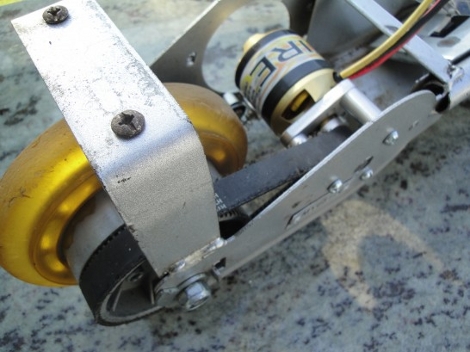
1480W Scooter Motor Guarantees Head Trauma

[Jerome’s] been working on some improvements to an electric foot scooter he picked up from a friend. He ordered up a powerful brushless motor and some lithium batteries. His system uses a belt drive and at 33 volts it can reach 25 miles per hour.

He had some problems with too much torque when the motor was first started. This resulted in unintentional wheelies, which sounds really cool if you’re not the one trying to hang on to the scooter. [Jerome] is using an Arduino to control the system so he built in the ability to gradually ramp up the speed of the motor and also added the ability to control the speed via remote control. You should note in the video after the break that [Jerome] is test-piloting his build sans-helmet.

So, we spend a lifetime and countless sums of money filling our noggins with knowledge. This is a precarious investment since a rather small bump to the melon could corrupt all of that data and end the once spectacular cognitive power. If you’re smart enough to build a foot scooter that can go 25mph, be smart enough to wear a helmet when you ride on it!

Continue reading “1480W Scooter Motor Guarantees Head Trauma” →

NES Processor Cloned On A FPGA

nes-on-an-fpga

[Bradley] decided to tackle the challenge to recreate the original Nintendo Entertainment System’s processor in a Field Programmable Gate Array. Say what? The original NES is a Legacy System, still used but no longer manufactured. If a system breaks, it becomes more and more difficult to repair or find replacements parts as time passes. By using a programmable integrated circuit such as a CPLD or a FPGA to clone the functionality of the original hardware, legacy systems can live on long after the original hardware has given up the ghost.

It took [Bradley] about a year to fully implement the NES processor as part of his Master’s project at Bradley University. He used what was known about the processor combined with some detective work with logic probes along the way. The programming was done in VHDL and those files are available for download (click on Documentation).

With the ubiquity of NES emulators on every device known to man you probably won’t be replicating this unless you want a reason to play with a FPGA. What interests us is the hardware solution this type of work provides for obsolete hardware that still serves a useful purpose. If you’ve used a FPGA or similar device to keep an old system running, let us know about it in the comments.

Radio Cabinet Media Center

old-time-radio-mediacenter

[Jon] picked up an old Philco radio from a pawn shop for $81. The electronics were shot and the controls had seen better days. So he set to work giving this old beast a makeover, turning it into a beauty of a media player.

The face plate for the controls had seen better days. His solution was to replace it, which gave him more options for mounting a display and controls. A menu system was implemented on the LCD display using a PIC18F4450 microcontroller. The chip also takes care of the three rotary encoders for the user interface and integrates the whole thing with the PC backend.

We’ll be the first to admit that a full PC is overkill in this situation. That being said, this was slow, unused system that is seeing new life. But is it worth the added noise and energy costs? Who knows, we think this leaves a lot of room for future revisions. Perhaps an NAS and wireless controls via iPhone or a similar device?

We’re a bit disappointed that [Jon] didn’t do some work to get better sound out of this. With a great big cabinet like this, the right speakers with a tube amp will produce some sweet sound. Certainly most things would be better than just using a pair of computer speakers. We’ll keep our eye out for an update that adds a tube kit to the project.

The Glass Recycling Game

bottle-bank-arcade

Operating under the premise that glass bottles were not being recycled as much as plastic or aluminum because there’s no payment for the effort, the team at The Fun Theory set out to add a non-monetary incentive. Here is the fruit of their efforts, the Bottle Bank Arcade. Now recycling glass bottles comes with a bit of a game.

A light flashes above one of the holes in the recycling bin and then rewards points if a bottle is inserted there quickly enough. This Simon says type concept proved incredibly popular in the video embedded after the break. We would image some of the kids in the video made their parents haul them home and back with some empties so they could play.

In one evening, this modified bottle bank was used over 100 times, while a nearby low-tech repository was used just twice. This is a great way to use some tech knowledge, a love of hacking, and desire to spread joy in order to make the neighborhood more fun and help increase the amount of trash that ends up being recycled. This is the same team that put together the musical subway steps, we hope they keep this trend going!

Continue reading “The Glass Recycling Game” →

Polycarbonate Fish Uses Three Servos To Swim

polycarbonate-fish

[Amnon] is learning the hard way that water and electronics don’t always like to play nicely together. He’s been working on creating a swimming fish that uses three servos to flex a sheet of fish-shaped polycarbonate. This photo doesn’t really do the project justice but you can get a better idea of what he’s accomplished by watching the videos after the break.

The three servos along with some distance sensors for obstacle avoidance are all controlled by a PIC 16F877A microcontroller. [Amnon] tried out three different waterproofing methods; coating the device in varnish, dipping it in hot glue, and dipping it in epoxy. The first two resulted in water damage to the electronics, but the third managed to work. It kept the water out, but also prevents reprogramming of the controller.

Although not successful, we would have loved to see the process of dipping the fish in a churning vat of molten glue. Once perfected, this may be the perfect platform for carrying our weapons of doom.

Continue reading “Polycarbonate Fish Uses Three Servos To Swim” →

Easy Touch Capacitance

[youtube http://www.youtube.com/watch?v=euv8ZLgPh8A&feature=player_embedded%5D

[Humberto] from NerdKits is one of our favorite tipsters. We like how he can take a concept that seems so extremely complicated, in this case touch capacitance sensing, and present it in a clear and concise manner thats impossible to not love. As previously mentioned the most recent NerdKits hack is on touch capacitance; by using a resistor capacitor pair and some clever switch timing, anyone is able to detect the presence of a human limb. Now who’s going to be the first to adapt this concept further in their own hack?







