This excellent content from the Hackaday writing crew highlights recurring topics and popular series like Linux-Fu, 3D-Printering, Hackaday Links, This Week in Security, Inputs of Interest, Profiles in Science, Retrotechtacular, Ask Hackaday, Teardowns, Reviews, and many more.
“Don’t Be Evil” was the mantra of Google from years before even Gmail was created. While certainly less vague than their replacement slogan “Do the Right Thing”, there has been a lot of criticism directed at Google over the past decade and a half for repeatedly being at odds with one of their key values. It seems as though they took this criticism to heart (or found it easier to make money without the slogan), and subsequently dropped it in 2018. Nothing at Google changed, though, as the company has continued with several practices which at best could be considered shady.
You may think you’ve never heard of Greg Zumwalt, but if you’ve spent any time on Instructables or Thingiverse, chances are pretty good you’ve seen some of his work. After a long career that ranged from avionics design and programming to video game development, Greg retired and found himself with the time to pursue pet projects that had always been on the back burner, including his intricate 3D-printed automata. His motto is “I fail when I decide to stop learning,” and from the number of projects he turns out and the different methods he incorporates, he has no intention of failing.
You are, of course, encouraged to add your own questions to the discussion. You can do that by leaving a comment on the Learning Through Play Hack Chat and we’ll put that in the queue for the Hack Chat discussion.
Click that speech bubble to the right, and you’ll be taken directly to the Hack Chat group on Hackaday.io. You don’t have to wait until Wednesday; join whenever you want and you can see what the community is talking about.
Do you like hamburgers? Everyone likes hamburgers. Inspired by a phone you could buy at Spencers in 1991, [Love Hulten] built a Game Burger Advance. The guts are a Raspberry Pi Zero, a standard LCD display and what appears to be a USB control pad. The fabrication is where this one really goes crazy. It’s a significant amount of laser-cut plywood or MDF stacked together into a laminate then sanded and painted to look like a hamburger. Actually, it’s a cheeseburger, but we don’t deal with the prescriptivist view of linguistics and Wendy’s doesn’t sell hamburgers, they sell cheeseburgers without cheese. Hamburgers are not cheeseburgers without cheese but I digress… Just be glad this links post isn’t me going off for two thousand words talking about language and cheeseburgers.
If you have a 2012 MacBook Pro, congratulations, you have one of the last good laptops Apple will ever build. [Docatl] over on Reddit has one of these fine machines, but found it was overheating. This Genius did what anyone would do — drilled some vents in the bottom of the laptop. The results are impressive, with stock temperatures climbing to 80º C when rendering video, and the post-drilled temps cooling down to a balmy 65º.
Here’s a Kickstarter for you. It’s an Arduino Zero in a narrow DIP-16 package, albeit with a USB connector hanging over the outline of a normal DIP-16 footprint. The specs are an ATSAMD21 Cortex-M0+ running at 48 MHz, 256kB of Flash, 32k of RAM, and an integrated bootloader.
Ha ha Tim Cook changed his name to Tim Square because Apple users are squares amirite?
We’re not going to get into a discussion about mental health or anything here, but TheFlightChannel just published a flight sim reenactment of the SeaTac Dash-8 Horizon Air incident from last summer. This video is absolutely fantastic.
The Sipeed K210 is a chip you should know about. It’s a RISC-V microcontroller that’s right up there with the fastest, most powerful STM32 chips, but it’s RISC-V and it costs eight dollars. Also, it has neural networks, because. We first heard about this chip as a preorder on Taobao (?!), but now it’s getting a slightly more official release. Seeed is working on a Raspberry Pi Hat for this chip, and they want your input. Right now we’re looking at two versions, one with WiFi and one without, and both can either work with a Raspberry Pi or as a standalone board. They have the basic layout, but they’d like to know what features the community would want.
Catch up on the past week of hacks with Hackaday Editors Elliot Williams and Mike Szczys. “AI on the Edge” is the buzzword of choice lately, with hardware offerings from BeagleBone and Google to satiate your thirst. We take on spotty data from Tesla, driving around on four bouncy-houses, reverse engineering a keytar, unearthing a gem of a dinosaur computer, and MIPI DSI display hacking. There are tips for getting better at commenting code, and making your computer do your algebra homework.
Links for all discussed on the show are found below. As always, join in the comments as we’ll be watching those as we work on next week’s episode!
Take a look at the links below if you want to follow along, and as always, tell us what you think about this episode in the comments!
Today we start a new series dedicated to amateur radio for cheapskates. Ham radio has a reputation as a “rich old guy” hobby, a reputation that it probably deserves to some degree. Pick up a glossy catalog from DX Engineering or cruise their website, and you’ll see that getting into the latest and greatest gear is not an exercise for the financially challenged. And thus the image persists of the recent retiree, long past the expense and time required to raise a family and suddenly with time on his hands, gleefully adding just one more piece of expensive gear to an already well-appointed ham shack to “chew the rag” with his “OMs”.
As I pointed out a few years back in “My Beef With Ham Radio”, I’m an inactive ham. My main reason for not practicing is that I’m not a fan of talking to strangers, but there’s a financial component to my reticence as well – it’s hard to spend a lot of money on gear when you don’t have a lot to talk about. I suspect that there are a lot of would-be hams out there who are turned off from the hobby by its perceived expense, and perhaps a few like me who are on the mic-shy side.
This series is aimed at dispelling the myth that one needs buckets of money to be a ham, and that jawboning is the only thing one does on the air. Each installment will feature a project that will move you further along your ham journey that can be completed for no more than $50 or so. Wherever possible, I’ll be building the project or testing the activity myself so I can pursue my own goal of actually using my license for a change.
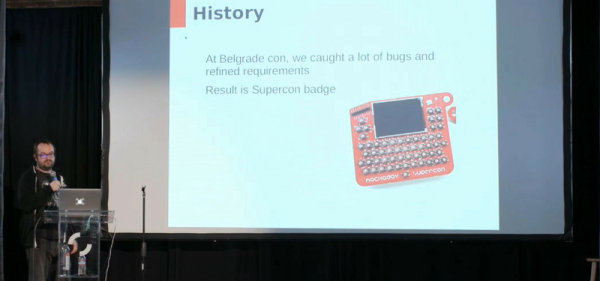
If you missed it, the Hackaday Supercon 2018 badge was a complete retro-minicomputer with a screen, keyboard, memory, speaker, and expansion ports that would make a TRS-80 blush. Only instead of taking up half of your desk, everyone at the conference had one around their neck, when they weren’t soldering to it, that is.
The killer feature of the badge was its accessibility and hackability — and a large part of that was due to the onboard BASIC interpreter. And that’s where Jaromir comes in. Once Voja Antonic had finalized the design of the badge hardware for our conference in Belgrade in the spring of 2018, as Jaromir puts it, “all we needed was a little bit of programming”. That would of course take three months. The badge was battle-tested in Belgrade, and various feature requests, speed ups, and bugfixes were implemented (during the con!) by Jaromir and others.
Firmware work proceeded over the summer. Ziggurat29 helped out greatly by finding ways to speed up the badge’s BASIC interpreter (that story is told on his UBASIC and the Need for Speed project page) and rolled into the code base by Jaromir. More bugs were fixed, keywords were added, and the three-month project grew to more like nine. The result: the badge was in great shape for the Supercon in the fall.
Jaromir’s talk about the badge is supremely short, so if you’re interested in hacking a retrocomputer into a PIC, or if you’ve got a badge and you still want to dig deeper into it, you should really give it a look. We don’t think that anyone fully exploited the CP/M machine emulator that lies inside — there’s tons of software written for that machine that is just begging to be run after all these years — but we’re pretty sure nearly everyone got at least into the basement in Zork. Dive in!
Blacksmiths were the high technologists of fabrication up until the industrial revolution gained momentum. At its core, this is the art and science of making any needed tool or mechanism out of metal. Are you using the correct metal? Is the tool strong where it needs to be? And how can you finish a project quickly, efficiently, and beautifully? These are lessons Blacksmiths feel in their bones and it’s well worth exploring the field yourself to appreciate the knowledge base that exists at any well-used forge.
I had an unexpected experience a few days ago at the Hacker Hotel weekend hacker camp in the Netherlands. At the side of the hotel our friends at RevSpace in The Hague had set up a portable forge. There was the evocative coal fire smell of burning coke from the hearth, an anvil, and the sound of hammering. This is intensely familiar to me, because I grew up around it. He may be retired now, but my dad is a blacksmith whose work lay mostly in high-end architectural ironwork.
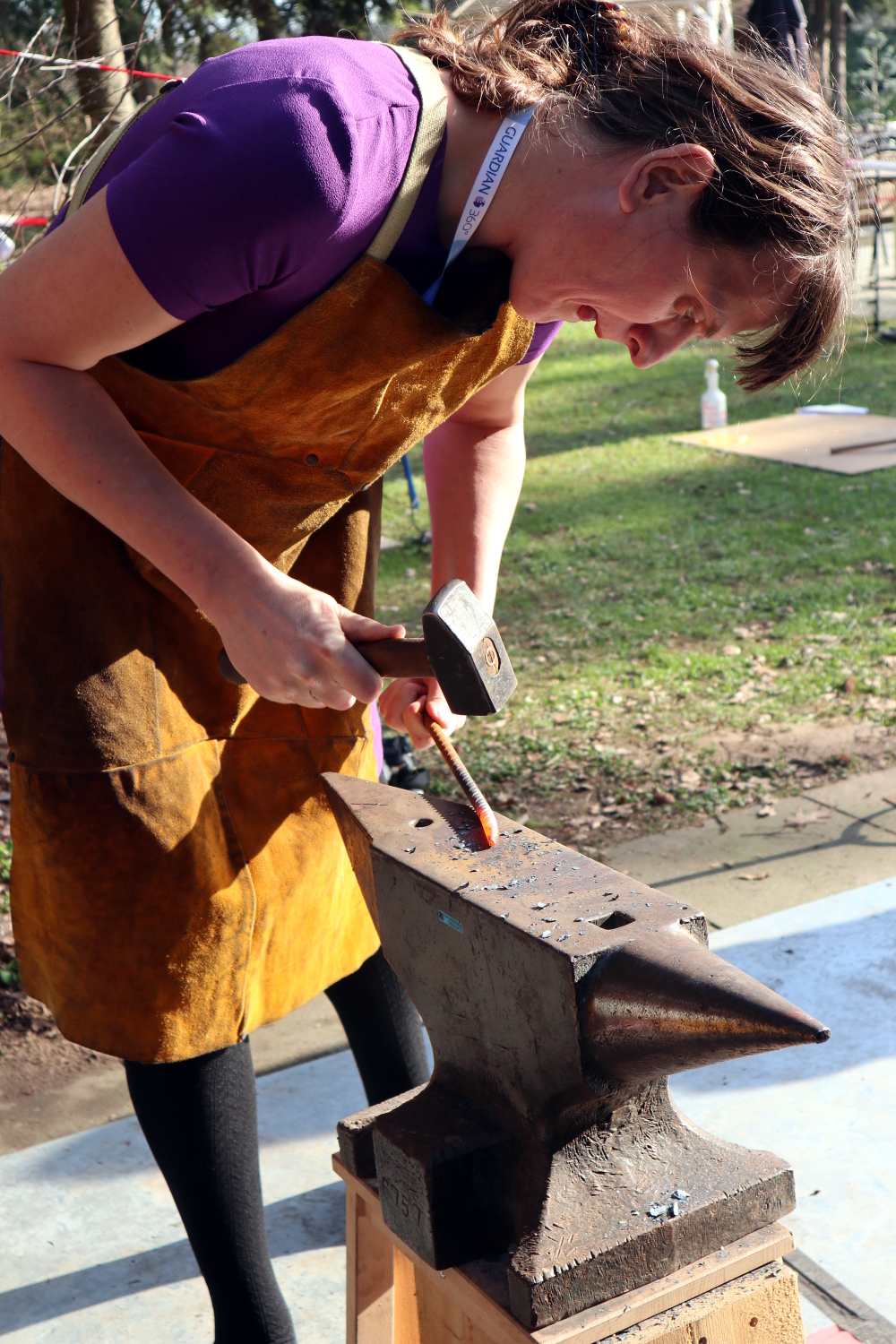
Working the RevSpace forge at Hacker Hotel, in not the most appropriate clothing for the job.
The trouble is, despite all that upbringing, I don’t consider myself to be a blacksmith. Sure, I am very familiar with forge work and can bash metal with the best of them, but I know blacksmiths. I can’t do everything my dad could, and there are people we’d encounter who are artists with metal. They can bend and shape it to their will in the way I can mould words or casually solder a tiny surface-mount component, and produce beautiful things in doing so. My enthusiastic metal-bashing may bear the mark of some experience at the anvil but I am not one of them.
It was a bit of a surprise then to see the RevSpace forge, and I found myself borrowing a blacksmith’s apron to protect my smart officewear and grabbing a bit of rebar. I set to and made a pretty simple standard of the dilletante blacksmith, a poker with a ring on one end. Hammer one end of the rebar down to a point, square off the other end for just over 3 times the diameter of the ring, then bend a right angle and form the ring on the pointy end of the anvil. Ten minutes or so of fun in the Dutch sunshine. Working a forge unexpectedly brought with it a bit of a revelation. I may not be a smith of a high standard, but I have a set of skills by virtue of my upbringing that I had to some extent ignored.
Where others might have put effort into learning them, they’re things I just know. It had perhaps never occurred to me that maybe all my friends in this community didn’t learn how to do this by hanging round the forge next to the house they grew up in. If I have this knowledge merely by virtue of my upbringing, perhaps I should share some of it in a series of articles for those in our community who’ve always fancied a go at a forge but have no idea where to start.