These Twenty Amazing Projects Won The Open Hardware Design Challenge

Right now, we’re running the greatest hardware competition on the planet. The Hackaday Prize is the Academy Awards of Open Hardware, and we’re opening the gates to thousands of hardware hackers, makers, and artist to create the next big thing.

Last week, we wrapped up the first challenge in this year’s Hackaday Prize. We’re now happy to announce twenty of those entries that have been selected to move to the final round and have been awarded a $1000 cash prize. Congratulations to the winners for the Open Hardware Design Challenge portion of the Hackaday Prize. Here are winners, in no particular order:

Open Hardware Design Challenge Hackaday Prize Finalists:

These projects are fantastic

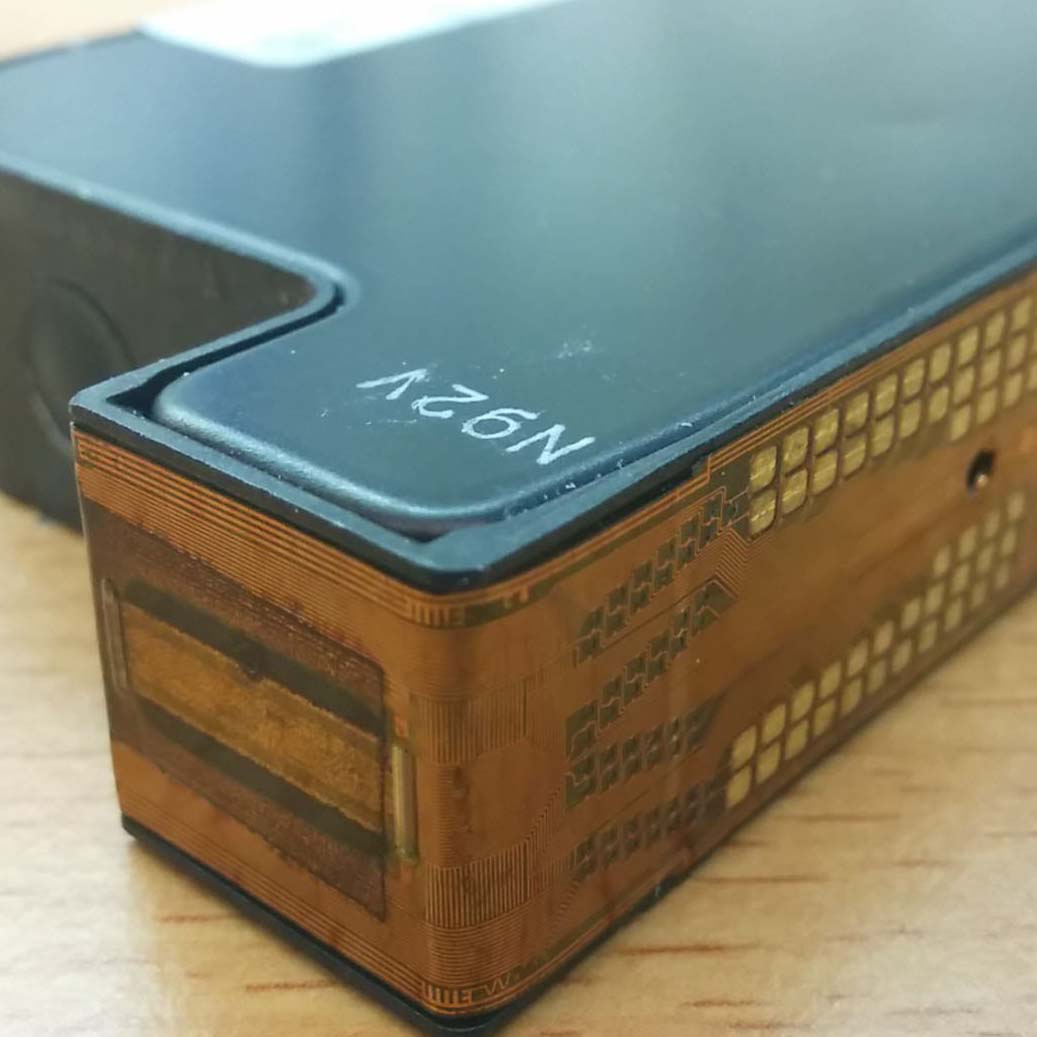
The Oasis 3D Printer repurposes HP ink cartridges to build a powder-baseed 3D printer

Just take a look at these projects. They are the best of the best, and there’s still more to come. We enjoyed seeing projects that repurpose off-the-shelf technology to vastly extend the capabilities of home manufacturing with the Oasis 3DP. This project from [Yvo de Haas] takes ink cartridges from HP printers and uses it to build a powder-based 3D printer. That’s something that really hasn’t been done in the world of homebuilt 3D printers, and the Oasis 3DP already has working hardware. It truly is one of the more interesting projects we’ve ever seen, and not just because [Yvo] is dealing with dozens of tiny micro pumps squirting binder out of microscopic nozzles.

But that’s not all. There were hundreds of projects entered in the Hackaday Prize for this round, and our only regret is that we could only pick twenty winners for the Open Hardware Design Challenge. Just check out Semiconductors @ Home, a project from [Nixie] — it’s a project trying to make sand blink. [Nixie] is building all the tools to make semiconductors at home. Being able to build a simple FET is amazing, and to do that you need a fume hood to contain the dangerous hydrofluoric acid, a vacuum chamber for sputtering deposition, and a fancy oven with a controlled atmosphere. These tools are [Nixie’s] entry in the design challenge. This isn’t your garden variety hardware hacking; this is advanced hardware hacking.
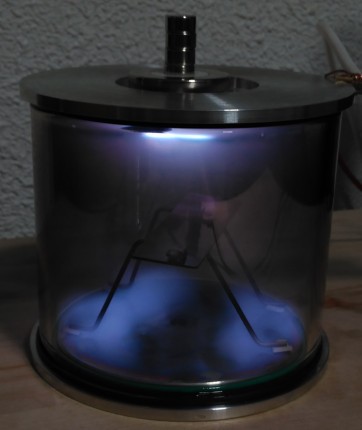
Semiconductors @ home is turning ions into FETs

Not impressed with DIY semiconductors? You’re a terrible person, but okay. How about an easy way to read rotary encoders? [fattore.saimon] and [Atikaimu] are building an I2C Encoder, an easy way to read multiple rotary encoders with just two microcontroller pins. Reading rotary encoders is one of the deceptively difficult tasks in electrical engineering; you really need some interrupts to do it right, and a microcontroller really only has a few of those to spare. [fattore] and [atikaimu]’s project does away with that problem, and puts rotary encoders on a board that can be read with a normal I2C bus. This means anyone can add a dozen rotary encoders to any project easily. Did anyone say MIDI controllers? Yes, that is possible. Everything from musical instruments to impressive control panels is possible with the I2C encoder, and it’s all Open Hardware.

Are you still not entertained? [Carl Bugeja] built a motor out of a PCB. Over the last decade, the price of custom fabricated printed circuit boards has dropped precipitously, and that means anyone can experiment with copper foil and fiberglass. [Carl] figured that since you can put coils on a PCB, you could also make a motor. While we’re only looking at a 1 Watt motor here, this is a brushless motor made out of printed circuit boards. It’s amazing, you’ve never seen it before, and we have absolutely no idea how many uses people will find a use for this amazing technology.

These are the winners of the Open Hardware Design Challenge in the Hackaday Prize, and we have a fondness for Open tools that are capable of building even more open hardware. If you want an example of that, you need only look at the Arcus-3D-P1 from [Daren Schwenke]. This is a project to add a lightweight pick and place head to any 3D printer. Below a certain size, a pick and place machine is necessary to create electronics, and almost everyone has a 3D printer these days. The Arcus-3D-P1 is an attachment for any 3D printer to turn it from a CNC hot glue gun into a machine that builds electronics. It’s Open Hardware, and hardware that creates hardware. It’s astonishing, and it’s happening on Hackaday.io.

Congratulations to all who entered the first challenge, and the twenty excellent entries that are moving to the finals. We can’t wait to see what other projects will make it to the finals in the Hackaday Prize, the greatest hardware competition on the planet.


Who will win the 2018 Hackaday Prize?

Who will win the Hackaday Prize? These finalists in the Open Hardware design challenge are now in the running for the final round of the Hackaday Prize where they will have the chance to win the Grand Prize $50,000 USD. That doesn’t mean you still can’t get in on the action; there are four more challenges left in the Hackaday Prize.

Right now, we’re in the middle of the Robotics Module Challenge, and after that, we’ll launch into the Power Harvesting Challenge, the Human Computer Interface Challenge, and finally the Musical Instrument challenge. There’s still time to win your place among the hardware greats, so start your Hackaday Prize entry now.


Inside Mechanical Calculators

For as busy as things can get at the grocery store on a typical afternoon just before the dinner hour, at least the modern experience has one thing going for it: it’s relatively quiet. Aside from the mumbled greetings and “Paper or plastic?” questions from the cashier, and the occasional screaming baby in the next aisle, the only sound you tend to hear is the beeping of the barcode scanner as your purchase is tallied up.

Jump back just 40 years and the same scene was raucous, with cashiers reading price tags and pounding numbers into behemoth electromechanical cash registers. Back then, if you wanted help with any arithmetic with more than just a few operations, some kind of mechanical calculator was your only choice. From simple “one-banger” adding machines to complex analog computers, mechanical devices were surprisingly capable data processing tools. Here’s a brief look at how some of the simpler ones worked.

Continue reading “Inside Mechanical Calculators”

Milspec Teardown: AH-64A Apache Data Entry Panel

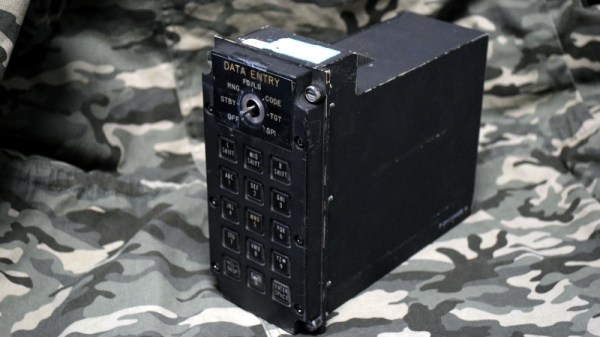
It’s time once again to see how those tax dollars are spent, this time in the form of a “Data Entry Keyboard” manufactured by Hughes Helicopters. This device was built circa 1986 or so, and was used in the AH-64A Apache. Specifically, this panel would have been located by the gunner’s left knee, and served as a general purpose input device for the Apache’s Fire Control System. Eventually the Apache was upgraded with a so-called “glass cockpit”; consolidating various vehicle functions into a handful of multi-purpose digital displays. As such, this particular device became obsolete and was pulled from the active Apache fleet.

The military vehicle aficionados out there may know that while the Apache is currently a product of Boeing, it was originally designed by Hughes Helicopter. In 1984, McDonnell Douglas purchased Hughes Helicopter and took over production of the Apache, and then McDonnell Douglas themselves were merged with Boeing in 1997.

So it’s somewhat interesting that this device bears the name of Hughes Helicopter, as of the time it was manufactured, they would have been known as McDonnell Douglas Helicopter Systems. Presumably they had to work through existing stock of components that already had Hughes branding on them, leaving some transitional examples such as this one.

But you didn’t come here for a history lesson on the American military-industrial complex, you want to know about the hardware itself. So let’s crack it open to see what we can learn about this piece of aviation history.

Continue reading “Milspec Teardown: AH-64A Apache Data Entry Panel”

Hackaday Belgrade Schedule Announced

Hackaday Belgrade preparations have now passed the flash point and the hacker village that is set to descend on Serbia in a few weeks grows larger and more awesome by the day. Prepare for a massive data dump on what is in store. But before you go any further, make sure you have a ticket.

Continue reading “Hackaday Belgrade Schedule Announced”

Hackaday Links: April 29, 2018

Amazon has released the Echo Dot Kids Edition, an always-on, Internet-connected microphone. According to Amazon’s Children’s Privacy Disclosure, the Amazon Echo Dot Kids Edition collects data such as, ‘name, birthdate, contact information (including phone numbers and email addresses), voice, photos, videos, location, and certain activity and device information. The Amazon Echo Dot Kids Edition is able to read audiobooks for bedtime reading and teaches your children to live in a dystopian panopticon of Orwellian proportions. It comes in green, red, and blue.

Kim Possible! The biggest news headline this week is the coming end of the Korean War. The peninsula has been in a state of war since 1950, but leaders from both countries have agreed to negotiate a treaty to replace the 60-year-old truce. There is also an agreement between the two countries for complete denuclearization. This is great news for Hackaday. Every day, we’re eyeing our North Korean readership. Some days we get a view, some days we don’t, but year over year we’re always getting more views. Will this treaty result in even more Hackaday readers in North Korea? Only time will tell. Here’s some music. It wasn’t a chicken.

The East Coast RepRap Festival is on. Inspired by the Midwest RepRap Festival, the ERRF is happening north of Baltimore on June 23rd and 24th. What’s it going to be like? Nobody knows! This is the first time ERRF is happening, but judging by MRRF standards, it should be awesome. Also, crab season.

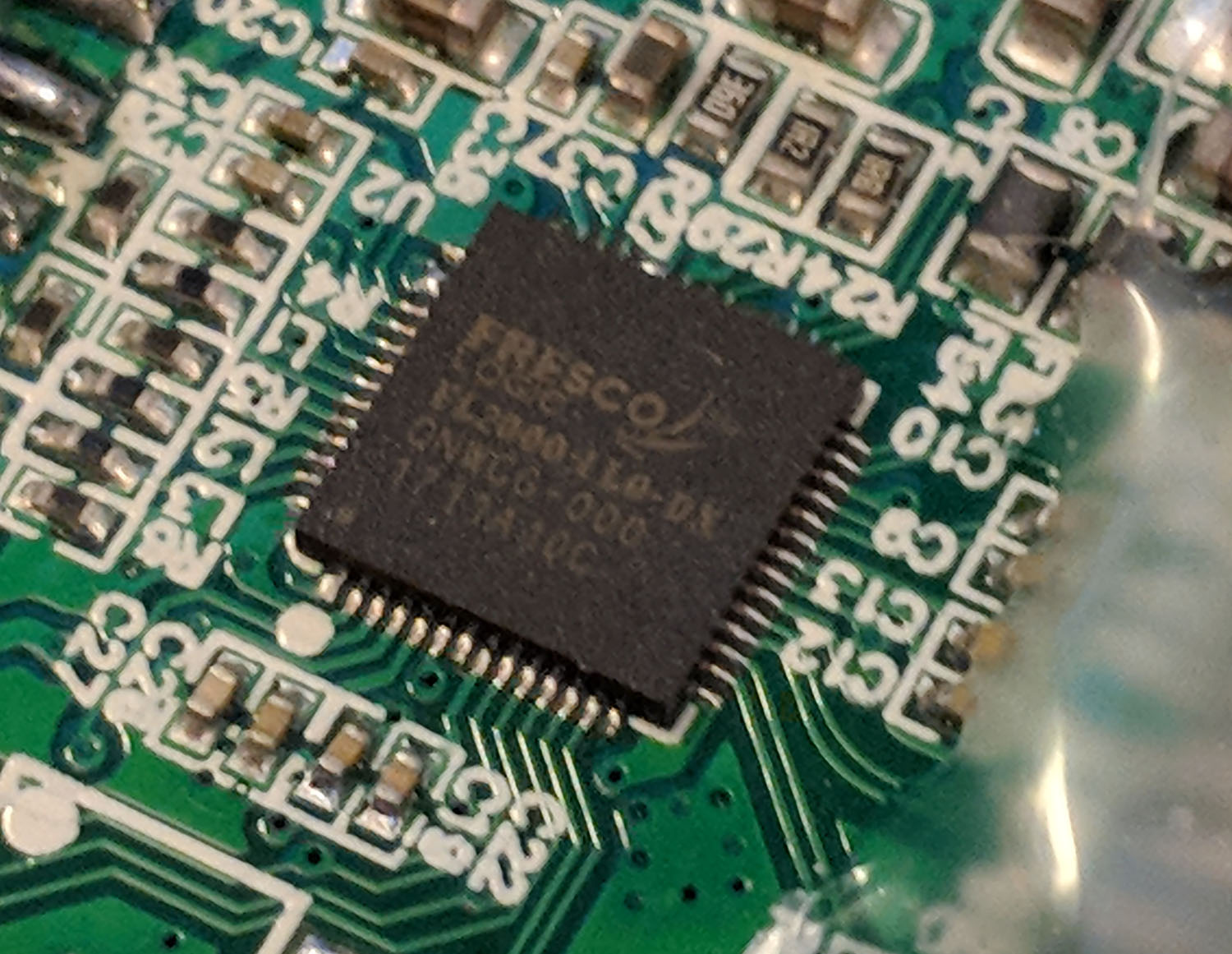
One of the most interesting hacks of this year is [Steve Markgraf]’s tool to allow transmit-only SDR through cheap USB 3.0 to VGA adapters. The hack relies on the Fresco Logic FL2000 chip and gives you the ability to transmit FM, TVB-T, and create your own GSM cell site. You can also spoof GPS to get something besides a rattata in Pokemon Go or hack your ankle bracelet to keep your parole officer off your back. The open question, though, is which USB to VGA adapter has the FL2000 chipset. I can confirm this one on Amazon has the relevant chipset. It’s a bit expensive at $15 (the same chipset is available from the usual eBay and AliExpress suppliers for $6), but if you’re looking for something that is available with Prime, there you go. Now we’re looking for shared OSH Park projects with a VGA input on one end and some antennas on the other. Make it happen, people.

Supercapacitors are awesome, but is it possible to fly a drone with a bank of them? Sure, for about 10 seconds. [dronelab] built a 7-cell, 200F supercap and managed to fly a little racing quad for about ten seconds. Not terribly great, but this is going to be awesome when we get multi-thousand Farad superultramegacaps.

Like Open Hardware? The Open Source Hardware Association is opening up the Ada Lovelace Fellowship for women, LGTBA+ and other minorities to attend the Open Hardware Summit. The deadline is tomorrow, so do it soon.

M3D has announced a new 3D printer that can print with four filaments. The Crane Quad is your basic i3 ripoff with an interesting extruder. It looks like it uses four tiny motors to feed filament into the main extruder motor. This isn’t really anything new; the Prusa i3 multimaterial upgrade does the same thing. However, M3D claims they have mastered color mixing. The Prusa upgrade doesn’t do mixing, and this is most likely the reason it works so well. Can M3D pull it off? This is a very, very, very hard problem.

A Blockchain, Robotics And AI Event In Vietnam

Blockchain Education Network Vietnam recently held an event titled “Building a Robotics & Artificial Intelligence Ecosystem with Blockchain”. The title alone has three of my favorite things in it, so when a client of mine asked me if I could put together a little hardware demonstration for the event, I jumped at the opportunity.

I also thought I’d take a moment to write about it, because I haven’t seen much coverage of emerging technology events in the developing world, and the fact is that there’s a consistently high level of interest. I’ve yet to go to an event that wasn’t filled to capacity, and I hope to share some of that enthusiasm with you.

Continue reading “A Blockchain, Robotics And AI Event In Vietnam”

Circuit VR: Oscillating Bridges

Circuit VR is where we talk about a circuit and examine how it works in simulation with LT Spice. This time we are looking at a common low-frequency oscillator known as the Wien bridge oscillator.

What makes an oscillator oscillate? A circuit with amplification that gets the same amount of the output signal fed back into its input, in phase, will oscillate. This is the Barkhausen criterion. Here, we’re going to look into what makes an oscillator work in simulation, and gain some insight into what happens when there’s too much feedback and too little.

In particular, we’ll look at the Wien bridge oscillator, a very simple design that originated as a way to measure impedance back in 1891. Modern versions add some additional features, but let’s start with the most simple implementation and work our way up.

Continue reading “Circuit VR: Oscillating Bridges”