Books You Should Read: Poorly Made In China

This book is scary, and honestly I can’t decide if I should recommend it or not. It’s not a guide, it doesn’t offer solutions, and it’s full of so many cautionary tales and descriptions of tricks and scams that you will wonder how any business gets done in China at all. If you are looking for a reason not to manufacture in China, then this is the book for you.

The author is not involved in the electronics industry. Most of the book describes a single customer in the personal products field (soap, shampoo, lotions, creams, etc.). He does describe other industries, and says that in general most factories in any industry will try the same tricks, and confirms this with experiences from other similar people in his position as local intermediary for foreign importers.

Continue reading “Books You Should Read: Poorly Made In China”

Review: The RC2014 Z80 Computer

As hackers and makers we are surrounded by accessible computing in an astonishing diversity. From tiny microcontrollers to multi-processor powerhouses, they have become the universal tool of our art. If you consider their architecture though you come to a surprising realisation. It is rare these days to interface directly to a microprocessor bus. Microcontrollers and systems-on-chip have all the functions that were once separate peripherals integrated into their packages, and though larger machines such as your laptop or server have their processor bus exposed you will never touch them as they head into your motherboard’s chipset.

A few decades ago this was definitely not the case. A typical 8-bit microprocessor of the 1970s had an 8-bit data bus, a 16-bit address bus, and a couple of request lines to indicate whether it wanted to talk to memory or an I/O port. Every peripheral you connected to it had to have some logic to decode its address and select it when you wanted to use it, and all shared the processor’s bus. This was how those of us whose first computers were the 8-bit machines of the late 1970s and early 1980s learned the craft of computer hardware, and in a world of Arduino and Raspberry Pi this now seems a lost art.

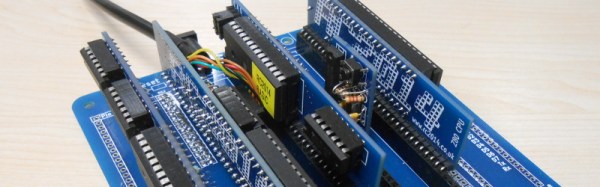
The subject of today’s review then provides a rare opportunity for the curious hardware hacker to get to grips with a traditional microprocessor bus. The RC2014 is a modular 8-bit computer in which daughter cards containing RAM, ROM, serial interface, clock, and Z80 processor are ranged on a backplane board, allowing complete understanding of and access to the workings of each part of the system. It comes with a ROM BASIC, and interfaces to a host computer through a serial port. There is also an ever-expanding range of further peripheral cards, including ones for digital I/O, LED matrixes, blinkenlights, a Raspberry Pi Zero for use as a VDU, and a small keyboard.

Continue reading “Review: The RC2014 Z80 Computer”

New Part Day: The ESP32 Has Been Released

A few years ago, a strange little chip showed up on Seeed Studio one day. It was the ESP8266, originally sold as a serial to WiFi adapter. Since then, the microcontroller in this wee WiFi module was discovered, and the ESP8266 has been the breakout module for hundreds of Internet of Thing modules, and other wireless baubles.

The company behind the ESP8266, Espressif, wasn’t sitting on their laurels for the last few years. They’ve been working on a followup to the ESP8266. It’s the ESP32, and it’s faster, has more peripherals, better WiFi, and Bluetooth LE. Since Christmas, we’ve been ogling this chip. Now, it’s finally out. You can buy an ESP32 right now. Consider the ESP32 released.

Almost exactly two years ago, the forerunner of the ESP32 was released, allowing anyone to blink a LED from the Internet for five dollars. There was a catch with the release of the ESP8266, and that was documentation. Documentation in English did not exist, and it took Espressif a while to realize the hit they had on their hands. Even now, with a proper English datasheet from Espressif, we don’t know if the ESP8266 has 5V tolerant pins. Documentation was an issue for the ESP8266, but it didn’t really matter because someone on the Internet figured it out.

History doesn’t repeat itself, but it is the franchise with the most reboots. There’s some documentation for the ESP32, but it’s far from complete. There’s a CAN bus peripheral in the ESP32, but no one knows what pins it’s attached to. There are some secrets hidden away, but no one is at liberty to discuss them. No one outside Espressif has any idea if the specs are real. This will, of course, change in the next month or so, but only due to the tireless work of electronics enthusiasts the world over.

Right now, there are several listings on the usual online outlets including Espressif’s Taobao shop and Seeed Studio offering either bare ESP32 chips or modules based on this WiFi Bluetooth wonder. These modules include the ESP-Wroom-32 (PDF) that is seemingly based on the ESP31 test modules released late last year and the ESP3212, a module based on the popular ESP8266-12. There are also bare chips floating about.

As far as any new information regarding the ESP32 is concerned, don’t expect much. It’s released, though, and in a month or so the work of documenting this supposed wonderchip will begin.

Although they’re not available to everyone quite yet, we have two ESP-32 modules in hand, and [Elliot] is currently slogging through installing the toolchain and getting everything working. Watch this space, because we’re going to have an Introduction to the ESP-32 post up shortly.


Retrotechtacular: Home Video Recording

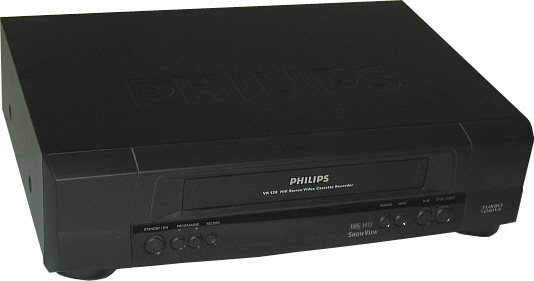
The news has been full of reports that the last company manufacturing consumer VCRs will cease making them this year. I think most of us are surprised that the event is only happening now. After all, these days, video recording is likely to be on a hard drive, a USB stick, or on a server somewhere. Even recording to DVDs seems a bit quaint these days.

VCR-03Back before there were web sites, people had to get information from magazines like Popular Electronics, Radio Electronics, and a few others. In the late 1960s and early 1970s, it was common to see these magazines predict that this would be the year of the home video recording system. For example, in 1971, [Lou Garner] wrote: “…they [Sony] hope will put home videotape playing in the same living room as conventional high-fidelity sound systems.” You should know that the video cassette he was talking about was 8 inches wide by 5 inches deep (a big larger than a VHS tape) and contained 3/4 inch magnetic tape (VHS used 1/2 inch tape). The 32-pound player had a retail price of about $350 (about $2,000 in today’s dollars; remember gas was $0.36 a gallon and eggs were $0.53 a dozen). It would be several years before VHS and Betamax would duke it out for home supremacy.

Continue reading “Retrotechtacular: Home Video Recording”

Hackaday Links Column Banner

Hackaday Links: September 4, 2016

Nozzle socks! Just keep saying, ‘nozzle socks’ until the semantic satiation undoes any semblance of sanity. E3D, makers of the world’s finest 3D printer hotends have released silicone nozzle covers that prevent caramelized plastic gunking up your hot end. Nozzle socks.

Let’s talk guitar pedals. If you’ve ever built your own guitar pedal, you probably stuffed it inside a Hammond enclosure. There’s more to guitar pedal enclosures than custom-painted electronic boxes, and arguably the best enclosures are the ‘Boss’ style – a metal cover over the switch that can be removed to access the battery independently of the circuit. Now you can buy this type of enclosure. [Rixen] is producing blank die-cast aluminum pedals that look so much better than the standard Hammond enclosure.

The Antonov AN-225 is the largest and heaviest airplane in the world. Only one was built. For the last thirty years, a second airframe, about 70% complete, has sat in a field or hangar in the Ukraine, waiting for someone to put it into service. After numerous false starts over the past decade or so, the second AN-225 is finally being built.

The Hackaday Retro edition is our version of Hackaday optimized for embedded devices. When someone gets some old hardware on that vast World Wide Web and manages to pull up the retro edition, we like to celebrate. [Michael] recently got his old Amiga 1200 online and managed to find the software and hardware to get this machine on the net. Inside the A1200 is a 4GB CompactFlash, an ACA 1232 accelerator card with 128MB of RAM and a 33MHz 030. The network is handled by a Linksys EC2T card, and the software is KS3.0, WB3.1, MiamiDX IP stack IBrowse 2.4, and a bunch of 3rd party libs he can’t remember. Here’s a pic.

On a related note, I haven’t touched the Hackaday Retro Edition in years. Right now, it’s just a script running every five minutes that assembles five random posts from the first 15,000 Hackaday posts since the beginning of time. The retro edition does what I want it to do, but I’m wondering if it can be better. If you have an idea of how to improve the Retro Edition, leave a note in the comments.

Hacklet 123 – Watches

Time and tide wait for no man. Chaucer may be right, but a man (or woman) wearing a watch can get ahead of time before it sneaks up on them. People aren’t ever satisfied with just the time though. They want the date, the phase of the moon. [Woz] summed it up pretty well when he said “I want the entire smartphone, the entire Internet, on my wrist”.   Hackers love watches too, which means there are plenty of watch projects out there. Some of them even tell time. This week we’re looking at some of the best watch projects on Hackaday.io!

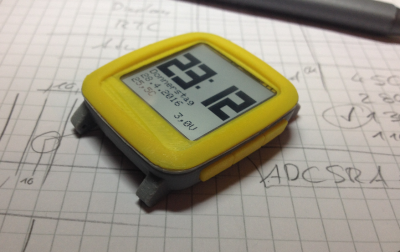
chronioWe start with [Max.K] and Chronio. You might think Chronio looks a bit like the Pebble Time, and you’d be right! [Max] based his design heavily on Pebble’s case design. Pebble even has their CAD files on GitHub, which helped [Max] with his modified, 3D printed version. Chronio is Arduino based, using an ATmega328p microcontroller with the Arduino bootloader. The display is Sharp’s 96×96 pixel Memory LCD. A DS3231 keeps the time accurate, and provides a free temperature sensor. The entire watch is powered by a CR2025 battery. Running a 20uA sleep current, [Max] estimates this watch will last about 6 months on a single battery.

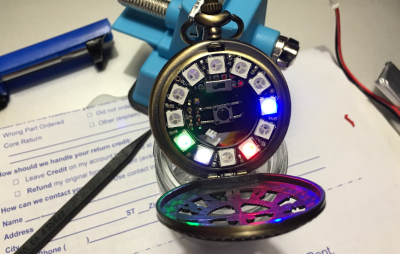
neopixel-pocketNext we have [Joshua Snyder] and Neopixel pocket watch. Who said a watch has to go on your wrist? [Joshua] brings some steampunk style to the party. His watch uses an Adafruit 12 NeoPixel ring to tell time. Red, blue, and green LEDS represent the hour, minute and second hands. The watch is controlled by an ESP8266. The time is set via WiFi. Between the LEDs and the power-hungry ESP8266, this isn’t exactly a low-power design. A 150mAh LiPo battery should keep things running for a few hours though. That’s more than enough time to make a splash at the next hackerspace event.

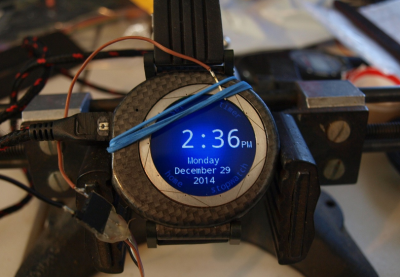
pi-watchNext up is [ipaq3115] and The Pi Watch. Round smartwatches have created a market for round LCD screens. These screens have started to trickle down into the hacker/maker market. [ipaq3115] got his hands on one, and had to design something cool with it. The Pi Watch isn’t powered by a Raspberry Pi, but a Teensy 3.1. [ipaq3115] included the Freescale/NXP Kinetis processor and MINI54 bootloader chip on his own custom board. He used the Teensy’s analog inputs to create his own 10 element capacitive touch ring. This watch even has a LSM303  magnetometer/accelerometer. All this power comes at a cost though. It takes a 480 mAh LiPo battery to keep The Pi Watch Ticking.

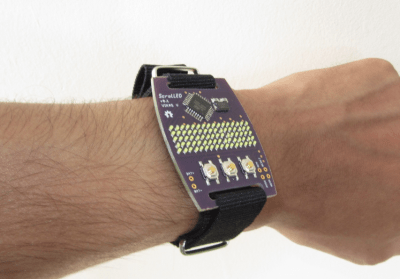
vikasFinally we have [Vikas V] and ScrolLED watch. Who says a watch has to have an LCD? [Vikas V] wanted a scrolling LED display on his wrist, so he built his own. An Atmel ATmega88V-10AU controls a 16×5 charlieplexed LED array. [Vikas] included a character font with many of the ASCII symbols in flash, so this watch can display messages. Power comes from a CR2032 watch battery in a custom PCB mounted holder. [Vikas] biggest issue so far has been light leaks from LED to LED. He’s considering mounting the array on the bottom of the watch. Shining the LEDs up through holes in the PCB would definitely help with the light leakage.

If you want to see more watch projects, check out our new watch projects list. Notice a project I might have missed? Don’t be shy, just drop me a message on Hackaday.io. That’s it for this week’s Hacklet, As always, see you next week. Same hack time, same hack channel, bringing you the best of Hackaday.io!