Hackaday Links Column Banner

Hackaday Links: August 23, 2015

Dutch security conference! It’s called hardwear.io, it’ll be in The Hague during the last week of September, and they have the CTO of Silent Circle/Blackphone giving the keynote.

Baltimore’s awesome despite what the majority of the population says, and they have a few hackerspaces. One of them has an Indiegogo going right now to save the space. Want a tour of the space? Here you go.

[Fran Blanche] made it on to the Amp Hour. Included in this episode are discussions about the boutique guitar pedal market and the realities of discarded technology that took us to the moon.

Speaking of electronics podcasts, SolderSmoke is 10 years old now.

TARDIS-shaped guitars are nothing new, but [Gary] from the LVL1 hackerspace in Louisville, KY is making an acoustic one. The neck is, of course, taken from another guitar but the entire TARDIS-shaped body is custom-made. Now do resonance calculations on something that’s bigger on the inside.

Think German-made means German quality? [AvE], [Chris], or whatever we call him did a teardown of a Festool Track Saw. It’s a thousand dollar tool that will start to stink in a few years and has bearings that don’t make any sense.

Love 8-bit? There’s a Kickstarter from 8-bit generation for a documentary about the love, loss, resurrection and continuation of old computers. Dozens of very interesting interviews including one from our own [Bil Herd]


Hacklet 71 – Waterborne Projects

Water: Life on earth wouldn’t exist without it. 71 percent of the Earth is covered by water. That only leaves 29 percent for us humans to live – and not all of that land is inhabitable. Water is so important that most human settlements start near water of some sort. Water to drink, or water to move goods. With all this water in oceans, lakes, and rivers, it is no surprise that hackers, makers, and engineers alike build some incredible projects that work on and under the water.

Continue reading “Hacklet 71 – Waterborne Projects”

Retrotechtacular: One Does Not Simply String Up A Half-Million VDC Transmission Line

It takes strong and determined population to build a lasting civilization. If the civilization includes electricity and the inhabitants live in a hilly place with an often-unforgiving climate, the required strength and determination increases proportionally. Such is the case of the gentlemen who strung up the first half-million VDC transmission line across New Zealand, connecting the country’s two main islands.

Construction for the line known as the HVDC Inter-Island link began in 1961. It starts at the Benmore hydroelectric plant on the south island and runs north to Cook Strait via overhead cables. Then it travels 40km underwater to the north island and ends near Wellington. This is the kind of infrastructure project that required smaller, preliminary infrastructure projects. Hundreds of miles of New Zealand countryside had to be surveyed before breaking ground for the first tower support hole. In order to transport the materials and maintain the towers, some 270 miles of road were laid and ten bridges were built. Fifteen camps were set up to house the workers.

The country’s hilly terrain and high winds made the project even more challenging. But as you’ll see, these men were practically unfazed. They sent bundles of steel across steep canyons on zip lines and hand-walked wire haulage rope across gullies because they couldn’t otherwise do their job. Six of these men could erect a tower within a few hours, which the filmmakers prove with a cool time-lapse sequence.

Splicing the mile-long conductors is done with 100-ton compressors. Each connection is covered with steel sleeve that must be centered across the joint for optimum transmission. How did they check this? By taking a bunch of x-rays with a portable cesium-137 source.

Continue reading “Retrotechtacular: One Does Not Simply String Up A Half-Million VDC Transmission Line”

Embed With Elliot: The Volatile Keyword

Last time on Embed with Elliot we covered the static keyword, which you can use while declaring a variable or function to increase the duration of the variable without enlarging the scope as you would with a global variable. This piqued the curiosity of a couple of our readers, and we thought we’d run over another (sometimes misunderstood) variable declaration option, namely the volatile keyword.

On its face, volatile is very simple. You use it to tell the compiler that the declared variable can change without notice, and this changes the way that the compiler optimizes with respect to this variable. In big-computer programming, you almost never end up using volatile in C. But in the embedded world, we end up using volatile in one trivial and two very important circumstances, so it’s worth taking a look.

Continue reading “Embed With Elliot: The Volatile Keyword”

Developed On Hackaday: Let’s Build An Electronic Hackaday Badge

We’re going to build an electronic Hackaday Badge, and by “we”, I mean Hackaday community members who are passionate about the project.

I’ll be leading the charge. I had a great learning experience the last time I helped design the e-paper badge for the 2013 Open Hardware Summit, and hope to learn a lot along the way this time too. Since then, Badges have come a long way – at cons like DEFCON, LayerONE, Shmoocon, The Next Hope, Open Hardware Summit, The EMF, SAINTCON, SXSW Create, The Last Hope, TROOPERS11, ZaCon V and of course the rad1o from this year’s CCCamp. Word is that this year’s Open Hardware Summit badge is going to be pretty kickass too. So, we have some very big shoes to fill. But this doesn’t have to be about “my badge is better than yours”. And this badge isn’t meant to be specific to any single con or event. So what does the Badge do, then? “It’s a physical extension of the hackaday.io community, made specifically for hacker gatherings of all types and sizes.”

Continue reading “Developed On Hackaday: Let’s Build An Electronic Hackaday Badge”

Hackaday Links Column Banner

Hackaday Links: August 16, 2015

[Matt] created an animated gif of New Horizon’s Pluto flyby. The source images were taken from the the raw LORRI images, modified so the background star field could be seen, and assembled with OpenCV. Because Pluto and Charon orbit each other around a point above Pluto’s surface, simply putting Pluto in the center of each frame wouldn’t work. It’s the best visual explanation of this weird arrangement yet, all brought to you by the magic of OpenCV and Python.

On the subject of Kickstarter creators that don’t understand the conservation of energy, I present this.

We don’t know exactly what’s going on with this one, but here’s a swimming pool covered with RGB LEDs. It’s controlled by two Rainbowduinos, and looks like the coolest disco floor you’ve ever seen.

[Frank]’s 2011 Hundai Santa Fe wasn’t cool enough, so he added an F16 flight stick to his shift knob. The choice of joystick is paramount here: Saitek joysticks look too techy, Logitech ones are too expensive, and the Warthog H.O.T.A.S costs $400. Joysticks are extremely niche peripherals these days, it seems. He ended up strapping an old F16 joystick from the 90s on his shift knob, and it looks close enough to the real thing.

Two bodgers are stuffing the engine from a Toyota Celica into a 1980 Mini, and they’re trying to make it look stock. We’ve seen their project before, and now there’s a new episode. In this episode: the pedal box, the steering wheel, and figuring out how to make the car drive straight.

Hacklet 70 – Calculator Projects

Hackers, makers, and engineers have long had a love affair with number crunching. Specifically with the machines that make crunching numbers easier. Today it may be computers, smart watches, and smartphones, but that wasn’t always the case. In the 50’s and 60’s, Slide rules were the rage. Engineers would carry them around in leather belt pouches. By the early 70’s though, the pocket calculator revolution had begun. Calculators have been close at hand for hackers and engineers ever since. This week’s Hacklet celebrates some of the best calculator projects on Hackaday.io!

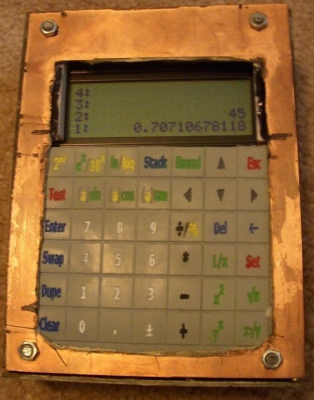
calc1We start with [Joey Shepard] and RPN Scientific Calculator. No equals sign needed here; [Joey] designed this calculator to work with Reverse Polish notation, just like many of HP’s early machines. Stacks are pretty important for RPN calculators, and this one has plenty of space with dual 200 layer stacks. The two main processors are MSP430s from Texas Instruments. The user interface are a 4 line x 20 character LCD and 42 hand wired buttons. The two processors are pretty ingenious. They communicate over a UART. One processor handles the keyboard and display, while the other concentrates on crunching the numbers and storing data in an SRAM. The case for this calculator is made from soldered up copper clad board. It’s mechanically strong especially since [Joey] added a bead of solder along each joint. If you want to learn more about this technique check out this guide on FR4 enclosures.

[Joey] definitely improved his solder skills with this project. Every wire and connection, including the full SRAM address and data bus were wired by hand on proto boards. We especially like the sweet looking laser cut keyboard on this project!
Continue reading “Hacklet 70 – Calculator Projects”