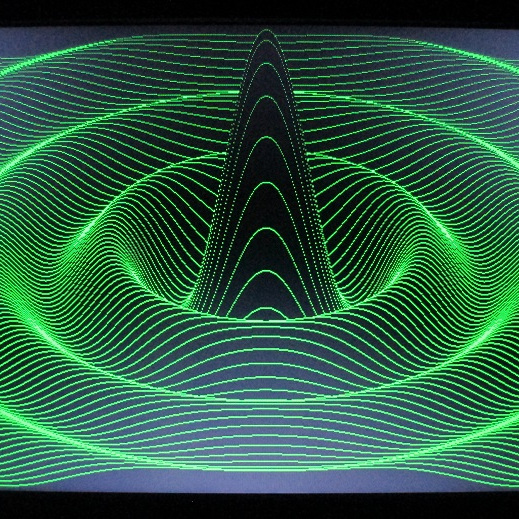
Drawing this sin(x)/x ripple surface can be done in only 17 lines of BASIC.
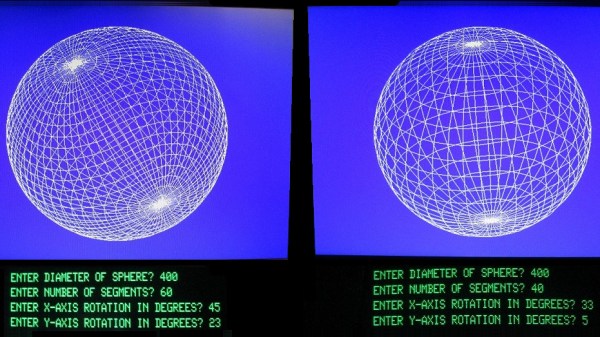
How does a TRS-80 even manage to output anything useful to these monitors? [Glen] wrote his own low-level driver in machine code to handle that. The driver even has useful routines that are callable from within BASIC, meaning that programs written on the TRS-80 are granted powerful drawing abilities. Oh, and did we mention that the VGA graphics cards themselves were designed and made by [Glen]?
Interested in making your own? [Glen] provides all the resources you’ll need to re-create his work, including machine code drivers and demonstration BASIC programs as downloadable audio files, just as they would have been on original cassette tapes.
Watch things in action in the videos embedded below. The first draws a Land Rover, and the second plots a simple Moiré pattern star. Not bad for 70s-era hardware and 74xx logic!
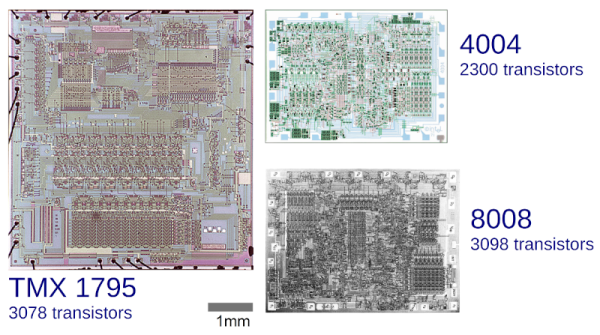
Texas Instruments isn’t the name you usually hear associated with the first microprocessor. But the TI TMX 1795 was an 8008 chip produced months before the 8008. It was never available commercially, though, so it has been largely forgotten by most people. But not [Ken Shirriff]. You can see a demo from 2015 of the device in the video below, too.
The reason the chips have the same architecture is they were built to replace the same large circuit board inside a Datapoint 2200 programmable terminal. These were big beasts that could be programmed in BASIC or PL/B.
Datapoint asked Intel to shrink the board to a chip due to heating problems — but after delays, they instead replaced the power supply and lost interest in the device. TI heard about the affair and wanted in on the deal. However, Datapoint was unimpressed. The chip didn’t tolerate voltage fluctuations very well, since they had replaced the power supply and had a new CPU design that was faster than the chip would be. They were also unimpressed with how much stuff you had to add to get a complete system.
So why did the Intel 8008 work out in the marketplace but the TI chip didn’t? After all, Datapoint decided not to use the 8008, also. But as [Ken] points out, the 8008 was much smaller than the TI chip and, thus, was more cost-effective to produce.
As usual, [Ken]’s posts are always interesting and enlightening. He’s looked at a lot of old computers. He’s even dug into old space hardware. Great stuff!
When [Stephen Cass] found himself with a broken Tandy TRS-80 Model 100 portable computer, the simplest solution was to buy another broken one and make one working computer from two non-working computers. However, this left him with a dilemma — what to do with the (now even more) broken one left over?
LCD layout is unusual by modern standard, but optimized for fast updates
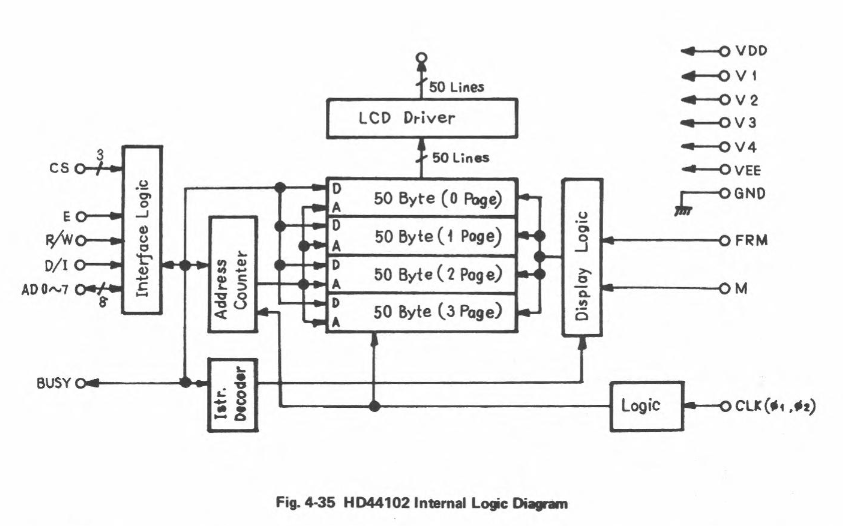
Luckily, the Model 100 has a substantial fanbase and there’s a lot of helpful information available online, including the detailed service manual, that helped [Stephen] to understand how to drive the unusual display. The LCD has a resolution of 240×64 pixels, which are broken down into eight zones of 50×32 pixels, and two zones of 40×42 pixels. Each zone is then further divided into four banks, eight pixels tall, so that each column of eight pixels corresponds to a single byte.
Every one of the ten zones is controlled by an individual HD44102 driver IC, connected to a 30-bit wide bus for selecting the correct chip, bank and column.
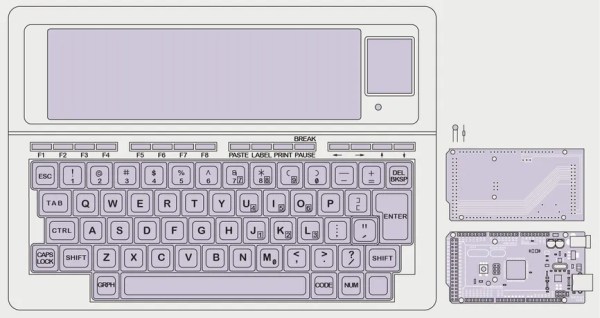
With the Arduino handling the data, the old LCD still needed a -5 V supply for contrast and an RC filter to smooth out the PWM signal [Stephen] is using to adjust the viewing angle.
With the new interface, [Stephen] is able to access all of the pixels on the original display, and to use modern graphics libraries such as displayio. With the display issue solved, he intends to use a separate Teensy 4.1 to connect with the keyboard matrix and provide a VT100 terminal interface.
Schematic of the HD44102 driver circuit
Upcycling old, broken hardware can be a lot of fun and is always educational. Understanding why certain design decisions were made at a time when the engineering trade-offs were different can lead to insights that are directly relevant to modern designs when resources get tight. In this case, the quirky LCD drivers were a response to making the display of text as efficient as possible, so as not to overburden the processor.
The TRS-80 computers are ripe for hacking, with their “built-for-service” designs, and we’ve featured a few in the past. Some have replaced the motherboard with something newer, like [Stephen], whereas others have also replaced the display, or connected them to the cellphone network.
Have you found new ways to get old hardware working? Tell us in the comments below or send us a message on the Hackaday tips line.
Floppies may be big in Japan, but nostalgic and/or needful Stateside floppy enthusiasts needn’t fret — just use AOL keyword point that browser toward floppydisk.com. There, you can buy new floppies of all sizes, both new and old, recycle your disks, or send them in to get all that precious vintage stuff transferred off of them.
That delightfully Web 1.0 site is owned by Tom Persky, who fancies himself the ‘last man standing in the floppy disk business’. Who are we to argue? By the way, Tom has owned that address since approximately 1990 — evidently that’s when a cyber-squatter offered up the domain for $1,000, and although Tom scoffed at paying so much as $1 for any URL, his wife got the checkbook out, and he has had her to thank for it ever since.
My business, which used to be 90% CD and DVD duplication, is now 90% selling blank floppy disks. It’s shocking to me. — Tom Persky
Tom also owns diskduper.com, which is where he got his start with floppies — by duplicating them. In the 80s and 90s, being in this business was a bit like cranking out legal tender in the basement. As time wore on and more companies stopped selling floppies or simply went under, the focus of Tom’s company shifted away from duplication and toward sales. Whereas the business was once 90% duplication and 10% floppy sales, in 2022, those percentages have flopped places, if you will.
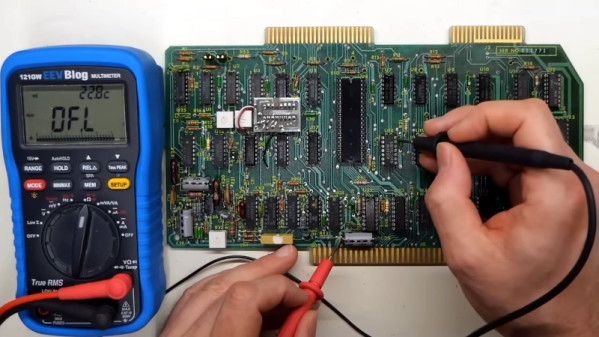
A lot of people had a Radio Shack TRS-80 Model I. This was a “home computer” built into a keyboard that needed an external monitor or TV set. Later, Radio Shack would update the computer to a model III which was a popular “all in one” option with a monitor and even space for — gasp — floppy disks. But the Model II was not nearly as common. The reason? It was aimed at businesses and priced accordingly. [Adrian] got a Model II that was in terrible shape and has been bringing it back to life. You can see the video of how he’s done with it, below.
The Model II was similar to the older “Trash 80” which had been used — to Radio Shack’s surprise — quite often by businesses. But it had more sophisticated features including a 4MHz CPU — blistering speed for those days. It also had an 80×25 text display and a 500K 8-inch floppy drive. There were also serial and printer ports standard.
There were a few interesting features. The floppy drive’s spindle ran on AC power and if the computer was on, the disk was spinning. In addition, there was bank switching so you could go beyond 64K and also you didn’t have to share your running memory with the video display. In theory, the machine could go beyond 64K since half the memory was bank switchable. In practice, the early models didn’t have enough expansion space to handle more than 64K physically.
There’s an old gag, about how this is finally the year of the Linux desktop. But oddly back in the ’90s it almost seemed possible, because alongside Microsoft Windows there were a host of other players that just might have become challengers. Foremost among them was IBM’s OS/2, a desktop PC operating system that could very much give Windows a run for its money. It could even run 16-bit Windows applications thanks to the code-sharing deal between the two companies dating back to the DOS days. Big Blue were so anxious to take their OS into new markets that they localized it into languages which Microsoft hadn’t touched, of which Slovenian was one.
But a couple of decades later, could a copy of this rare operating system version be found? While it may still lurk on a dusty shelf in an IT office somewhere it’s proved elusive, and online sources have dried up. The quest for it makes interesting reading for anyone with an interest in that period of retrocomputing, and finally ended up at the Slovenian company which had performed the localisation. This resulted in a copy of the OS, but not of the media, box, or paperwork. It yielded the fascinating discovery that IBM had localized the Windows 3.1-derived components as well as their own code, something that Microsoft had never done.
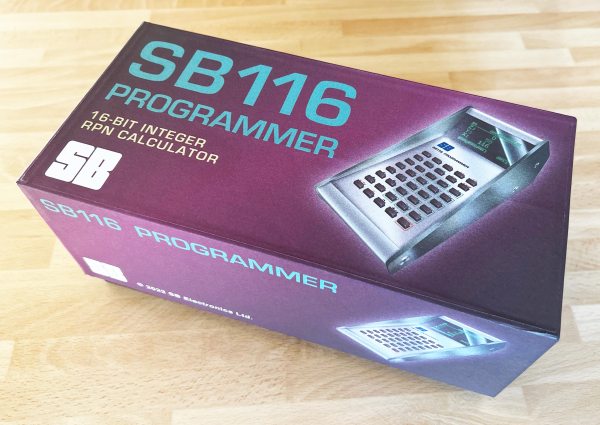
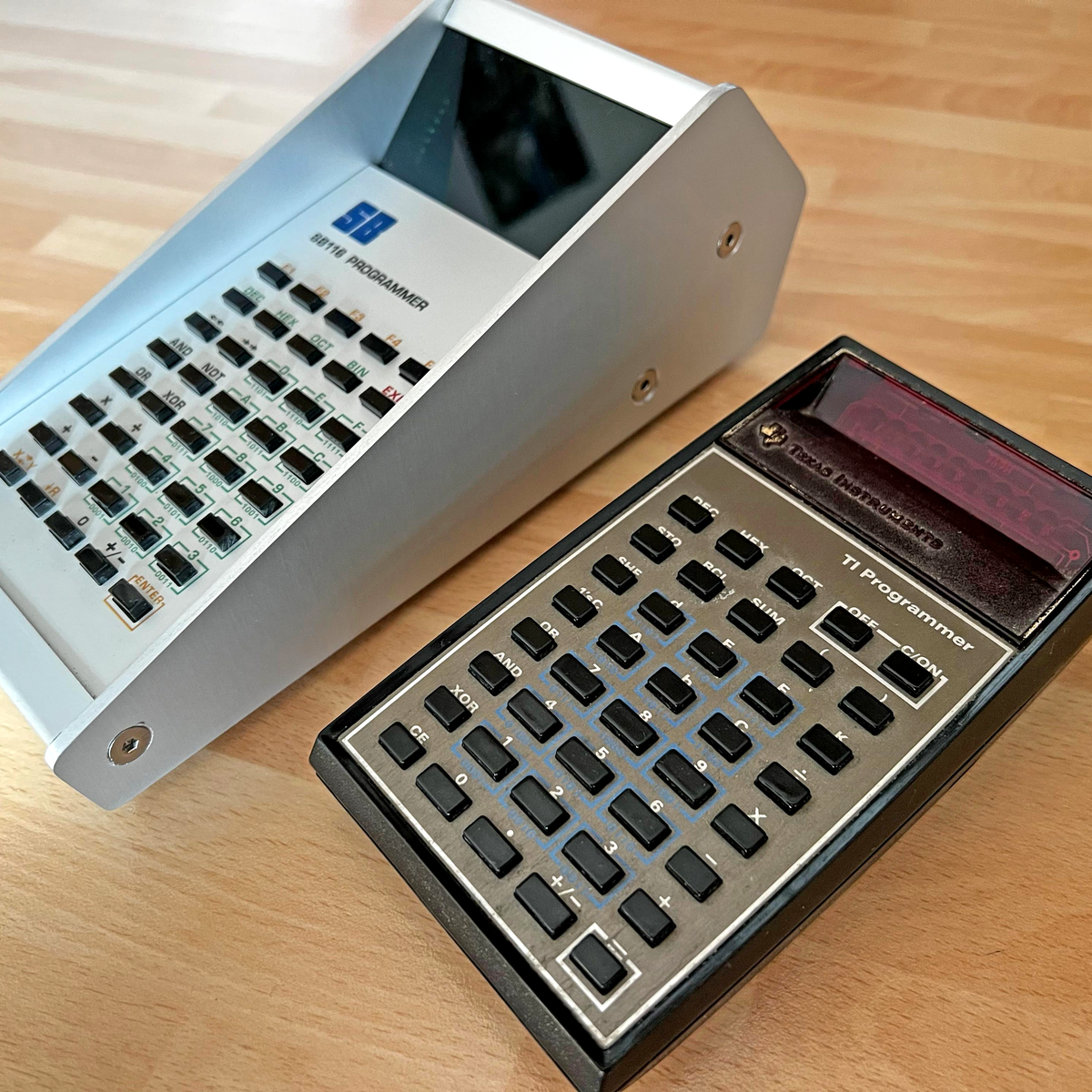
There’s something about Reverse Polish Notation (RPN) and the calculators that use it. It calls to mind a time when a calculator was a serious tool, and not just a throwaway toy. Created in the legacy of such calculators by HP and Texas Instruments, [Simon Boak] shows off his SB116, sporting an Arduino Nano under the hood. It’s a fully custom design, with a hand-built metal case, a custom PCB for the keyboard, and a tiny OLED display for maximum retro green goodness.
The impetus for this build was to replace a particular calculator, a well-used TI Programmer, that’s useful for working with 6502 assembly. The SB116 supports binary, octal, decimal, and hex; and boasts some downright useful functions — AND, NOT, OR, XOR, and bitshifts. The source code is available, but you’re on your own for the case and keyboard. And for maximized retro faux-nostalgia, [Simon] designed a box that would have looked right at home on an 80s store shelf.