Unitree GO-M8018-6 Motor Reverse Engineering

People seem to be rather into the Unitree Go2 quadruped robot, if only for the low price tag. But perhaps more interesting are the motors that propel it — they appear to be similar to the Go1’s GO-M8010-6 motors that Unitree also sells, with [Thomas Flayols] currently working on reverse-engineering its proprietary driver using the publicly available documentation for that motor and some reverse-engineering.

These motors are an assembly that includes a reducer, magnetic encoder, 3-phase inverter, current sensing, an RS-485 bus and a Cortex-M0-based CMS32M57xx MCU, all in a very capable package intended for robotics applications where a compact actuator is needed.

The first step of reverse-engineering involved the physical PCB, made all the more difficult as Unitree was so kind as to remove all markings on the ICs. Fortunately using an X-ray machine and some sleuthing it was possible to deduce the MCU and other components. Following this SWD/OpenOCD access to the MCU could be established and the firmware key extracted from the bootloader SRAM.

Although the firmware was encrypted, a locally recovered key was found to decrypt it. This allowed for an initial custom firmware to be developed, which [Thomas] hopes to develop into a fully featured open source firmware. Doing so would obviously open these motors to a larger audience outside of Unitree’s ecosystem, as they are pretty good value for what they offer mechanically.

It might give the associated Go2 robot a new life too considering the serious malware accusations and security issues pertaining to its firmware.

Autonomous Submarine Relies On Color Detection

We talk about all kinds of autonomous vehicles here at Hackaday, from aerial drones to rugged rovers. A little less common are the submarine builds, likely due to their technical complexity. That said, though they perhaps benefit most from autonomy given they’re so hard to talk to while underwater. In any case, [Ayman] has built an impressive sub that uses some rudimentary techniques to navigate around while under the surface. 

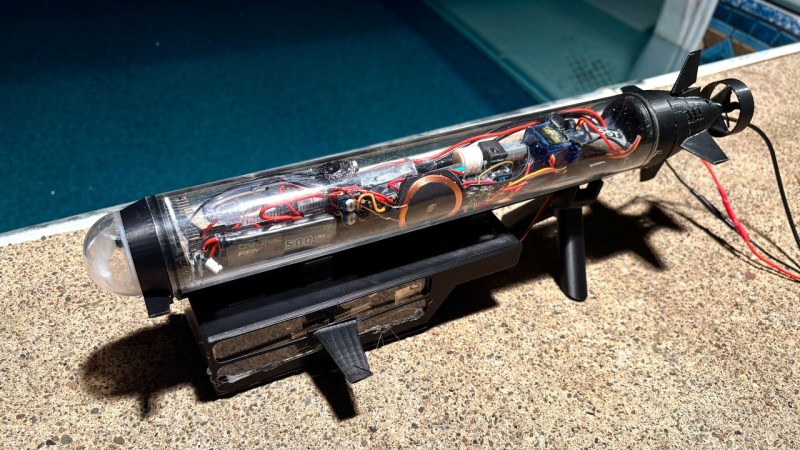
The build uses typical construction techniques for DIY subs of this size, with a clear acrylic tube serving as the body of the craft. It’s carefully sealed to ensure water ingress doesn’t send it to the bottom, using nifty tricks like a magnetic coupling for the prop. Inside, there’s a Raspberry Pi 4, kitted out with an Arducam IMX708 camera with a wide angle lens. It’s joined by a BNO085 inertial measurement unit, along with two BMP280 pressure sensors for keeping track of motion and the sub’s vital signs, while a DRV8833 motor controller runs the main drive motor.

There’s also an ESP32 which helps out with motor and servo control for steering, and ballast control. Sinking and floating the sub is handled with a pair of two ballast tanks constructed out of 5 mL syringes that are driven in and out with high-torque output gear motors. The build uses an antenna buoy so that communication can be maintained with the sub when it’s within a certain range of the surface.

A neat addition to the sub is its autonomous navigation code. [Ayman] whipped up some simple object avoidance routines, which rely on the Raspberry Pi’s camera. The code uses HSV values to track specific colored objects and avoid them, which proves more reliable than RGB as it allows tracking color in a largely brightness-independent manner.

Although we’ve featured other builds that use similar construction techniques, seeing a transparent submarine gliding through the water will always make us think of the incredible Open Source Underwater Glider that won the 2017 Hackaday Prize.

Continue reading “Autonomous Submarine Relies On Color Detection”

Biofeedback Butterfly Beats With A Pulse

Biofeedback is the idea of making one conscious of a biological process or feature, and then using this to try and exert control over the very same. [Mariia Hruntes] demonstrates this ably with a fluttering build of her own design.

In this case, the biological process being made clear is that of the user’s heartbeat. This is tracked with a MAX30102 pulse oximetry sensor, which can be used to measure both heart rate and blood oxygen levels if so desired. It’s hooked up to an Arduino Uno, which polls for pulse rate data, and then actuates an SG90 micro servo in turn. This operates the wings of a 3D printed butterfly, such that they flap in pace with the wearer’s pulse. The goal is to observe this, and then try and calm one’s self to relax and slow the flapping through the power of the mind.

It’s a simple build, but one that clearly demonstrates the concepts of biofeedback in action. We’ve seen similar principles applied to everything from aiding sleep to improving the practice of mediation. If you’re working on your own neat biofeedback project, be sure to let us know on the tipsline.

Asimov Is An Open Source Humanoid Robot For The Rest Of Us

Given that some of the more famous demos were by Honda and Tesla, you might be forgiven for thinking you need pockets as deep as a car company to get into humanoid robotics — and maybe that was true once, but now Asimov v1 is here. It doesn’t have a positronic brain, and you’ll have to code in the Three Laws for yourself, but at least you have the freedom to, because Asimov is open source. 

It’s not exactly cheap: the kit version comes with a target price of $15,000 USD, but they do provide the Bill of Materials on the GitHub repository so you can try and hunt down some deals. Still, compared to the millions poured into these sorts of robots in the early days, we have to consider it accessible. With 25 total degrees of freedom, you’ll have to source a lot of actuators, but at least the onboard compute will be easy to get. Rather than begging CERN for spare positrons, you’ only need a Raspberry 5 and a Radaxa CM5.

No word on if this robot can write a symphony — though we’ve seen software that can — and its 5 kg personal best for squats and 18 kg single-arm lat raises aren’t going to impress the bros at the gym. But hey, at least now you have someone to shake your chair for sim gaming.  If you’re wondering what the deal with these androids is, well, so were we.

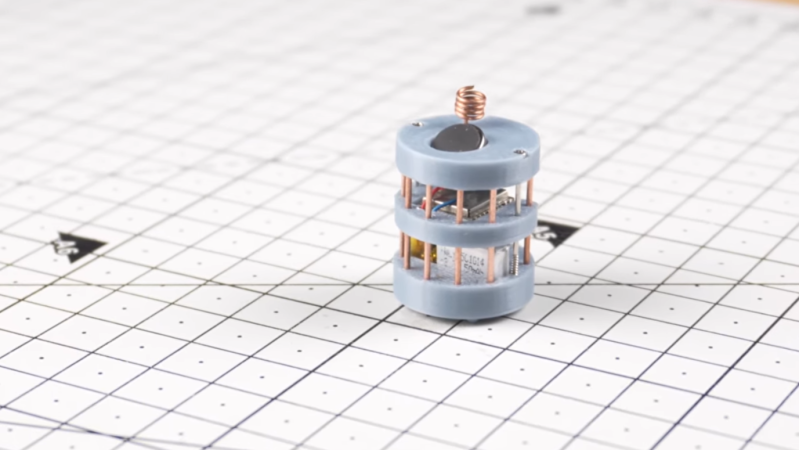
A cylindrical grey robot sits on a white mat. The robot is made of three grey sections connected by a series of radially-arranged copper pillars.

Controlling A Vibrobot With Only One Motor

The vibrobot – a vibrating motor and battery attached to the head of a brush – isn’t truly a robot, since its movement can’t be controlled, but it’s whetted the interest of many future roboticists. With a clever control method, though, it is in fact possible to drive them in any desired direction while using only one motor.

[Namaskar Mitro] based the design of this robot on this research paper; if the vibrating motor is mounted at an angle above the base of the robot, it causes the bot to rotate, and if the motor is mounted off-center from the center of mass, the robot moves in a circle. Crucially, reversing the direction of the motor’s rotation reverses the direction of the robot’s rotation. By rapidly switching the direction of rotation, the bot can move in a series of short, shallow arcs which approximate a straight line.

The robot which [Namaskar] built was based on an ESP-01F microcontroller, which let it be remote-controlled over Wi-Fi. It used a DRF8212 motor driver to control a vibrating pager motor, which was housed inside a 3D-printed enclosure. To move in a straight line, the ESP-01F switches the motor’s direction every 250 milliseconds, which still produces a slightly erratic movement. It can, however, approximately follow a traced path.

This adds to the previous vibrobot control methods we’ve seen: a pair of differentially-driven vibrating motors or a weight-shifting mechanism.

Thanks to [110y6] for the tip!

LiDAR Matrix Sensor Sees In 3D

[Mellow_Labs] picked up a few LiDAR matrix sensors and found them very exciting. While a normal time-of-flight sensor can accurately determine a range,  the matrix sensor is like an array of 64 sensors that can build a 2D map of distances from 2 cm to 3.5 m. [Mellow] wanted to add the sensor to his robot to help it see what was in front of it. You can see how it worked out in the video below.

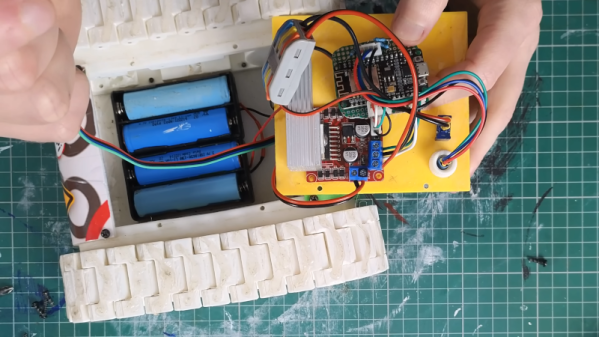
The robot in question is Zippy, a 3D printed tank-like robot with an ESP32. By default, the robot requires control inputs, but using the sensor will enable autonomous operation. For good or ill, the sensor mounted to Zippy was seeing the floor with about half of the rows. That means about 50% of the data went to waste. However, we think having a robot be able to see the floor in front of it might be a good thing.

[Mellow] used an LLM to write most of the code, so there were a number of iterations required to get things working. This required decimating even more of the data from the sensor. Still, pretty impressive.

Want to learn more about ToF sensors? Or if you want to focus on the practical, there’s code you can borrow.

Continue reading “LiDAR Matrix Sensor Sees In 3D”

The Dark Side Of Unitree Robot Dogs

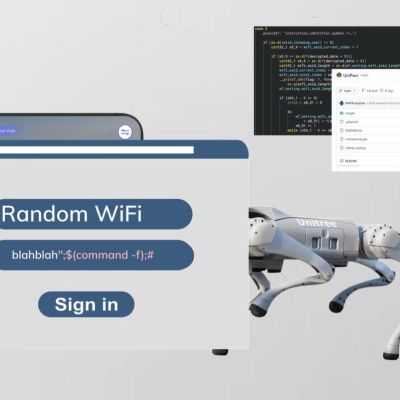
Arbitrary command execution with the Wi-Fi password. (Credit: Benn Jordan)

Continuing on his quest to expose the dark underbelly of modern technology, [Benn Jordan] recently did a deep-dive into the rise of so-called robot dogs. Although their most striking resemblance with biological dogs is that they also have four legs and generally follow commands, [Benn] found many issues with them that range from safety issues due to limited sensory capabilities, to basic security vulnerabilities, all the way to suspicious network traffic from Unitree’s robot dog firmware.

Although not the only seller of this type of quadruped robot, Unitree Robotics has made a name for itself by offering very capable and yet very cheap products. Their basic quadruped robot costs only a few thousand clams and features Lidar and heaps of processing power, all of which should make it a pretty useful device.

Despite this, [Benn] found that the original task that he’d envisioned for the robot, as in protecting his chickens from uninvited visitors, wouldn’t quite work as the robot is rather blind. The reason for this is the placement of the Lidar below the head, which obscures most of what’s behind and around the robot. Rather than risk trampled chickens and chicks, this plan was thus abandoned.

When digging further into the robot, he found an easy to exploit arbitrary command execution flaw via the Wi-Fi password entry field, a year-old CVE-2025-2894 exploit, as well as highly suspicious traffic to Chinese servers whenever the robot’s software figured that it was not being watched. It’s not just their dogs either: UniTree’s humanoid robots are also succeptible.

Although much of this can be circumvented with hacks, issues like the sensory limitations and general distrust of firmware updates makes using these robots a rather daunting and often ill-advised proposition.

Continue reading “The Dark Side Of Unitree Robot Dogs”