Building A WiFi Picture Frame With An EInk Display

LCD photo frames never really caught on — by emitting light, they didn’t seamlessly blend in with a home’s decor in the way printed photos do. [Sprite_tm] decided to see if a color e-Ink screen could do any better, and whipped up a WiFi-enabled photo frame using a Waveshare display.

The part in question is a 5.65-inch display with 640 x 448 resolution, and is capable of displaying seven colors. It’s not designed to display photorealistic images, so much as display simple graphics with block colors. However, with some dithering, [Sprite_tm] suspected it might do an okay job. An algorithm that uses Floyd-Steinberg diffusion and the CIEDE2000 color space takes regular RGB images and breaks them down into dithered images that are displayed using the screen’s 7 available colors.

The build relies on an ESP32-C3, which drives the display and fetches new images daily over WiFi. Thanks to the e-Ink screen, which uses zero power when not updating, the whole setup runs off two AA batteries and a Natlinear LN2266 boost converter.

There are some limitations; the screen’s color space is altogether quite limited, and images don’t look very high-fidelity in such low resolution. However, it does an able job of displaying photos for a device that was never designed to do so. It looks rather handsome all wrapped up as a 3D printed picture frame, and [Sprite_tm]’s monkey test photos are very cute.

Files are on GitHub for those that wish to roll their own. We’ve seen similar works before, like this e-Ink wall-hanging newspaper display that keeps up with the times. If you’ve got your own neat e-ink build, hit us up on the tipsline!

Sound Sculpture Uses Daisy Seed To Generate Audio

Here at Hackaday, we love a good art piece, whether that involves light or sound. Combining both is a sure-fire way to get our attention, and [Eirik Brandal] did just that with his Void Extrusion piece.

The project is built around the Daisy Seed from Electrosmith. It’s an embedded platform designed for musical purposes, which made it perfect for [Eirik]’s project. Based on an STM32 chip, it’s very capable when it comes to DSP tasks. In this role, it’s charged with algorithmic music composition, providing the captivating soundtrack that emanates from the sculpture.

The sculpture itself looks almost like a fancy mid-century home from the Hollywood Hills, but it’s fundamentally a little more abstract than that. [Eirik] built it as an opportunity to experiment with using 3D printed forms in his work. To that end, it features a beautiful diffused LED wall and a speaker enclosure as an integral part of the build. The LEDs are run from an Arduino Nano Every.

[Eirik’s] work shows us that “generative” music can be intoxicating and compelling with a real sense of feeling and mood. The sculpture is a visually-capable pairing that works with the soundscape. It recalls us of some other great artworks we’ve featured from [Eirik] before, too.

Continue reading “Sound Sculpture Uses Daisy Seed To Generate Audio”

Make Anything Clockwork With This Ridiculous Stick-On Device

Clockwork devices were popular right up until motors and electronics proved far more capable in just about every way. However, there’s something charming about a device you can wind up to make it do its thing. To recreate this feeling on modern technology, [Kousuke Saito] created a clockwork winder that you can fit to a wide variety of modern appliances. 

Somehow it just feels right.

The design is simple. It consists of a motor which is run from a battery. The two components are installed in a 3D printed housing with a magnet on the bottom. When the device is attached to a metal surface, a switch is activated which turns the motor on. The motor is attached to a large printed “winding key” that would be familiar to anyone who has used a clockwork toy or timepiece before. If the magnetic manner of activation is familiar, you might recall it from [Kousuke Saito’s] chirping cicada project.

It’s a silly build, to be sure. Regardless, when placed on certain appliances, like a simple fan, the motion really does imply that the clockwork winder is connected to the mechanism inside. It’s a falsehood, of course, but a joyous one.

We’ve featured some real clockwork hardware before, too, like these amazing time locks.

Continue reading “Make Anything Clockwork With This Ridiculous Stick-On Device”

CNC Intaglio-Esque Engraving

Intaglio is an ancient carving technique for adding details to a workpiece, by manually removing material from a surface with only basic hand tools. If enough material depth is removed, the resulting piece can be used as a stamp, as was the case with rings, used to stamp the wax seals of verified letters. [Nicolas Tranchant] works in the jewelry industry, and wondered if he could press a CNC engraving machine into service to engrave gemstones in a more time-efficient manner than the manual carving methods of old.

Engraving and machining generally work only if the tool you are using is mechanically harder than the material the workpiece is made from. In this case, this property is measured on the Mohs scale, which is a qualitative measurement of the ability of one (harder) material to scratch another. Diamond is the hardest known material on the Mohs scale and has a Mohs hardness of 10, so it can produce a scratch on the surface of say, Corundum — Mohs value 9 — but not the other way around.

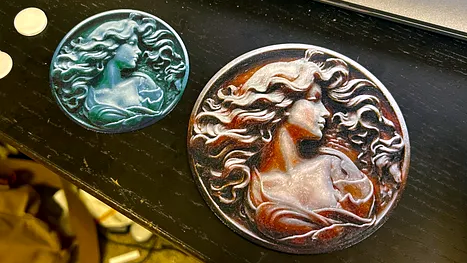
[Nicolas] shows the results of using a diamond tip equipped CNC engraver on various gemstones typical of Intaglio work, such as Black Onyx, Malachite, and Amethyst with some details of the number of engraving passes needed and visual comparison to the same material treated to traditional carving.

Let’s be clear here, the traditional intaglio process produces deep grooves on the surface of the workpiece and the results are different from this simple multi-pass engraving method — but limiting the CNC machine to purely metal engraving duties seemed a tad wasteful. Now if they can only get a suitable machine for deeper engraving, then custom digitally engraved intaglio style seal rings could be seeing a comeback!

Intaglio isn’t just about jewelry of course, the technique has been used in the typesetting industry for centuries. But to bring this back into ours, here’s a little something about making a simple printing press.

Modifying Artwork With Glaze To Interfere With Art Generating Algorithms

With the rise of machine-generated art we have also seen a major discussion begin about the ethics of using existing, human-made art to train these art models. Their defenders will often claim that the original art cannot be reproduced by the generator, but this is belied by the fact that one possible query to these generators is to produce art in the style of a specific artist. This is where feature extraction comes into play, and the Glaze tool as a potential obfuscation tool.

Developed by researchers at the University of Chicago, the theory behind this tool is covered in their preprint paper. The essential concept is that an artist can pick a target ‘cloak style’, which is used by Glaze to calculate specific perturbations which are added to the original image. These perturbations are not easily detected by the human eye, but will be picked up by the feature extraction algorithms of current machine-generated art models. Continue reading “Modifying Artwork With Glaze To Interfere With Art Generating Algorithms”

E-Paper Wall Paper

Just like the clock clock of old, there’s something magical about a giant wall of smaller pieces working together to make a larger version of that thing. The E-Paper Wall 2.0 by [Aaron Christophel] is no exception as it has now upgraded from 2.9″ to 7.4″ screens.

On the 1.0 version, the bezels made it harder to make out the image. The larger screens still have bezels but the larger screen area makes it much easier to make out the image. 3D-printed clips hold the displays onto a plywood backer. We can marvel that e-ink price tags brought the price of e-ink down so that building a wall is still expensive but not eye-wateringly so. The 5×9 array likely uses a module sold on DigiKey for $47 each.

So aside from being willing to drop some money on a custom piece of art, what’s special about this? The real magic comes with the firmware and tooling that [Aaron] developed to flash custom firmware onto each of the 45 displays. A 100MHz ZBS243/SEM9110 8051-based controller lives inside each display and [Aaron] even has a Ghidra plugin to reverse-engineer the existing firmware. It only has 64kb of flash onboard, so [Aaron] devised a clever compression technique that enabled him to store complex images on the displays. A 3D-printed jig with pogo pins means flashing them doesn’t require soldering pins or headers, just drop it on and flash it with an Arduino with a helpful library [Aaron] wrote. A central station communicates with the various displays over ZigBee to send image updates.

The 8051 has a funny way of showing up in projects like this portable soldering iron or the TV Guardian. In many ways, it is a boon for us hackers as it makes it easier to reverse engineer and write new custom firmware when so many devices use the same architecture.

Continue reading “E-Paper Wall Paper”

A Pi Calculating Pi For Pi Day

What is it about pi that we humans — at least some of us — find so endlessly fascinating? Maybe that’s just it — it’s endless, an eternal march of digits that tempts us with the thought that if we just calculate one more digit, something interesting will happen. Spoiler alert: it never does.

That doesn’t stop people from trying, of course, especially when “Pi Day” rolls around on March 14 every day  — with apologies to the DD/MM set, of course. This year, [Cristiano Monteiro] commemorated the day with this Pi-based eternal pi calculator. The heart of the build is a Raspberry Pi Pico board, which does double duty thanks to its two cores. One core is devoted to running the pi calculation routine, while the other takes care of updating the seven-segment LED display with the last eight calculated digits. Since the calculation takes increasingly more time the farther into pi it gets, [Cristiano] thoughtfully included a 1-Hz heartbeat indicator, to assure users that the display isn’t frozen; the video below shows how slow the display gets even just a few seconds after starting up, so it’s a welcome addition.

This is actually [Cristiano]’s second go at a Pi Day pi calculator; last year’s effort was a decidedly tactical breadboard build, and only supported a four-digit display. We applaud the upgrades, and if anyone wants to replicate the build, [Cristiano] has posted his code.

Continue reading “A Pi Calculating Pi For Pi Day”