Manufacturing Your Own Single-Origin Tea

It’s nice to take a break from hacking together the newest bleeding-edge technology, relax, and enjoy a beverage. It’s no surprise that hacks devoted to beer and coffee roasting are popular. We’ve also seen a few projects helping brew the perfect cup of tea, but none involving the actual production of tea. Today we’re going to take a short recess from modernity and explore this ancient tradition.

Consumption of tea is about equal to all other manufactured beverages, such as coffee and alcohol, combined. It is hands-down the most popular manufactured beverage in the world, and we thought it would be interesting to make some ourselves. Also the local tea is so bitter that it’s used to clean things, and it works alarmingly well. To each their own!

I started by driving into Vietnam’s Central Highlands, down what Google simply refers to as ‘unnamed road’, to about 11°52’59.3″N 108°33’49.5″E. I asked around until I found a street vendor that knew a farmer at the nearby tea plantation, and would sell us five kilograms of fresh tea. I carried it 330 kilometers back to the city, because I’m a sane person that does normal things.

Continue reading “Manufacturing Your Own Single-Origin Tea”

Pitmaster BBQ Dashboard Monitors Your Meat And Veggies

Barbecue is all about temperature, about making sure that whatever is on the grill reaches the right temperature. At least, that is the part that makes sure you don’t poison people, because your food should get hot enough to kill any bacteria. [Chris Aquino] decided to take this a step further than simply sticking a thermometer into a hunk of meat by creating Pitmaster. This combination of hardware and software monitors the temperature of multiple chunks of food and alerts you when each is ready, all through a web interface.

Continue reading “Pitmaster BBQ Dashboard Monitors Your Meat And Veggies”

PID Controlled Charcoal BBQ – Put An Arduino On It!

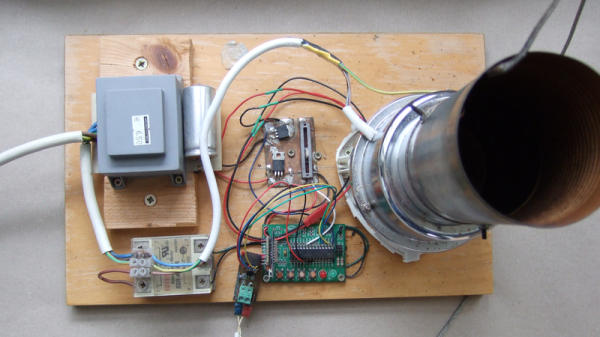
At Maker Faire Milwaukee this past weekend, [basement tech]  was showing off his latest build, a PID controlled charcoal grill. While it hasn’t QUITE been tested yet with real food, it does work in theory.

PID (a feedback loop with some fancy math used to adjust the input to get a consistent output) controlled cooking is commonly used for sous vide, where one heats up a water bath to a controlled temperature to cook food in plastic bags. Maintaining water temperature is fairly easy. Controlling a charcoal barbecue is much more difficult. [basement tech] accomplishes this with controlled venting and fans. With the charcoal hot and the lid on, there are two ways to control temperature; venting to let hot air out, and blowing air on the coals to make them hotter. A thermocouple sensor stuck through the grill gives the reading of the air inside, and an Arduino nearby reads that and adjusts the vents and fans accordingly.

The video goes into extensive detail on the project, and describes some of the challenges he had along the way, such as preventing the electronics and servos from melting.

Continue reading “PID Controlled Charcoal BBQ – Put An Arduino On It!”

A 3D-Printed Coffee Grinder

It’s safe to say that a Venn diagram of Hackaday readers and coffee drinkers would have significant intersection, many of you will be lovers of the bean. Some of you will be happy enough with a spoonful of instant granules and a bit of boiling water, but among your number there will undoubtedly be owners of significant quantities of coffee-related machinery and paraphernalia.

If your coffee enthusiasm extends to grinding your own direct from the bean, then [Christian Pederkoff]’s project should hit the mark, he’s created a rather neat 3D-printed coffee grinder. Sadly the creation of a steel burr and ring was beyond his 3D-printing capabilities so those parts come from a commercial grinder, but the housing, shaft coupler and hopper are all from his printer. Power is from a conveniently available source, he’s made use of an automotive windscreen wiper motor. The whole is a straightforward and easy-to-assemble unit that we think would sit well alongside many readers’ coffee making equipment.

If coffee projects are your thing, we have a few for your entertainment. Another not quite so neat enclosure for a coffee grinder, for example, or a tea-light-powered filter coffee machine for power cut beverage satisfaction.

DIY Mocha Cooker

Food-grade 3D printing filament is on the rise and it is nice to have a custom coffee mug in the office to instill a little envy in the locals. [Stefan] took it upon himself to create a Mocha Machine that he would 3D print and test the boundaries of his filament.

[Stefan] used Fusion 360 to replicate the famous Bialetti Moka Express pot in it true octagonal shape. Since the pot brews coffee under pressure, he tested tolerances in Fusion 360 to make sure all the thicknesses were right. While the design was being printed, a steel washer was added to facilitate induction heating since you can’t really put a plastic pot over a flame. The print uses Formfutura Volcano PLA which is annealed for an hour at 110 degrees Celsius.

Below is a video of the whole process and though the material may not be food grade, the project is definitely a step in the right direction. Since the printed parts can withstand temperatures of up to 160 degrees Celsius, projects that involve boiling water or experiments with crystallization can benefit from a custom design.

We really hope to see more projects that use this technique, however, for those looking at their coffee machine right now, take a look at more coffee machine hacks as well as alarm clock hacks to get the coffee brewing in the morning.

Thanks for the tip [Nils Hitze] Continue reading “DIY Mocha Cooker”

Listen To Your Fermentation To Monitor Its Progress

If you are a wine, beer, or cider maker, you’ll know the ritual of checking for fermentation. As the yeast does its work of turning sugar into alcohol, carbon dioxide bubbles froth on the surface of your developing brew, and if your fermentation container has an airlock, large bubbles pass through the water within it on a regular basis. Your ears become attuned to the regular “Plop… plop… plop” sound they make, and from their interval you can tell what stage you have reached.

[Chris] automated this listening for fermentation bubbles, placing a microphone next to his airlock and detecting amplitude spikes through two techniques: one using an FFT algorithm and the other a bandpass filter. Both techniques yielded similar graphs for fermentation activity over time.

He has a few ideas for improvement, but notes that his system is vulnerable to external noises. There is also an admission that using light to detect bubbles might be a more practical solution as we have shown you more than once with other projects, but as with so many projects on these pages, it is the joy of the tech as much as the practicality that matters.

Portable Stir-Fry Range

If you love a good stir-fry, you know that it can be a challenge to make on your stove at home. Engineer gourmet and Youtuber [Alex French Guy Cooking], in collaboration with [Make:], whipped up a portable range capable of making delectable stir-fry.

There are three major problems when it comes to cooking stir-fry: woks are typically unstable on normal burners, those burners don’t tend to heat from a center point out, and they usually aren’t hot enough. [Alex]’s 12,000BTU portable stove is great for regular applications, but doesn’t cut it when it comes to making an authentic stir-fry.

To focus the burner’s heat, he cut and bent a stainless steel baking ring into the shape of an exhaust nozzle — not unlike a jet engine — and lightly modified the range to accommodate the nozzle. He also added a larger baking ring with air flow holes for the wok to rest on. Two down, but there’s the issue of it not being hot enough.

So, why not use two butane canisters to double the output to 22,200 BTUs!

Continue reading “Portable Stir-Fry Range”