The Man Whose ‘Scopes We All Wanted To Own: Walter LeCroy

We’re sorry to say that back in May we missed the passing of Walter LeCroy, the man whose name appeared on some of the most desirable and higher-spec oscilloscopes to be found. If you’ve never used a LeCroy ‘scope then you’ll still have benefited from his work, as a pioneer of storage oscilloscopes even the more modest instruments which now grace our benches owe much to his legacy.

The linked article about his life comes from the successor to his company, and describes his early experience in scientific instrumentation and in particular in the field of high-energy physics,before the development of the first digital storage oscilloscopes. In particular it mentions the 1971 “Waveform Digitizer”,a device that used a transmission line and a series of sample-and-hold circuits to grab and digitize a sequence of readings with a single ADC. It goes on to describe the model 9400 series from the 1980s which with its successors are probably are what come to mind for many of us when thinking of a LeCroy ‘scope, the familiar big square box with integrated computer-style CRT, floppy drive, and small printer.

Here in 2023 it’s not beyond the bounds of possibility to design your own digital oscilloscope simply by pairing a fast microcontroller with an appropriately expensive ADC chip. To look back at the effort required to produce one with a high bandwidth using 16-bit microcomputer parts and 1980s silicon is to be reminded that we stand upon the shoulders of giants.

Thanks [Daniel Valuch] for the tip.

Warmer Ice Cream?

What if you could tweak the recipe on ice cream to keep it frozen at higher temperatures? The idea comes from massive conglomerate Unilever. Among other things, the brand owns a wide variety of ice cream brands, from Ben & Jerry’s to the Magnum and Cornetto lines. Instead of running freezers at the industry standard of -18 °C (0°F), the company is experimenting with upping the temperature to -12 °C (10 °F) instead.

First off, you’d save a lot of electricity. Thanks to the way the industry works, the company actually owns the vast majority of the three million or so display freezers that are used to sell its stock to customers. Running at a higher temperature could slash the freezer’s energy use by 20% to 30%, according to the company’s calculations. The company also estimates that the energy used by these freezers makes up around 10% of its total greenhouse gas footprint, so it’s better for the environment too.

Of course, there’s savvy commercial reasons behind the idea. Unilever had noticed its ice cream sales dropping in 2022. The company believes this was in part due to retailers unplugging their freezers earlier than usual as winter approached, due to high energy bills. If the company’s freezers aren’t humming, they’re doing less business. If shaving down the freezer’s energy use helps retailers keep them plugged in and the lights on, that’s a net bonus to the company’s bottom line. It could also make their freezers unhospitable places for rival products, giving them an edge in the marketplace.

But this is all business intrigue. Let’s instead take a deeper look at ice cream.

Continue reading “Warmer Ice Cream?”

The Label Says HDMI 2.1 But That Doesn’t Mean You’ll Get It

Technology moves quickly these days as consumers continue to demand more data and more pixels. We see regular updates to standards for USB and RAM continually coming down the pipeline as the quest for greater performance goes on.

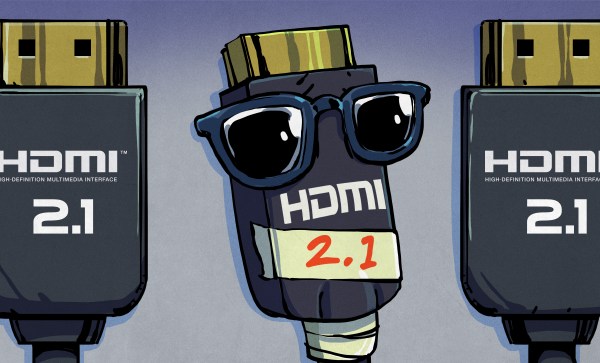
HDMI 2.1 is the latest version of the popular audio-visual interface, and promises a raft of new features and greater performance than preceding versions of the standard. As it turns out, though, buying a new monitor or TV with an HDMI 2.1 logo on the box doesn’t mean you’ll get any of those new features, as discovered by TFT Central.

Continue reading “The Label Says HDMI 2.1 But That Doesn’t Mean You’ll Get It”

Hyperloop: Fast, But At What Cost?

When it comes to travelling long distances, Americans tend to rely on planes, while the Chinese and Europeans love their high speed rail. However, a new technology promises greater speed with lower fares, with fancy pods travelling in large tubes held at near-vacuum pressures. It goes by the name of Hyperloop.

Virgin Hyperloop recently ran the first-ever passenger test of a Hyperloop vehicle, reaching 100 mph on a short test track.

Spawned from an “alpha paper” put together by Elon Musk in 2013, the technology is similar to other vactrain systems proposed in the past. Claiming potential top speeds of up to 760 mph, Hyperloop has been touted as a new high-speed solution for inter city travel, beating planes and high speed rail for travel time. Various groups have sprung up around the world to propose potential routes and develop the technology. Virgin Hyperloop are one of the companies at the forefront, being the first to run a pod on their test track with live human passengers, reaching speeds of 100 mph over a short 500 meter run.

It’s an exciting technology with a futuristic bent, but to hit the big time, it needs to beat out all comers on price and practicality. Let’s take a look at how it breaks down.

Continue reading “Hyperloop: Fast, But At What Cost?”

Nvidia Acquires ARM For $40 Billion

Nvidia announced on Sunday evening that it has reached an agreement to acquire Arm Limited from SoftBank for a cool $40 billion.

In this age of headlines that use the b-word in place of nine zeros it’s easy to lose track, so you may be wondering, didn’t SoftBank just buy Arm? That was all the way back in July of 2016 to the tune of $32 billion. SoftBank is a holding company, so that deal didn’t ruffle any feathers, but this week’s move by Nvidia might.

Arm Limited is the company behind the ARM architecture, but they don’t actually produce the chips themselves, instead licensing them to other companies who pay a fee to use the core design and build their own chip around it. Nvidia licenses the ARM core for some of their chips, and with this deal they will be in a position to set terms for how their competitors may license the ARM core. The deal still needs regulatory approval so time will tell if this becomes a kink in the acquisition plan.

There’s a good chance that you’re reading this article on a device that contains an ARM processor because of its dominance in the smartphone and tablet market. Although less common in the laptop market, and nearly unheard of in the desktop market, the tide may be changing as Apple announced early in the summer that their Mac line will be moving to ARM.

Chances are you know the Nvidia name for their role as purveyors of fine graphics cards. They got a major boost as the world ramped up Bitcoin and other cryptocurrency mining hardware which early on was mainly based on the heavy lifting of graphics processors. But the company also has their eye on the ongoing wave of hardware targeting AI applications like computer vision. Nvidia’s line of Jetson boards, marketed for “next-generation autonomous machines”, all feature ARM cores.

Assuming the deal goes through without a hitch, what will be the fallout? Your guess is as good ours. There is certainly a conflict of interest in a company who competes in the ARM market owning the Arm. But it’s impossible to say what efforts they will make to firewall those parts of the business. Some might predict a mass exodus from the ARM ecosystem in favor of an open standard like RISC-V, but that is unlikely in the near-term. Momentum is difficult to overcome — look at how long it took ARM to climb that mountain and it was primarily the advent of a new mobile ecosystem lacking an established dominant player that let ARM thrive.

Lattice Drops EULA Clause Forbidding FPGA Bitstream Reverse Engineering

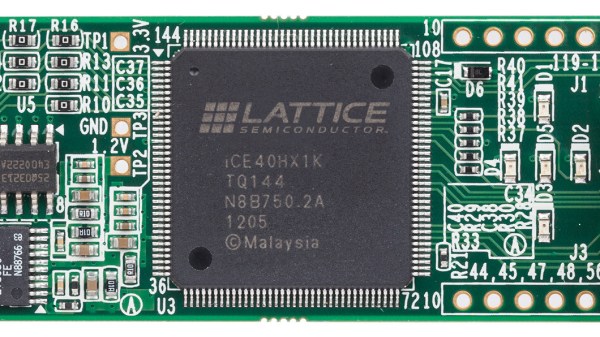
Yesterday we reported that Lattice Semiconductor had inserted a clause that restricted the reverse engineering of bitstreams produced by their FPGA toolchains. Although not explicitly stated, it’s assumed that this was directed toward several projects over the past five years that have created fully open source toolchains by reverse engineering the bitstream protocols of the Lattice ICE40 and ECP5 FPGA architectures. Late yesterday Lattice made an announcement reversing course.

To the open source community, thank-you for pointing out a new bitstream usage restriction in the Lattice Propel license. We are excited about the community’s engagement with Lattice devices and our intent is to not hinder the creation of innovative open source FPGA tools.

It’s refreshing then to see this announcement from Lattice Semiconductor. Even more so is the unexpected turn of speed with which they have done so, within a couple of days of it being discovered by the open-source community. We report depressingly often on boneheaded legal moves from corporations intent on curbing open source uses of their products. This announcement from Lattice removes what was an admonition opposing open source toolchains, can we hope that the company will continue yesterday’s gesture and build a more lasting relationship with the open source community?

The underlying point to this story is that in the world of electronics there has long been an understanding that hardware hackers drive product innovation which will later lead to more sales. Texas Instruments would for years supply samples of exotic semiconductors to impecunious students for one example, and maybe you have a base-model Rigol oscilloscope with a tacitly-approved software hack that gives it an extra 50MHz of bandwidth for another.

We can only congratulate Lattice on their recognition that open source use of their products is beneficial for them, and wish that some of the other companies triggering similar stories would see the world in the same way. Try interacting more with your open source fans; they know and love your hardware more than the average user and embracing that could mean a windfall for you down the road.

Lattice Semiconductor Targets Bitstream Reverse Engineering In Latest Propel SDK License

The topic of reverse engineering is highly contentious at best when it comes to software and hardware development. Ever since the configuration protocol (bitstream) for Lattice Semiconductor’s iCE40 FPGAs was published in 2015 through reverse engineering efforts, there has been a silent war between proponents of open bitstream protocols and FPGA manufacturers, with the Lattice ECP5’s bitstream format having been largely reverse-engineered at this point.

Update: About eight hours after this article was published, Lattice Semiconductor issued a statement retracting the EULA language that banned bitstream reverse engineering. Please check out Hackaday’s article about this reversal.

Most recently, it appears that Lattice has fired a fresh shot across the bow of the open source projects. A recently discovered addition to the Propel SDK, which contains tools to program and debug Lattice devices, specifically references bitstream reverse engineering. When logged in with an account on the company’s website the user must agree to the Lattice Propel License Agreement for Lattice Propel 1.0 prior to download. That document includes the following language:

In particular, no right is granted hereunder […] (3) for reverse engineering a bitstream format or other signaling protocol of any Lattice Semiconductor Corporation programmable logic device.

Continue reading “Lattice Semiconductor Targets Bitstream Reverse Engineering In Latest Propel SDK License”