Blend Your Last Frogs. Google Turns A Blind Eye To Flash.

Google has announced that it will no longer index Flash files.

Journey with me to a time in a faraway internet; a time before we had monetized social media. A time when the page you shared with your friends was your page and not a page on someone’s network. Way back when Visual Basic was what Python is now and JavaScript was a hack mostly used for cool effects. A hero arose. Macromedia Flash opened the gates to the interactive web, and for a chunk of time it consumed more than a decent portion of humanity’s attention and artistic output.

Computer art was growing, but was it public? How many grandmothers would see a demo?

New grounds were paved and anyone who wanted to become an animator or a web designer could manage it in a few tutorials. Only a few years before Flash took off, people had started talking about computers as a source for art in mostly theoretical terms. There were demoscenes, university studies, and professional communities, of course, but were they truly public? Suddenly Flash made computer art an everyday thing. How could computers not be used for art? In schools and offices all over the world people of varying technical skill would get links to games, animation, and clever sites sent by their friends and colleagues.

For 23 years Flash has had this incredible creative legacy. Yet it’s not perfect by any means. It’s a constant headache for our friendly neighborhood super-conglomerates. Apple hates how it drains the battery on their mobile devices, and that it’s a little village outside of their walled garden. Microsoft sees it as another endless security violation. They all saw it as a competitor product eating their proprietary code bases. Continue reading “Blend Your Last Frogs. Google Turns A Blind Eye To Flash.”

Qantas’ Research Flight Travels 115% Of Range With Undercrowded Cabin

Long-haul flights can be a real pain when you’re trying to get around the world. Typically, they’re achieved by including a stop along the way, with the layover forcing passengers to deplane and kill time before continuing the flight. As planes have improved over the years, airlines have begun to introduce more direct flights where possible, negating this frustration.

Australian flag carrier Qantas are at the forefront of this push, recently attempting a direct flight from New York to Sydney. This required careful planning and preparation, and the research flight is intended to be a trial run ahead of future commercial operations. How did they keep the plane — and the passengers — in the air for this extremely long haul? The short answer is that they cheated with no cargo and by pampering their 85% empty passenger cabin. Yet they plan to leverage what they learn to begin operating 10,000+ mile non-stop passenger flights — besting the current record by 10% — as soon as four years from now.
Continue reading “Qantas’ Research Flight Travels 115% Of Range With Undercrowded Cabin”

The Murky Business Of Stopping Oil Spills

Six years before Deepwater Horizon exploded in April 2010, the force of Hurricane Ivan blew an offshore drilling platform off its legs and into the Gulf of Mexico. For the last 14 years, that well’s pipes, long buried in mud and debris have been spilling oil into the Gulf every single day. That makes it the longest-running spill in history. Every day for fourteen years. Let that sink in for a bit.

Taylor Energy’s platform sat just 10 miles off the coast, much closer to the Louisiana shore than Deepwater Horizon was. Since the hurricane hit, Taylor has tried a number of unsuccessful things to stop the spill. They’ve only been able to plug 9 of the 25 broken pipes so far. The rest are buried deep in mud and debris. Why on Earth haven’t you heard about this before? Taylor spent six years covering it up. And they might have gotten away with it, too, if it weren’t for pesky watchdog groups surveying the Gulf after Deepwater Horizon exploded.

So how are oil spills stopped, anyway? The answer depends on many things. Most immediately, the answer depends whether the spill happened onshore or offshore, and the inciting incident that caused the spill. Underwater oil spills are much more difficult to stop because of the weight and existence of the ocean. In Taylor Energy’s case, the muddy Gulf bed has become a murky tomb for the broken and buried pipes, which makes it even more messy.

Continue reading “The Murky Business Of Stopping Oil Spills”

How Smart Are AI Chips, Really?

The best part about the term “Artificial Intelligence” is that nobody can really tell you what it exactly means. The main reason for this stems from the term “intelligence”, with definitions ranging from the ability to practice logical reasoning to the ability to perform cognitive tasks or dream up symphonies. When it comes to human intelligence, properties such as self-awareness, complex cognitive feats, and the ability to plan and motivate oneself are generally considered to be defining features. But frankly, what is and isn’t “intelligence” is open to debate.

What isn’t open to debate is that AI is a marketing goldmine. The vagueness has allowed for marketing departments around the world to go all AI-happy, declaring that their product is AI-enabled and insisting that their speech assistant responds ‘intelligently’ to one’s queries. One might begin to believe that we’re on the cusp of a fantastic future inhabited by androids and strong AIs attending to our every whim.

In this article we’ll be looking at the reality behind these claims and ponder humanity’s progress towards becoming a Type I civilization. But this is Hackaday, so we’re also going to dig into the guts of some AI chips, including the Kendryte K210 and see how the hardware of today fits into our Glorious Future. Continue reading “How Smart Are AI Chips, Really?”

5G Is For Robots

Ecclesiastes 1:9 reads “What has been will be again, what has done will be done again; there is nothing new under the sun.” Or in other words, 5G is mostly marketing nonsense; like 4G, 3G, and 2G was before it. Let’s not forget LTE, 4G LTE, Advance 4G, and Edge.

Just a normal everyday antenna array in a Seattle parking garage.

Technically, 5G means that providers could, if they wanted to, install some EHF antennas; the same kind we’ve been using forever to do point to point microwave internet in cities. These frequencies are too lazy to pass through a wall, so we’d have to install these antennas in a grid at ground level. The promised result is that we’ll all get slightly lower latency tiered internet connections that won’t live up to the hype at all. From a customer perspective, about the only thing it will do is let us hit the 8Gb ceiling twice as faster on our “unlimited” plans before they throttle us. It might be nice on a laptop, but it would be a historically ridiculous assumption that Verizon is going to let us tether devices to their shiny new network without charging us a million Yen for the privilege.

So, what’s the deal? From a practical standpoint we’ve already maxed out what a phone needs. For example, here’s a dirty secret of the phone world: you can’t tell the difference between 1080p and 720p video on a tiny screen. I know of more than one company where the 1080p on their app really means 640 or 720 displayed on the device and 1080p is recorded on the cloud somewhere for download. Not a single user has noticed or complained. Oh, maybe if you’re looking hard you can feel that one picture is sharper than the other, but past that what are you doing? Likewise, what’s the point of 60fps 8k video on a phone? Or even a laptop for that matter?

Are we really going to max out a mobile webpage? Since our device’s ability to present information exceeds our ability to process it, is there a theoretical maximum to the size of an app? Even if we had Gbit internet to every phone in the world, from a user standpoint it would be a marginal improvement at best. Unless you’re a professional mobile game player (is that a thing yet?) latency is meaningless to you. The buffer buffs the experience until it shines.

So why should we care about billion dollar corporations racing to have the best network for sending low resolution advertising gifs to our disctracto cubes? Because 5G is for robots.

Continue reading “5G Is For Robots”

Hacking Mars: InSight Mole Is On The Move Again

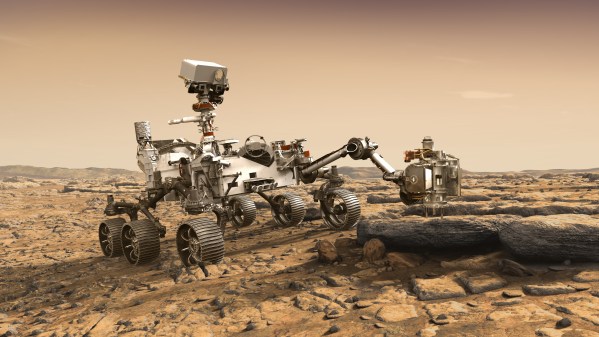
Your job might be tough, but spare a thought for any of the engineers involved in the Mars InSight lander mission when they learned that one of the flagship instruments aboard the lander, indeed the very instrument for which the entire mission was named, appeared to be a dud. That’s a bad day at work by anyone’s standards, and it happened over the summer when it was reported that the Mars Interior Exploration using Seismic Investigations, Geodesy and Heat Transport lander’s Heat Flow and Physical Properties Package (HP³), commonly known as “The Mole”, was not drilling itself into the Martian regolith as planned.

But now, after months of brainstorming and painstaking testing on Earth and on Mars, it looks as if the mole is working again. NASA has announced that, with a little help from the lander’s backhoe bucket, the HP³ penetrator has dug itself 2 cm into the soil. It’s a far cry from the 5-meter planned depth for its heat-transfer experiments, but it’s progress, and the clever hack that got the probe that far might just go on to salvage a huge chunk of the science planned for the $828 million program.

Continue reading “Hacking Mars: InSight Mole Is On The Move Again”

Developing Guidelines For Sustainable Spaceflight

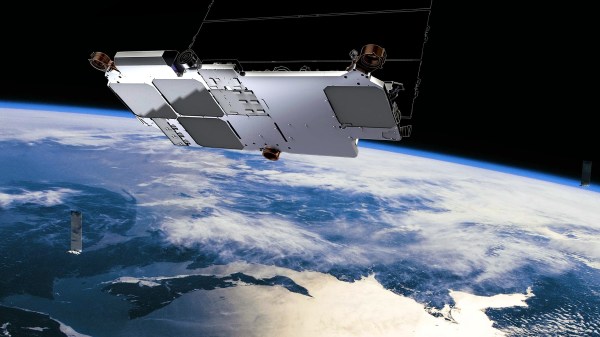
In the early days of spaceflight, when only the governments of the United States and the Soviet Union had the ability to put an object into orbit, even the most fanciful of futurists would have had a hard time believing that commercial entities would one day be launching sixty satellites at a time. What once seemed like an infinite expanse above our heads is now starting to look quite a bit smaller, and it’s only going to get more crowded as time goes on. SpaceX is gearing up to launch nearly 12,000 individual satellites for their Starlink network by the mid-2020s, and that’s just one of the “mega constellations” currently in the works.

Just some of the objects in orbit around the Earth

It might seem like overcrowding of Earth orbit is a concern for the distant future, but one needs only look at recent events to see the first hints of trouble. On September 2nd, the European Space Agency announced that one of its research spacecraft had to perform an evasive maneuver due to a higher than acceptable risk of colliding with one of the first-generation Starlink satellites. Just two weeks later, Bigelow Aerospace were informed by the United States Air Force that there was a 1 in 20 chance that a defunct Russian Cosmos 1300 satellite would strike their Genesis II space station prototype.

A collision between two satellites in orbit is almost certain to be catastrophic, ending with both spacecraft either completely destroyed or severely damaged. But in the worst case, the relative velocity between the vehicles can be so great that the impact generates thousands of individual fragments. The resulting cloud of shrapnel can circle the Earth for years or even decades, threatening to tear apart any spacecraft unlucky enough to pass by.

Fortunately avoiding these collisions shouldn’t be difficult, assuming everyone can get on the same page before it’s too late. The recently formed Space Safety Coalition (SSC) is made up of more than twenty aerospace companies that realize the importance of taking proactive steps to ensure humanity retains the unfettered access to outer space by establishing some common “Rules of the Road” for future spacecraft.

Continue reading “Developing Guidelines For Sustainable Spaceflight”