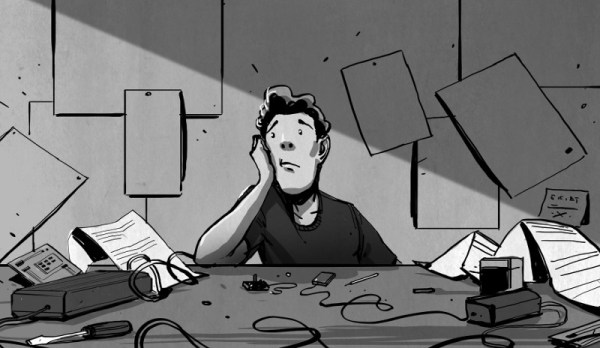
My basement workshop is so crammed full of stuff I literally can’t use it. My workbench, a sturdy hardwood library table, is covered in junk to the point that I couldn’t find a square foot that didn’t have two layers of detritus on it — the top layer is big things like old projects that no longer work, boxes of stuff, fragile but light things perched on top. Underneath is the magma of bent resistors, snippets of LED strip, #4 screws, mystery fasteners I’ll never use, purple circuit boards from old versions of projects, and a surprising number of SparkFun and Adafruit breakouts that have filtered down from higher up in the heap.
When work on something I bring the parts up to the dining room and work on the table, which is great for many reasons — more space, better light, and superior noms access top the list. The down side is that I don’t devote any time to making my real shop into a viable working place, and it becomes a cluttered store room by default.
I am therefore focusing on a four-part plan to reclaim my work space from heaps of junk.
In 1978, Tim Jenkin was a man living on borrowed time, and he knew it. A white South African in his late 20s, he had been born into the apartheid system of brutally enforced racial segregation. By his own admission, he didn’t even realize in his youth that apartheid existed — it was just a part of his world. But while traveling abroad in the early 1970s he began to see the injustice of the South African political system, and spurred on by what he learned, he became an activist in the anti-apartheid underground.
Intent on righting the wrongs he saw in his homeland, he embarked on a year of training in London. He returned to South Africa as a propaganda agent with the mission to spread anti-apartheid news and information to black South Africans. His group’s distribution method of choice was a leaflet bomb, which used a small explosive charge to disperse African National Congress propaganda in public places. Given that the ANC was a banned organization, and that they were setting off explosives in a public place, even though they only had a few grams of gunpowder, it was inevitable that Jenkin would be caught. He and cohort Steven Lee were arrested, tried and convicted; Jenkin was sentenced to 12 years in prison, while Lee got eight.
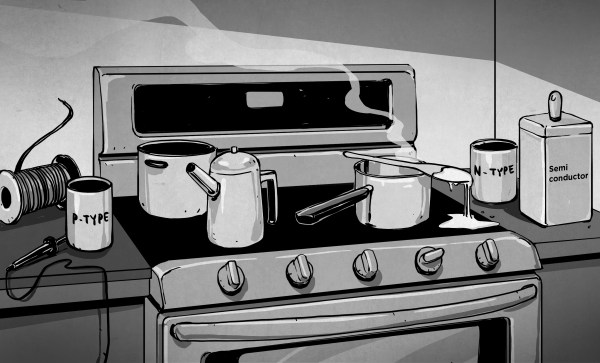
As the saying goes, hindsight is 20/20. It may surprise you that the microchip that we all know and love today was far from an obvious idea. Some of the paths that were being explored back then to cram more components into a smaller area seem odd now. But who hasn’t experienced hindsight of that sort, even on our own bench tops.
Let’s start the story of the microchip like any good engineering challenge should be started, by diving into the problem that existed at the time with the skyrocketing complexity of computing machines.
We live in an electromagnetic soup, bombarded by wavelengths from DC to daylight and beyond. A lot of it is of our own making, especially further up the spectrum where wavelengths are short enough for the bandwidth needed for things like WiFi and cell phones. But long before humans figured out how to make their own electromagnetic ripples, the Earth was singing songs at the low end of the spectrum. The very low frequency (VLF) band abounds with interesting natural emissions, and listening to these Earth sounds can be quite a treat.
In an era where we can watch rockets land on their tails Buck Rogers-style live on YouTube, it’s difficult to imagine a time when even the most basic concepts of rocketry were hotly debated. At the time, many argued that the very concept of a liquid fueled rocket was impossible, and that any work towards designing practical rocket powered vehicles was a waste of time and money. Manned spacecraft, satellite communications, to say nothing of landing on other worlds; all considered nothing more than entertainment for children or particularly fanciful adults.
Walter Dornberger (Bundesarchiv, Bild 146-1980-009-33 / CC-BY-SA 3.0)
This is the world in which V-2, written by the head of the German rocket development program Walter Dornberger, takes place. The entire history of the A-4/V-2 rocket program is laid out in this book, from the very early days when Dornberger and his team were launching rockets with little more than matches, all the way up to Germany’s frantic attempts to mobilize the still incomplete V-2 rocket in face of increasingly certain defeat at the end of World War II.
For those fascinated with early space exploration and the development of the V-2 rocket like myself, this book is essentially unparalleled. It’s written completely in the first person, through Dornberger’s own eyes, and reads in most places like a personal tour of his rocket development site at the Peenemünde Army Research Center. Dornberger walks through the laboratories and factories of Peenemünde, describing the research being done and the engineers at work in a personal detail that you simply don’t get anywhere else.
But this book is not only a personal account of how the world’s first man-made object to reach space was created, it’s also a realistic case study of how engineers and the management that pays the bills often clash with disastrous results. Dornberger and his team wanted to create a vehicle to someday allow man to reach space, while the Nazi government had a much more nefarious and immediate goal. But this isn’t a book about the war — the only battles you’ll read about in V-2 take place in meeting rooms, where the engineers who understood the immense difficulty of their task tried in vain to explain why the timetables and production numbers the German military wanted simply couldn’t be met.
Bill Shockley brought the transistor to a pasture in Palo Alto, but he didn’t land there by chance. There was already a plot afoot which had nothing to do with silicon, and it had already been a happening place for some time by then.
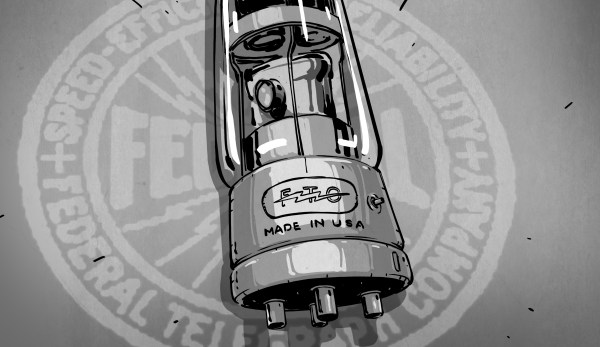
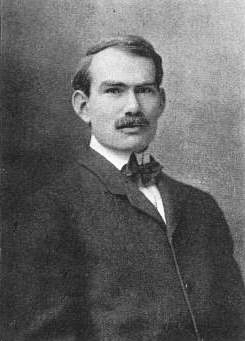
Often overshadowed by Edison and Menlo Park or Western Electric and its Bell Labs, people forget that the practical beginning of modern radio and telecommunications began unsuspectingly in the Bay Area on the shoestring-budgeted work benches of Lee de Forest at Federal Telegraph.
As the first decade of the 20th century passed, Lee de Forest was already a controversial figure. He had founded a company in New York to develop his early vacuum tubes as detectors for radio, but he was not very good at business. Some of the officers of the company decided that progress was not being made fast enough and drained the company of assets while de Forest was away. This led to years of legal troubles and the arrest of many involved due to fraud and loss of investors’ money.
There’s a time in every geek’s development when they learn of Conway’s Game of Life. This is usually followed by an afternoon spent on discovering that the standard rule set has been chosen because most of the others just don’t do interesting things, and that every idea you have has already been implemented. Often enough this episode is then remembered as ‘having learned about cellular automata’ (CA). While important, the Game of Life is not the only CA out there and it’s not even the first. The story starts decades before Life’s publication in 1970 in a place where a lot of science happened at that time: the year is 1943, the place is Los Alamos in New Mexico and the name is John von Neumann.
The ‘cellular’ part in the name comes from the fact that CAs represent a grid of cells that can be in a number of defined states. The grid can have any number of dimensions, but with three dimensions the visual representation starts to get into the way, and above that most human brains stop working, so two-dimensional grids are the most common — with the occasional one-dimensional surprise. The cells’ states are in most cases discrete but a subset of continuous CAs exists. During the operation of a CA the future state of every cell in the grid is determined from each cells state according to a set of rules which in most cases take into account the states of neighboring cells.