Remote Driving Controversial In UK, But It’s Already Here

The automotive industry is rushing towards autonomous vehicles as a futuristic ideal. They haven’t got the autonomous part sorted just yet. However, as part of this push, the technology to drive vehicles remotely via video link has become mature.

In the United Kingdom, there has been great controversy on whether this should be allowed, particularly for vehicles piloted by individuals outside the country’s borders. That came to a head with a Law Commission repot published earlier this year, but since then, innovative companies have continued to work on remote driving regardless. Let’s dive in to the current state of play.

Continue reading “Remote Driving Controversial In UK, But It’s Already Here” →

Know Snow: Monitoring Snowpack With The SNOTEL Network

With summer just underway here in North America, it may seem like a strange time to talk about snow. But when you live in North Idaho, winter is never very far away and is always very much on everyone’s mind. Our summers are fierce but all too brief, so starting around September, most of us begin to cast a wary eye at the peaks of the Bitterroot range in the mornings, looking for the first signs of snow. And in the late spring, we do much the same, except longingly looking for the first signs that the snowpack is finally breaking up.

We all know how important snow is, of course. Snow is our lifeline, nearly the only source of drinking water we have here, as well as the foundation of our outdoor recreation industries. We also know that the snowpack determines our risk for wildfires, so while the long, dark winters may take a psychological toll, the longer the snow stays on the mountains, the less chance we have of burning come summer.

These are all very subjective measures, though, and there’s way too much riding on the snowpack to leave it up to casual observation. To make things more quantitative, the US Department of Agriculture’s Natural Resources Conservation Service (NRCS) has built a system across the western US that measures the snowpack in real-time, and provides invaluable data to climatologists, fish and game managers, farmers, and even the recreation industry, all of whom have a vested interest in the water held within. The network is called SNOTEL, and I recently got a chance to take a field trip with a hydrologist and get an up-close look at how it works.

Continue reading “Know Snow: Monitoring Snowpack With The SNOTEL Network” →

Earth’s Final Frontier: Exploring The Alien Depths Of The Earth’s Oceans

Despite how hostile to life some parts of the Earth’s continents are, humanity has enthusiastically endeavored over the course of millennia to establish at least a toehold on each of them. Yet humanity has barely ventured beyond the surface of the oceans which cover around three-quarters of the planet, with human activity in these bodies of water dropping off quickly along with the fading of light from the surface.

Effectively, this means for all intents and purposes we have to this day not explored the vast majority of the Earth’s surface, due to over 70% of it being covered by water. As an ocean planet, much of Earth’s surface is covered by watery depths of multiple kilometers, with each 10 meters of water increasing the pressure by one atmosphere (1.013 bar), so that at a depth of one kilometer we’re talking about an intense 101 atmospheres.

Over the past decades, the 1985 discovery of Titanic’s wreck approximately 3.8 kilometer below the surface of the Atlantic, the two year long search for AF447’s black boxes, and the fruitless search for the wreckage of MH370 despite washed-up remnants have served as stark reminders of just how alien and how hostile the depths of the Earth’s oceans are. Yet with both tourism and mining efforts booming, will we one day conquer the full surface of Earth?

Continue reading “Earth’s Final Frontier: Exploring The Alien Depths Of The Earth’s Oceans” →

Luxury Train Cars Used To Ride On Paper Wheels

Early on, railways primarily used wheels made of wood or iron. The former were cheap and relatively easy to manufacture, while the latter had far superior wear qualities. It may surprise you to learn, however, that some railways once used wheels made out of paper, as [Train of Thought] explains.

The wheels were pioneered by a man known as Richard N. Allen, in the 19th century. The wheels were constructed by layering up hundreds of sheets of paper with glue, compacting them with a press, and allowing them to cure for a few weeks. The solid paper disks were then machined to size, and were drilled to accept bolts that attached metal plates for protection. The wheels were given a cast-iron hub and a steel rim for wear reasons.

The benefit of the wheels was that their composite paper construction helped damp vibrations and noise from the wheels and rails. The North American Pullman railway ended up using the wheels for sleeper and dining carriages for the more luxurious ride they provided.

The paper wheels were short lived, however. While the wheels were up to the task when new, they would fail much sooner than solid metal wheels. A series of derailments led to the wheels being declared unsafe for use in the US by 1915.

The wheels serve as a good example of wheels and tires acting as a tuned part of a whole suspension system. Experimental wheel designs come and go, but there are reasons why we landed on certain designs for certain applications, after all. Video after the break.

Continue reading “Luxury Train Cars Used To Ride On Paper Wheels” →

Wind-to-Heat: A Lot Of Hot Air?

Heating is one of the greatest uses of energy in human society today. Where we once burned logs to stave off the brutal winter chill, now we lean on gas and electricity to warm our homes and keep us safe and toasty. In some colder climates, like the UK, heating can make up 60-80% of total domestic energy demands.

However, there are alternative ways to provide heating. Using wind energy to directly provide heat could be key in this area, using a variety of interesting methods that could have some unique niche applications.

Continue reading “Wind-to-Heat: A Lot Of Hot Air?” →

Meshtastic For The Greater Good

Last week, my city was hit by a tornado. That’s not surprising here in Oklahoma, and thankfully this event was an F0 or possibly even an EF0 — a really weak tornado. Only a couple roofs collapsed, though probably half the houses in town are going to need roof repairs, thanks to the combination of huge hail and high winds. While it wasn’t too bad, power did go down in a few places around town, and this led to an interesting series of events.

Chat messages were coming in like this: “That was a [power] flicker, yeah. Even took down my Internet.” Followed by “Whee, [fiber Internet] got knocked out and now Starlink has too many clouds in the way.” And after ten minutes of silence, we got a bit worried to see “Time to hide under a bed. … Is cell service back?” It is a bit spooky to think about trying to help neighbors and friends after a disaster, in the midst of the communication breakdown that often follows. If he had needed help, and had no working communications, how long would it have taken for us to go check on him?
Continue reading “Meshtastic For The Greater Good” →

Et Tu, Red Hat?

Something odd happened to git.centos.org last week. That’s the repository where Red Hat has traditionally published the source code to everything that’s a part of Red Hat Enterprise Linux (RHEL) to fulfill the requirements of the GPL license. Last week, those packages just stopped flowing. Updates weren’t being published. And finally, Red Hat has published a clear answer to why:

Red Hat has decided to continue to use the Customer Portal to share source code with our partners and customers, while treating CentOS Stream as the venue for collaboration with the community.

Sounds innocuous, but what’s really going on here? Let’s have a look at the Red Hat family: RHEL, CentOS, and Fedora.

RHEL is the enterprise Linux distribution that is Red Hat’s bread and butter. Fedora is RHEL’s upstream distribution, where changes happen fast and things occasionally break. CentOS started off as a community repackaging of RHEL, as allowed under the GPL and other Open Source licenses, for people who liked the stability but didn’t need the software support that you’re paying for when you buy RHEL.

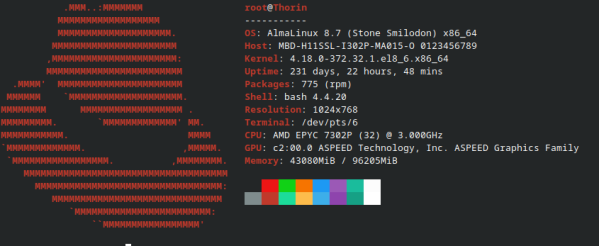
Red Hat took over the reigns of CentOS back in 2014, and then imposed the transition to CentOS Stream in 2020, to some consternation. This placed CentOS Stream between the upstream Fedora, and the downstream RHEL. Some people missed the stability of the old CentOS, and in response a handful of efforts spun up to fill the gap, like Alma Linux and Rocky Linux. These projects took the source from git.centos.org, and rebuilt them into usable community operating systems, staying closer to RHEL in the process.

Red Hat has published a longer statement elaborating on the growth of CentOS Stream, but it ends with an interesting statement: “Red Hat customers and partners can access RHEL sources via the customer and partner portals, in accordance with their subscription agreement.” What exactly is in that subscription agreement? Well according to Alma Linux, “the way we understand it today, Red Hat’s user interface agreements indicate that re-publishing sources acquired through the customer portal would be a violation of those agreements.” Continue reading “Et Tu, Red Hat?” →