NASA’s upcoming Artemis I mission represents a critical milestone on the space agency’s path towards establishing a sustainable human presence on the Moon. It will mark not only the first flight of the massive Space Launch System (SLS) and its Interim Cryogenic Propulsion Stage (ICPS), but will also test the ability of the 25 ton Orion Multi-Purpose Crew Vehicle (MPCV) to operate in lunar orbit. While there won’t be any crew aboard this flight, it will serve as a dress rehearsal for the Artemis II mission — which will see humans travel beyond low Earth orbit for the first time since the Apollo program ended in 1972.
As the SLS was designed to lift a fully loaded and crewed Orion capsule, the towering rocket and the ISPS are being considerably underutilized for this test flight. With so much excess payload capacity available, Artemis I is in the unique position of being able to carry a number of secondary payloads into cislunar space without making any changes to the overall mission or flight trajectory.
NASA has selected ten CubeSats to hitch a ride into space aboard Artemis I, which will test out new technologies and conduct deep space research. These secondary payloads are officially deemed “High Risk, High Reward”, with their success far from guaranteed. But should they complete their individual missions, they may well help shape the future of lunar exploration.
With Artemis I potentially just days away from liftoff, let’s take a look at a few of these secondary payloads and how they’ll be deployed without endangering the primary mission of getting Orion to the Moon.
Ask the average person about steam power and they’ll probably imagine a bygone era, a time when the sky was thick with smoke belched out by coal-burning locomotives and paddle-wheel ships. Steam is ancient technology they’ll say, and has as much to do with modern living as the penny-farthing.
Naturally, the real story is a bit more complex than that. Sure the reciprocating steam engine has fallen out of favor as a means of propulsion, but the concept of running machinery with steam is alive and well. In fact, unless you’re running on wind or solar power, there’s an excellent chance that a steam turbine is responsible for keeping the lights on in your house.
In honor of all things steam, we invited Quinn Dunki to host this week’s Hack Chat. Those who follow her exploits on YouTube will know that over the last several years she’s built a number of steam engines, from miniature scratch-built models to commercial kits that can do useful work. Who better to answer your burning steaming questions?
The first questions in the Chat were logical enough, with several users wanting to know just how hard it is to build a functional steam engine if you don’t have access to a mill or other means of high precision machining. According to Quinn, while better equipment will certainly allow you to build a more powerful and efficient engine, the basic premise is so simple that it doesn’t take much to get one going. If you’ve got a mini lathe and some bar stock, you’re half way there. In fact, they are so forgiving that she opines you’d struggle to build a steam engine that didn’t at least turn over — though that doesn’t mean it will necessarily run well.
Naturally some comparisons were drawn between the complexity of building a steam engine and putting together a small internal combustion engine (ICE). But while they might seem conceptually similar, Quinn cautions that building a working ICE from scratch is far more difficult and dangerous. She explains that steam engines have a tendency to fail gracefully, that is, mistakes in the design or poor tolerances generally result in little worse than wasted steam and extra noise. Comparatively, a faulty ICE design could easily turn into a bomb on your workbench.
Of course, that’s not to say working with steam is without danger. You certainly don’t want to underestimate high pressure steam, which is why boilers that are over 6 in (15 cm) in diameter or that produce more than 100 PSI will often require the operator to be licensed. They may also need to be inspected, though Quinn notes that your local government official probably won’t be able to make heads or tails of your homebrew build — so if you need an official stamp of approval, your best bet is to find a local model engineering club or society that would have the appropriate connections. All that being said, most hobbyists make it a point to try and get their engine running at the lowest pressure possible, so unless you’ve got something really massive in mind, you’ll probably never need to build up more than 60 PSI or so.
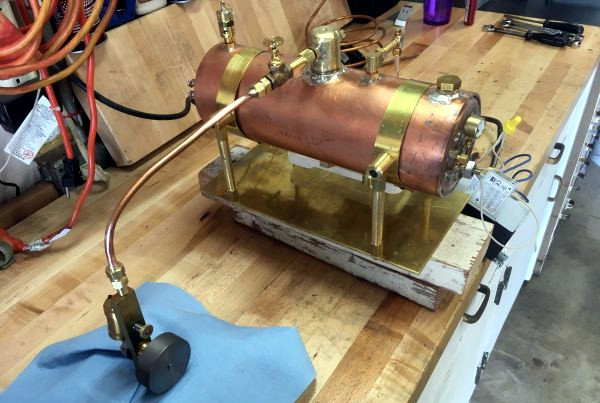
A DIY electric boiler and small steam engine.
Another topic of discussion was how to fuel the boiler itself. An electrically powered boiler is perhaps the easiest option, but is somewhat counterproductive if you hope to put your steam engine to useful work. Coal and wood fires are an option, and indeed were commonly used in the old days, but the soot and ash they produce can be a problem.
Quinn also notes that if you’re using such fuels, you need a way to quickly remove the firebox from the boiler in an emergency; something she likens to the starship Enterprise having to eject its warp core before it explodes. For her own projects, Quinn says she uses either an electric element or a camping gas burner.
While most of the questions during this Hack Chat had to do with the work Quinn has already featured on her blog and YouTube channel, naturally there were questions about where things go from here. After she completes the steam engine kit she’s working on currently, she says she’ll likely to back to another scratch-built engine. She also plans on coupling some of her engines to generators, as she’s gotten many requests about seeing these machines put to useful work. Looking further ahead Quinn says she’s interested in casting her own bronze and aluminum components, and specifically wants to work with “lost PLA” casting, which is a variant of lost wax casting that uses a mold based on a 3D printed part.
We’d like to thank Quinn Dunki for stopping by the Hack Chat and sharing some insights into this unique hobby. While a handcrafted boiler or a desktop steam reciprocating engine might not be on the average Hackaday reader’s list of future projects, it’s still fascinating to see how they work. We owe much of our modern life to steam power, so the least we can do is show it some respect.
The Hack Chat is a weekly online chat session hosted by leading experts from all corners of the hardware hacking universe. It’s a great way for hackers connect in a fun and informal way, but if you can’t make it live, these overview posts as well as the transcripts posted to Hackaday.io make sure you don’t miss out.
There’s a dreaded disease that’s plagued Internet Service Providers for years. OK, there’s probably several diseases, but today we’re talking about bufferbloat. What it is, how to test for it, and finally what you can do about it. Oh, and a huge shout-out to all the folks working on this problem. Many programmers and engineers, like Vint Cerf, Dave Taht, Jim Gettys, and many more have cracked this nut for our collective benefit.
When your computer sends a TCP/IP packet to another host on the Internet, that packet routes through your computer, through the network card, through a switch, through your router, through an ISP modem, through a couple ISP routers, and then finally through some very large routers on its way to the datacenter. Or maybe through that convoluted chain of devices in reverse, to arrive at another desktop. It’s amazing that the whole thing works at all, really. Each of those hops represents another place for things to go wrong. And if something really goes wrong, you know it right away. Pages suddenly won’t load. Your VoIP calls get cut off, or have drop-outs. It’s pretty easy to spot a broken connection, even if finding and fixing it isn’t so trivial.
That’s an obvious problem. What if you have a non-obvious problem? Sites load, but just a little slower than it seems like they used to. You know how to use a command line, so you try a ping test. Huh, 15.0 ms off to Google.com. Let it run for a hundred packets, and essentially no packet loss. But something’s just not right. When someone else is streaming a movie, or a machine is pushing a backup up to a remote server, it all falls apart. That’s bufferbloat, and it’s actually really easy to do a simple test to detect it. Run a speed test, and run a ping test while your connection is being saturated. If your latency under load goes through the roof, you likely have bufferbloat. There are even a few of the big speed test sites that now offer bufferbloat tests. But first, some history. Continue reading “Bufferbloat, The Internet, And How To Fix It”→
One of the primary issues with EVs is that you need to pull over and stop to get a charge. If there isn’t a high-speed DC charger available, this can mean waiting for hours while your battery tops up.
It’s been the major bugbear of electric vehicles since they started hitting the road in real numbers. However, a new wireless charging setup could allow you to juice up on the go.
Electric Highways
Over the years, many proposals have been made to power or charge electric vehicles as they drive down the road. Many are similar to the way we commonly charge phones these days, using inductive power transfer via magnetic coils. The theory is simple. Power is delivered to coils in the roadway, and then picked up via induction by a coil on the moving vehicle.
Taking these ideas from concept into reality is difficult, though. When it comes to charging an electric vehicle, huge power levels are required, in the range of tens to hundreds of kilowatts. And, while a phone can sit neatly on top of a charging pad, EVs typically require a fair bit of ground clearance for safely navigating the road. Plus, since cars move at quite a rapid pace, an inductive charging system that could handle this dynamic condition would require huge numbers of coils buried repeatedly into the road bed. Continue reading “Coils In The Road Could Charge EVs While Driving”→
Traveling through mainland Europe on a British passport leads you to several predictable conversations. There’s Marmite of course, then all the fun of the Brexit fair, and finally on a more serious note, beer. You see, I didn’t know this, but after decades of quaffing fine ales, I’m told we do it wrong because we drink our beer warm. “Warm?”, I say, thinking of a cooling glass of my local Old Hooky which is anything but warm when served in an Oxfordshire village pub, to receive the reply that they drink their beers cold. A bit of international deciphering later it emerges that “warm” is what I’d refer to as “cold”, or in fact “room temperature”, while “cold” in their parlance means “refrigerated”, or as I’d say it: “Too cold to taste anything”. Mild humour aside there’s clearly something afoot, so it’s time to get to the bottom of all this. Continue reading “Why Do Brits Drink Warm Beer?”→
Testing any kind of project in the real world is expensive. You have to haul people and equipment around, which costs money, and if you break anything, you have to pay for that too! Simulation tends to come first. Making mistakes in a simulation is much cheaper, and the lessons learned can later be verified in the real world. If you want to learn to fly a quadcopter, the best thing to do is get some time behind the sticks of a simulator before you even purchase anything with physical whirly blades.
Oddly enough, the same goes for AI. Microsoft built a simulation product to aid the development of artificial intelligence systems for drones by the name of Project AirSim. It aims to provide a comprehensive environment for the testing of drone AI systems, making development faster, cheaper, and more practical.
Long-time readers of Hackaday will know that we attend quite a few events, including summer hacker camps. Here in Europe this year there are two large events, the British Electromagnetic Field, and the Dutch MCH, or May Contain Hackers. These events are put together by volunteers from within the community, and as part of the MCH setup I noticed they needed drivers for their off-site logistics. I have a licence to drive medium-sized trucks in Europe so it seemed like a perfect fit. I traveled early on the first set-up day to the Dutch city of Utrecht, and found myself behind the wheel of a large Volkswagen box van. My brief career as a trucker had begun!
An Empty Field Of Dreams
The tents stand in isolation at the end of day one.
The Netherlands is a relatively small country and the MCH site at Zeewolde is roughly in its centre, so while the traffic could be heavy the distances weren’t large by American or even British standards. There were however a wide variety of loads waiting for me and my fellow driver, and a few obstacles such as the hottest days of the year and angry Dutch farmers blockading the roads. If you’re interested in the logistics behind a large hacker camp then our journeys provided an insight that maybe wandering around the field doesn’t quite deliver.
Arriving on site on the first day gives a perspective on how much of the infrastructure comes from specialist contractors and thus isn’t delivered by the hackers. Articulated trucks from the marquee company were disgorging the main tents, with their crews expertly assembling them in record time. The toilets and showers were arriving as self-contained hook lift container units, and yet more contractors were delivering fencing or tables and chairs. I can add the power infrastructure to this list, but due I’m told to delays at another event this wasn’t on site on the first day. Continue reading “What Goes Into A Hacker Camp”→


 As the SLS was designed to lift a fully loaded and crewed Orion capsule, the towering rocket and the ISPS are being considerably underutilized for this test flight. With so much excess payload capacity available, Artemis I is in the unique position of being able to carry a number of secondary payloads into cislunar space without making any changes to the overall mission or flight trajectory.