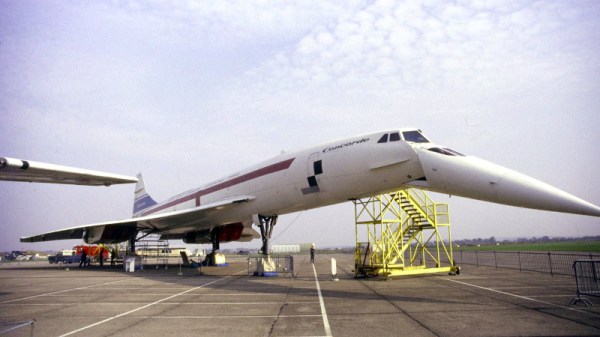
Every nation has icons of national pride: a sports star, a space mission, or a piece of architecture. Usually they encapsulate a country’s spirit, so citizens can look up from their dreary lives and say “Now there‘s something I can take pride in!” Concorde, the supersonic airliner beloved by the late 20th century elite for their Atlantic crossings, was a genuine bona-fide British engineering icon.
But this icon is unique as symbols of national pride go, because we share it with the French. For every British Airways Concorde that plied the Atlantic from London, there was another doing the same from Paris, and for every British designed or built Concorde component there was another with a French pedigree. This unexpected international collaboration gave us the world’s most successful supersonic airliner, and given the political manoeuverings that surrounded its gestation, the fact that it made it to the skies at all is something of a minor miracle. Continue reading “The Politics Of Supersonic Flight: The Concord(e)”→
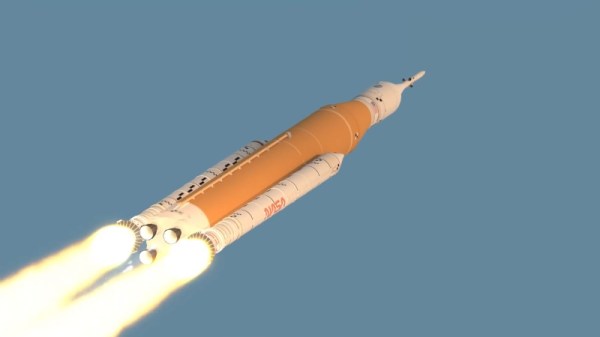
The January 16th “Green Run” test of NASA’s Space Launch System (SLS) was intended to be the final milestone before the super heavy-lift booster would be moved to Cape Canaveral ahead of its inaugural Artemis I mission in November 2021. The full duration static fire test was designed to simulate a typical launch, with the rocket’s main engines burning for approximately eight minutes at maximum power. But despite a thunderous start start, the vehicle’s onboard systems triggered an automatic abort after just 67 seconds; making it the latest in a long line of disappointments surrounding the controversial booster.
When it was proposed in 2011, the SLS seemed so simple. Rather than spending the time and money required to develop a completely new rocket, the super heavy-lift booster would be based on lightly modified versions of Space Shuttle components. All engineers had to do was attach four of the Orbiter’s RS-25 engines to the bottom of an enlarged External Tank and strap on a pair of similarly elongated Solid Rocket Boosters. In place of the complex winged Orbiter, crew and cargo would ride atop the rocket using an upper stage and capsule not unlike what was used in the Apollo program.
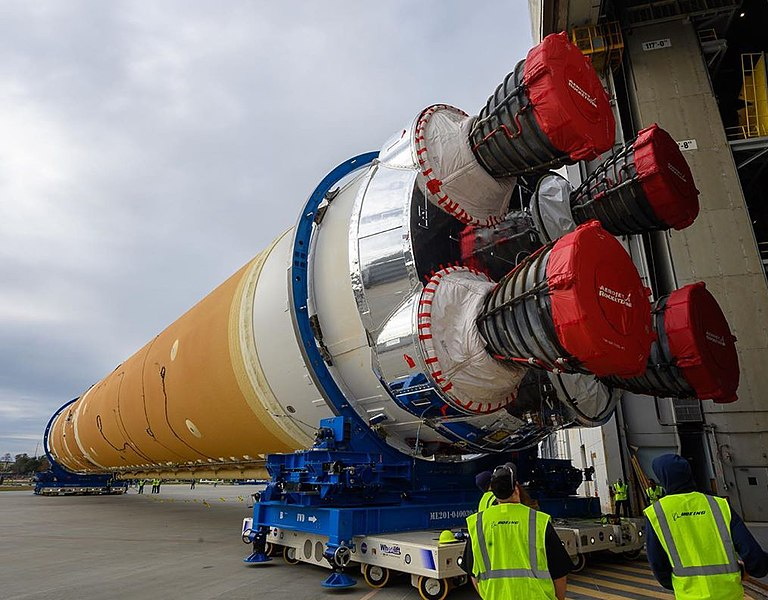
The SLS core stage is rolled out for testing.
There’s very little that could be called “easy” when it comes to spaceflight, but the SLS was certainly designed to take the path of least resistance. By using flight-proven components assembled in existing production facilities, NASA estimated that the first SLS could be ready for a test flight in 2016.
If everything went according to schedule, the agency expected it would be ready to send astronauts beyond low Earth orbit by the early 2020s. Just in time to meet the aspirational goals laid out by President Obama in a 2010 speech at Kennedy Space Center, including the crewed exploitation of a nearby asteroid by 2025 and a potential mission to Mars in the 2030s.
But of course, none of that ever happened. By the time SLS was expected to make its first flight in 2016, with nearly $10 billion already spent on the program, only a few structural test articles had actually been assembled. Each year NASA pushed back the date for the booster’s first shakedown flight, as the project sailed past deadlines in 2017, 2018, 2019, and 2020. After the recent engine test ended before engineers were able to collect the data necessary to ensure the vehicle could safely perform a full-duration burn, outgoing NASA Administrator Jim Bridenstine said it was too early to tell if the booster would still fly this year.
What went wrong? As commercial entities like SpaceX and Blue Origin move in leaps and bounds, NASA seems stuck in the past. How did such a comparatively simple project get so far behind schedule and over budget?
I’m always fascinated that someone designed just about everything you use, no matter how trivial it is. The keyboard you type on, the light switch you turn on, even the faucet handle. They don’t just spontaneously grow on trees, so some human being had to build it and probably had at least a hazy design in mind when they started it.
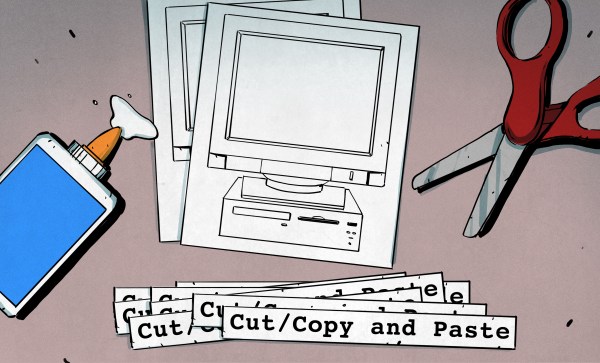
Some things are so ubiquitous that it is hard to remember that someone had to dream them up to begin with. A friend of mine asked me the other day why we use Control+X and Control+V to manipulate the clipboard almost universally. Control+C for copy makes sense, of course, but it is still odd that it is virtually universal in an industry where everyone likes to reinvent the wheel. I wasn’t sure of the answer but figured it had to do with some of the user interface standards from IBM or Sun. Turns out, it is much older than that.
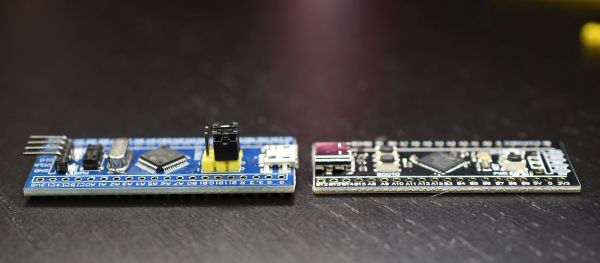
For many years now, the so-called ‘Blue Pill’ STM32 MCU development board has been a staple in the hobbyist community. Finding its origins as an apparent Maple Mini clone, the diminutive board is easily to use in breadboard projects thanks to its dual rows of 0.1″ pin sockets. Best of all, it only costs a few bucks, even if you can only really buy it via sellers on AliExpress and EBay.
Starting last year, boards with a black soldermask and an STM32F4 Access (entry-level) series MCUs including the F401 and F411 began to appear. These boards with the nickname ‘Black Pill’ or ‘Black Pill 2’. F103 boards also existed with black soldermask for a while, so it’s confusing. The F4xx Black Pills are available via the same sources as the F103-based Blue Pill ones, for a similar price, but feature an MCU that’s considerably newer and more powerful. This raises the question of whether it makes sense at this point to switch to these new boards.
Our answer is yes, but it’s not entirely clearcut. The newer hardware is better for most purposes, really lacking only the F103’s dual ADCs. But hardware isn’t the only consideration; depending on one’s preferred framework, support may be lacking or incomplete. So let’s take a look at what it takes to switch. Continue reading “Blue Pill Vs Black Pill: Transitioning From STM32F103 To STM32F411”→
When the Space Shuttle Atlantis rolled to a stop on its final mission in 2011, it was truly the end of an era. Few could deny that the program had become too complex and expensive to keep running, but even still, humanity’s ability to do useful work in low Earth orbit took a serious hit with the retirement of the Shuttle fleet. Worse, there was no indication of when or if another spacecraft would be developed that could truly rival the capabilities of the winged orbiters first conceived in the late 1960s.
While its primary function was to carry large payloads such as satellites into orbit, the Shuttle’s ability to retrieve objects from space and bring them back was arguably just as important. Throughout its storied career, sensitive experiments conducted at the International Space Station or aboard the Orbiter itself were returned gently to Earth thanks to the craft’s unique design. Unlike traditional spacecraft that ended their flight with a rough splashdown in the open ocean, the Shuttle eased itself down to the tarmac like an airplane. Once landed, experiments could be quickly unloaded and transferred to the nearby Space Station Processing Facility where science teams would be waiting to perform further processing or analysis.
Atlantis is towed from the runway for payload processing.
For 30 years, the Space Shuttle and its assorted facilities at Kennedy Space Center provided a reliable way to deliver fragile or time-sensitive scientific experiments into the hands of researchers just a few hours after leaving orbit. It was a valuable service that simply didn’t exist before the Shuttle, and one that scientists have been deprived of ever since its retirement.
Until now. With the successful splashdown of the first Cargo Dragon 2 off the coast of Florida, NASA is one step closer to regaining a critical capability it hasn’t had for a decade. While it’s still not quite as convenient as simply rolling the Shuttle into the Orbiter Processing Facility after a mission, the fact that SpaceX can guide their capsule down into the waters near the Space Coast greatly reduces the time required to return experiments to the researchers who designed them.
So far in the $50 Ham series, I’ve concentrated mainly on the VHF and UHF bands. The reason for this has to do mainly with FCC rules, which largely restrict Technician-level licensees to those bands. But there’s a financial component to it, too; high-frequency (HF) band privileges come both at the price of learning enough about radio to pass the General license test, as well as the need for gear that can be orders of magnitude more expensive than a $30 handy-talkie radio.
But while HF gear can be expensive, not everything needed to get on the air has to be so. And since it’s often the antenna that makes or breaks an amateur radio operator’s ability to make contacts, we’ll look at a simple but versatile antenna design that can be adapted to support everything from a big, powerful base station to portable QRP (low-power) activations in the field: the end-fed half-wave antenna.