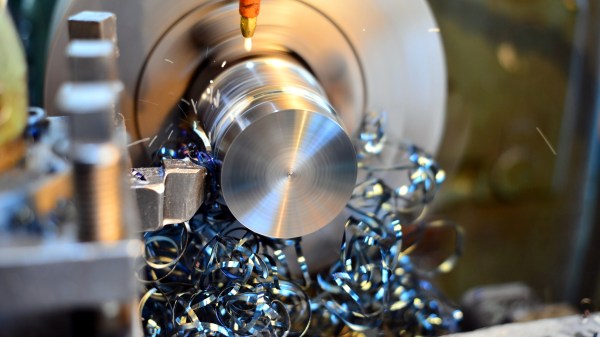
How Art Became Science In Machining

Machining is one of those fascinating fields that bridges the pre-scientific and scientific eras. As such, it has gone from a discipline full of home-spun acquired wisdom and crusty old superstitions to one of rigorously analyzed physics and crusty old superstitions.

The earliest machinists figured out most of what you need to know just by jamming a tool bit into spinning stock and seeing what happens. Change a few things, and see what happens next. There is a kind of informal experimentation taking place here. People are gradually controlling for variables and getting better at the craft as they learn what seems to affect what. However, the difference between fumbling around and actually knowing something is controlling for one’s own biases in a reproducible and falsifiable way. It’s the only way to know for sure what is true, and we call this “science”. It also means being willing to let go of ideas you had because the double-blinded evidence clearly says they are wrong.

That last part is where human nature lets us down the most. We really want to believe things that confirm our preconceived notions about the world, justify our emotions, or make us feel better. The funny thing about science, though, is that it doesn’t care whether you believe in it or not. So go get your kids vaccinated, and up your machining game with scientific precision. Let’s take a look.

Continue reading “How Art Became Science In Machining”

A Million Zombie Taxis By 2020? It’s Not Going To Happen

The tech world has a love for Messianic figures, usually high-profile CEOs of darling companies whose words are hung upon and combed through for hidden meaning, as though they had arrived from above to our venture-capital-backed prophet on tablets of stone. In the past it has been Steve Jobs or Bill Gates, now it seems to be Elon Musk who has received this treatment. Whether his companies are launching a used car into space, shooting things down tubes in the desert, or synchronised-landing used booster rockets, everybody’s talking about him. He’s a showman whose many pronouncements are always soon eclipsed by bigger ones to keep his public on the edge of their seats, and now we’ve been suckered in too, which puts us on the spot, doesn’t it.

Your Johnny Cab is almost here

The latest pearl of Muskology came in a late April presentation: that by 2020 there would be a million Tesla electric self-driving taxis on the road. It involves a little slight-of-hand in assuming that a fleet of existing Teslas will be software upgraded to be autonomous-capable and that some of them will somehow be abandoned by their current owners and end up as taxis, but it’s still a bold claim by any standard.

Here at Hackaday, we want to believe, but we’re not so sure. It’s time to have a little think about it all. It’s the start of May, so 2020 is about 7 months away. December 2020 is about 18 months away, so let’s give Tesla that timescale. 18 months to put a million self-driving taxis on the road. Can the company do it? Let’s find out.

Continue reading “A Million Zombie Taxis By 2020? It’s Not Going To Happen”

Get To Know The Physics Behind Soldering And The Packaging Of ICs

Often it feels as if soldering is deemed to be more of an art form than something that’s underpinned by the cold, hard reality of physics and chemistry. From organic chemistry with rosin, to the material properties of fragile gold bond wires and silicon dies inside IC packages and the effects of thermal stress on the different parts of an IC package, it’s a complicated topic that deserves a lot more attention than it usually gets.

A casual inquiry around one’s friends, acquaintances, colleagues and perfect strangers on the internet usually reveals the same pattern: people have picked up a soldering iron at some point, and either figured out what seemed to work through trial and error, or learned from someone else who has learned what seemed to work through trial and error. Can we say something scientific about soldering?

Continue reading “Get To Know The Physics Behind Soldering And The Packaging Of ICs”

Twenty Five Years Since The End Of Commodore

This week marks the twenty-five year anniversary of the demise of Commodore International. This weekend, pour one out for our lost homies.

Commodore began life as a corporate entity in 1954 headed by Jack Tramiel. Tramiel, a Holocaust survivor, moved to New York after the war where he became a taxi driver. This job led him to create a typewriter repair shop in Bronx. Wanting a ‘military-style’ name for his business, and the names ‘Admiral’ and ‘General’ already taken, and ‘Lieutenant’ simply being a bad name, Tramiel chose the rank of Commodore.

Later, a deal was inked with a Czechoslovakian typewriter manufacture to assemble typewriters for the North American market, and Commodore Business Machines was born. Of course, no one cares about this pre-history of Commodore, for the same reason that very few people care about a company that makes filing cabinets. On the electronics side of the business, Commodore made digital calculators. In 1975, Commodore bought MOS, Inc., manufacturers of those calculator chips. This purchase of MOS brought Chuck Peddle to Commodore as the Head of Engineering. The calculators turned into computers, and the Commodore we know and love was born.

Continue reading “Twenty Five Years Since The End Of Commodore”

The Stratolaunch Is Flying, But Can It Do Cargo?

The world’s largest aircraft is flying. Stratolaunch took to the skies in test flights leading up to its main mission to take rockets up to 20,000 feet on the first stage of their flight to space. But the Stratolaunch is a remarkable aircraft, a one-of-a-kind, and unlike anything ever built before. It can lift a massive 250 tons into the air, and it can bring it back down again.

By most measures that matter, the Stratolaunch is the largest aircraft ever flown. It has the largest wingspan of any aircraft, and it has the largest cargo capacity of any aircraft. In an industry that is grasping at interesting and novel approaches to spaceflight like rockoons and a small satellite launcher from a company whose CTO is still a junior in college, the Stratolaunch makes unexpected sense; this is a launch platform above the clouds, that can deliver a rocket to orbit, on time.

But the Stratolaunch is much more than that. This is an aircraft whose simple existence deserves respect. And, like others of its kind, the Antonov AN-225, the Spruce Goose, there is only one. Even if it never launches a rocket, the Stratolaunch will live on by the simple nature of its unique capabilities. But what are those capabilities? Is it possible for the Stratolaunch to serve as a cargo plane? The answer is more interesting than you think.

Continue reading “The Stratolaunch Is Flying, But Can It Do Cargo?”