Raspberry Pi’s Power Over Ethernet Hardware Sparks False Spying Hubbub

Have you ever torn open an Ethernet jack? We’d bet the vast majority of readers — even the ones elbow-deep into the hardware world — will answer no. So we applaud the effort in this one, but the conclusion landed way off the mark.

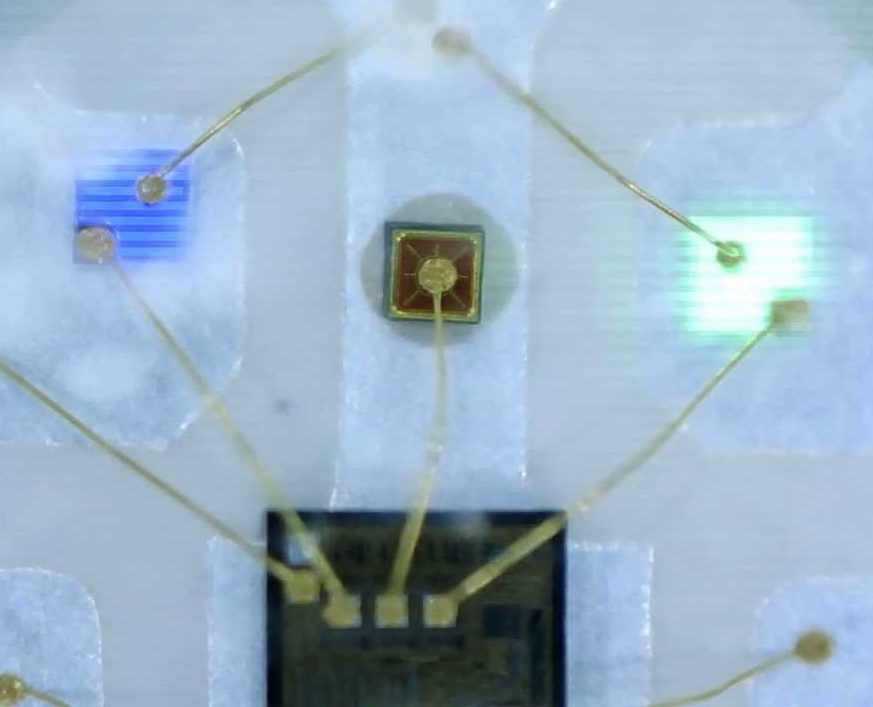
In the last few days, a Tweet showing a Raspberry Pi with its Ethernet socket broken open suggested the little PCB inside it is a hidden bug. With more going on inside than one might expect, the conclusion of the person doing the teardown was that the Raspberry Pi foundation are spying upon us through our Ethernet traffic. That’s just not the case. But we’re still excited about what was found.

Continue reading “Raspberry Pi’s Power Over Ethernet Hardware Sparks False Spying Hubbub”

Modular Robotics Made Easier With ROS

A robot is made up of many hardware components each of which requires its own software. Even a small robot arm with a handful of servo motors uses a servo motor library.

Add that arm to a wheeled vehicle and you have more motors. Then attach some ultrasonic sensors for collision avoidance or a camera for vision. By that point, you’ve probably split the software into multiple processes: one for the arm, another for the mobility, one for vision, and one to act as the brains interfacing somehow with all the rest. The vision may be doing object recognition, something which is computationally demanding and so you now have multiple computers.

Break all this complexity into modules and you have a use case for ROS, the Robot Operating System. As this article shows, ROS can help with designing, building, managing, and even evolving your robot.

Continue reading “Modular Robotics Made Easier With ROS”

Internet Of Smells: Giving A Machine The Job Of Sniffing Out Spoiled Food

Has the food in your pantry turned? Sometimes it’s the sickening smell of rot that tells you there’s something amiss. But is there a way to catch this before it makes life unpleasant? If only there were machines that could smell spoiled food before it stinks up the whole place.

In early May, I was lucky enough to attend the fourth FabLab Asia Network Conference (Fan4). The theme of their event this year was ‘Co-Create a Better World’. One of the major features of the conference was that there were a number of projects featured, often from rural areas, that were requesting assistance throughout the course of the conference.

Overall there were many bright people tackling difficult problems with limited resources. This is how I met [Yogesh Kulkarni] who runs a FabLab in Pabal, a farming community not far from Pune, India. [Yogesh] has also appeared on TED Talks (video here). He explained to me that in his area, vendors sell milk-based desserts. These are not exactly refrigerated, and sometimes people become ill from eating them. It would be nice if there was a way for the vendors to avoid selling the occasional harmful product.

I’ve had similar concerns with food safety in my area (Vietnam), and while it has been fine nearly all of the time, a few years ago I nearly died from a preventable food-borne illness. I had sufficient motivation to do a little research.

Continue reading “Internet Of Smells: Giving A Machine The Job Of Sniffing Out Spoiled Food”

360 Live VR Teleportation Uses Drones, Neural Networks, And Perseverance

This past semester I added research to my already full schedule of math and engineering classes, as any masochistic student eagerly would. Packed schedule aside, how do you pass up the chance to work on implementing 360° virtual teleportation to anywhere in the world, in real-time. Yes, it is indeed the same concept as the cult worshipped Star Trek transporter, minus the ability to physically be at the location. Perhaps we can add a, “beam me up, Scotty” command when shutting down.

The research lab I was working with is the Laboratory for Immersive CommunicatiON (LION). It’s funded by NSF, Microsoft, and Adobe and has been on the pursuit of VR teleportation for some time now.  There’s a lot of cool technologies at work here, like drones which are used as location collection devices. A network of drones will survey landscape anywhere in the world and build the collection assets needed for recreating it in VR. Okay, so a swarm of drones might seem a little intimidating at first, but when has emerging technology not?

Continue reading “360 Live VR Teleportation Uses Drones, Neural Networks, And Perseverance”

Spanning The Tree : Dr Radia Perlman & Untangling Networks

As computer networks get bigger, it becomes increasingly hard to keep track of the flow of data over this network. How do you route data, making sure that the data is spread to all parts of the network? You use an algorithm called the spanning tree protocol — just one of the contributions to computer science of a remarkable engineer, Dr. Radia Perlman. But before she created this fundamental Internet protocol, she also worked on LOGO, the first programming language for children, creating a dialect for toddlers.

Continue reading “Spanning The Tree : Dr Radia Perlman & Untangling Networks”

Smart Plugs Don’t Save You Energy, But Don’t Consume Much Either

Amazon Alexa, Google Home, and just about every electronic device manufacturer are jumping on the bandwagon of connected devices. They promise us the ability to turn on our toaster from another room, unlock our doors just by shouting at them from outside, and change the channel on our TV through perfectly enunciating a sentence instead of mashing the buttons on our remotes like chumps. And yet, despite all this new-fangled finger-less control, there is an unanswered question: does this technology save us energy in the long run?

For years we’ve been hearing about vampire power and all the devices in our home that sit in standby, waiting for their masters to turn them on, quietly burning power to listen for that signal to wake. Fortunately the One Watt Initiative and general awareness and design for energy savings has cut out a lot of this phantom load. So how does the smart home, which essentially adds a bunch of connected vampires to our base load, end up saving money in the long run? And is it better than other alternatives or just good habits? I put these questions to the test with today’s smart power strips and controllable outlets.

Continue reading “Smart Plugs Don’t Save You Energy, But Don’t Consume Much Either”

Hacking When It Counts: The Pioneer Missions

If the heady early days of space exploration taught us anything, it was how much we just didn’t know. Failure after failure mounted, often dramatic and expensive and sometimes deadly. Launch vehicles exploded, satellites failed to deploy, or some widget decided to give up the ghost at a crucial time, blinding a multi-million dollar probe and ending a mission long before any useful science was done. For the United States, with a deadline to meet for manned missions to the moon, every failure in the late 1950s and early 1960s was valuable, though, at least to the extent that it taught them what not to do next time.

For the scientists planning unmanned missions, there was another, later deadline looming that presented a rare opportunity to expand our knowledge of the outer solar system, a strange and as yet unexplored wilderness with the potential to destroy anything humans could build and send there. Before investing billions in missions to take a Grand Tour of the outer planets, they needed more information. They needed to send out some Pioneers.

Continue reading “Hacking When It Counts: The Pioneer Missions”