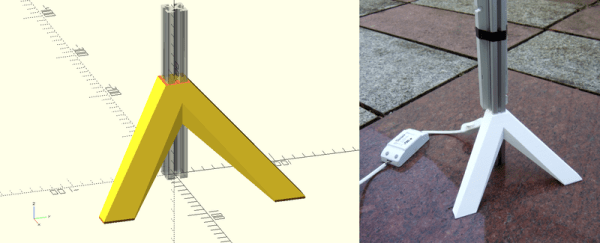
What’s your favorite OpenSCAD command? Perhaps it’s intersection() or difference()? Or are you a polygon() and extrude() modeler? For me, the most useful, and maybe most often overlooked, function is hull(). Hull() does just what it says on the can — creates a convex hull around the objects that are passed to it as children — but that turns out to be invaluable.
Hull() solves a number of newbie problems: making things round and connecting things together. And with a little ingenuity, hull() can provide a nearly complete modelling strategy all on its own. If you use OpenSCAD and your creations end up with hard edges, or you spend too much time figuring out angles, or if you just want to experience another way to get the job done, read on!
Science, as a concept, is relatively new. Benjamin Franklin wasn’t a scientist probing the mysteries of amber and wool and electricity and ‘air baths’; he was a natural philosopher. Antonie van Leeuwenhoek was simply a man with a proclivity towards creating new and novel instruments. Robert Hooke was a naturalist and polymath, and Newton was simply a ‘man of science’. None of these men were ever called ‘scientists’ in their time; the term hadn’t even been coined yet.
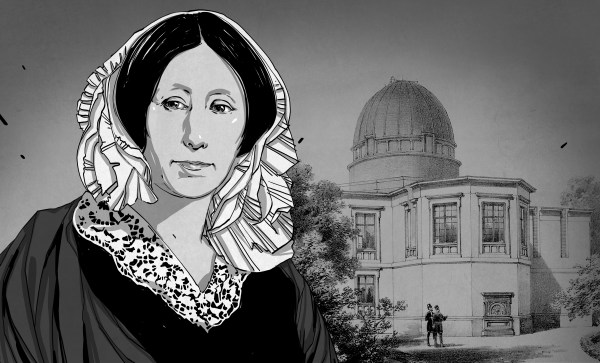
The word ‘scientist’ wouldn’t come into vogue until the 1830s. The word itself was created by William Whewell, reviewing The Connexion of the Physical Sciences by Mary Somerville. The term used at the time, ‘a man of science’, didn’t apply to Mrs. Somerville, and, truth be told, the men of science of the day each filled a particular niche; Faraday was interested in electricity, Darwin was a naturalist. Mary Somerville was a woman and an interdisciplinarian, and the word ‘scientist’ was created for her.
When you think about space stations, which ones come to mind first? You might think Skylab, the International Space Station (ISS), or maybe Russia’s Mir. But before any of those took to the heavens, there was Salyut.
Russia’s Salyut 1 was humankind’s first space station. The ensuing Salyut program lasted fifteen years, from 1971 to 1986, and the lessons learned from this remarkable series of experiments are still in use today in the International Space Station (ISS). The program was so successful at a time when the US manned space program was dormant that one could say that the Russians lost the Moon but won the space race.
Nothing brings out the worst in humanity like war. Perversely, war also seems to exert an opposite if not equal force that leads to massive outbursts of creativity, the likes of which are not generally seen during times of peace. With inhibitions relaxed and national goals to meet, or in some cases where the very survival of a people is at stake, we always seem to find new and clever ways to blow each other to smithereens.
The run-up to World War II was a time where almost every nation was caught on its heels, and the rapidity of events unfolding across Europe and in Asia demanded immediate and decisive response. As young men and women mobilized and made ready for war, teams of engineers, scientists, and inventors were pressed into service to develop the weapons that would support them. For the British, these “boffins” would team up under a directorate called Ministry of Defence 1, or MD1. Informally, they’d be known as “Churchill’s Toy Shop,” and the devices they came up with were deviously clever hacks.
Current. Too little of it, and you can’t get where you’re going, too much and your hardware’s on fire. In many projects, it’s desirable to know just how much current is being drawn, and even more desirable to limit it to avoid catastrophic destruction. The humble current shunt is an excellent way to do just that.
Ohm’s Law.
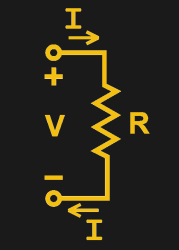
To understand current, it’s important to understand Ohm’s Law, which defines the relationship between current, voltage, and resistance. If we know two out of the three, we can calculate the unknown. This is the underlying principle behind the current shunt. A current flows through a resistor, and the voltage drop across the resistor is measured. If the resistance also is known, the current can be calculated with the equation I=V/R.
This simple fact can be used to great effect. As an example, consider a microcontroller used to control a DC motor with a transistor controlled by a PWM output. A known resistance is placed inline with the motor and, the voltage drop across it measured with the onboard analog-to-digital converter. With a few lines of code, it’s simple for the microcontroller to calculate the current flowing to the motor. Armed with this knowledge, code can be crafted to limit the motor current draw for such purposes as avoiding overheating the motor, or to protect the drive transistors from failure.
In fact, such strategies can be used in a wide variety of applications. In microcontroller projects you can measure as many currents as you have spare ADC channels and time. Whether you’re driving high power LEDs or trying to build protection into a power supply, current shunts are key to doing this.
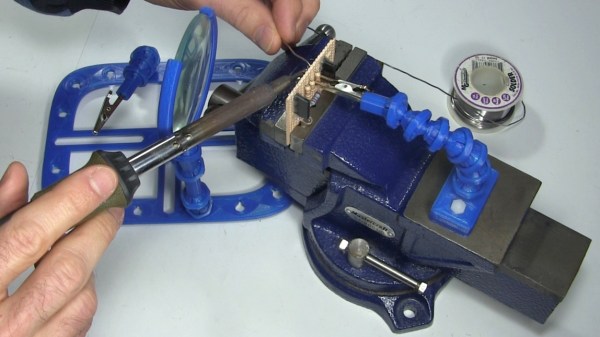
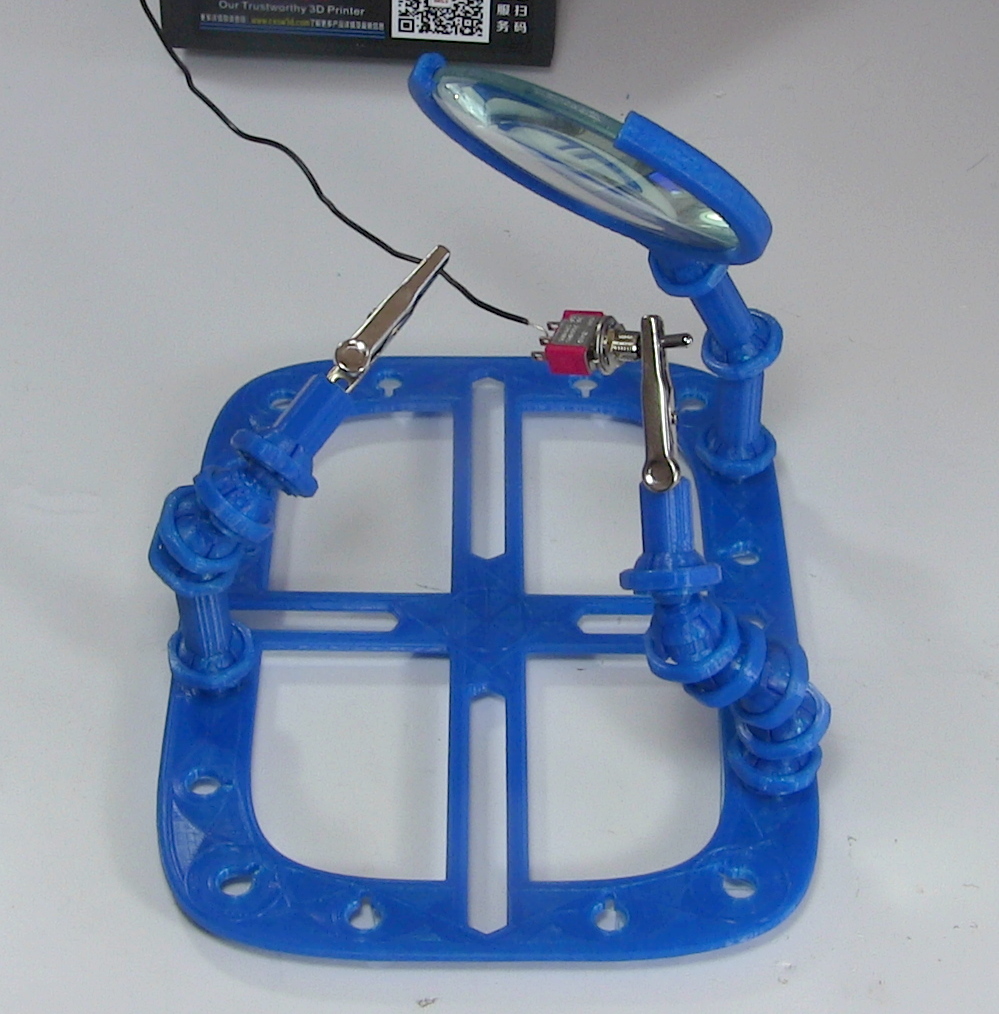
In one hand you hold the soldering iron, in the other the solder, and in two more hands the parts you’re trying to solder together. Clearly this is a case where helping hands could be useful.
One reason is to take advantage of standardized, open source creativity. Anyone can share a model of their design for all to use as is, or to modify for their needs. A case in point is the ball and socket model which I downloaded for a helping hand. I then drew up and printed a magnifying glass holder with a matching socket, made a variation of the ball and socket joint, and came up with a magnetic holder with matching ball. Let’s takea look at what worked well and what didn’t.
If you’ve made it through the last two posts on quantum computing (QC), then you’ve seen the Quirk simulator, a little of IBM’s web-based offering, and how entanglement and superposition can do strange and possibly wonderful things. However, the superdense encoding I showed you didn’t really feel like a real computer algorithm. This time we will look at Grover’s algorithm which is often incorrectly billed as an “unstructured database search.” In reality, it is an algorithm for making a state — that is a set of qubits — match some desired state without simply setting the state.
By analogy, consider a web service where you guess a number. Most discussions of Grover’s algorithm will tell you that the service will only tell you if the number is correct or not. If the number was from 1 to 16, using traditional computing, you’d have to query the values one at a time to see which is correct. You might get lucky and hit the first time. Or it might take 16 times. With qubits you can get the same result in only four attempts. In fact, if you try more times, you might get the wrong answer. Of course, what you really get is an answer that is probably correct, because that how QC works.