Hams In Space Part 2: The Manned Spaceflights

Whether it’s trying to make contacts across the planet with a transmitter that would have a hard time lighting an LED, or blasting signals into space and bouncing them off the moon, amateur radio operators have always been on the forefront of communications technology. As mankind took to space in the 1950s and 1960s, hams went along for the ride with the first private satellites. But as successful as the OSCAR satellites were, they were still at best only beacons or repeaters in space. What was needed was the human touch – a real live operator making contacts with people on the ground, showing the capabilities of amateur radio while generating public interest in the space program. What was needed was a ham in space. Continue reading “Hams In Space Part 2: The Manned Spaceflights”

What’s New, ESP-32? Testing The Arduino Library

In case you missed it, the big news is that a minimal Arduino core is up and working on the ESP32. There’s still lots left to do, but the core functionality — GPIO, UART, SPI, I2C, and WiFi — are all up and ready to be tested out. Installing the library is as easy as checking out the code from GitHub into your Arduino install, so that’s exactly what I did.

I then spent a couple days playing around with it. It’s a work in progress, but it’s getting to the point of being useful, and the codebase itself contains some hidden gems. Come on along and take a sneak peek.

Continue reading “What’s New, ESP-32? Testing The Arduino Library”

The Lotus Sevens: The Real Most-Hackable Cars

In the late 1940s and early 1950s, Europe was still struggling to recover from the crippling after-effects of war. In Britain it is referred to as the “austerity period”, with food still rationed and in which “make do and mend” was very much the order of the day. The consumer boom of the late 1950s and 1960s was very far in the future, and if you were a hardware hacker your source materials were limited to whatever you could find from war surplus or whatever prewar junk might come your way. This was a time in which the majority of adults had recently returned from war service, during which they had acquired practical skills through the necessities of battle that they sought an outlet for in peacetime.

One field that benefited from this unexpected flowering of creativity was that of motor racing. Before the war it had been an exclusive pursuit, with bespoke cars at famous circuits like the banked track at Brooklands, in Surrey. In a reflection of the wider social changes that followed the war the motor racers of the post-war years came from humbler backgrounds, they raced homemade specials made from tired-out prewar motors on wartime airfield perimeter tracks like the one at Silverstone which still hosts Formula One racing today.

Continue reading “The Lotus Sevens: The Real Most-Hackable Cars”

Apple Sucks Now, Here’s A ThinkPad Buyer’s Guide

For the last decade, Macs have been running a UNIX-ish operating system on x86 processors. They’ve been fantastic developer’s machines, and the MacBook Pro is the de facto standard laptop issued to all developers, all hackathon attendees, and arguably, anyone who does real work with a computer.

This week, Apple unveiled the latest MacBook Pro and provided more evidence Steve Jobs actually knew what he was doing. Fifteen hundred bones will get you a MacBook Pro with a last-gen processor, an Escape key, a headphone jack, and two Thunderbolt 3 ports (with one port required for charging). The next model up costs $1800, ditches the Escape key for a dedicated emoji bar, and includes four Thunderbolt 3 ports.

In the past, I have defended people who choose MacBooks as their laptop of choice. A MacBook is a business-class laptop, and of course carries a higher price tag. However, Apple’s latest hardware release was underwhelming and overpriced. If you’re looking for a new laptop, you would do well to consider other brands. To that end, here’s a buyer’s guide to ThinkPads, currently the second most popular laptop I’ve seen with the dev/hacker/code cracker crowd.

Continue reading “Apple Sucks Now, Here’s A ThinkPad Buyer’s Guide”

Not Quite 101 Uses For An ATX Power Supply

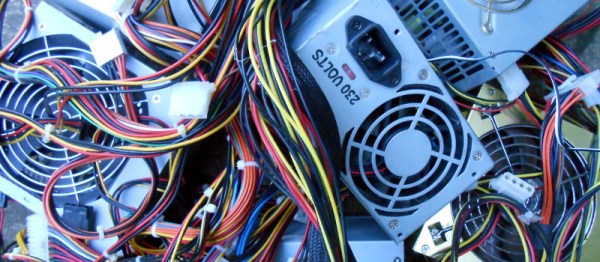
The PC power supply has been a standard of the junk box for the last couple of decades, and will probably continue to be for the foreseeable future. A product that is often built to a very high standard and which will give years of faithful service, yet which has a life of only a few years as the PC of which it is a part becomes obsolete. Over the decades it has evolved from the original PC and AT into ATX, supplying an ever-expanding range of voltage rails at increasing power levels. There have been multiple different revisions of the ATX power supply standard over the years, but they all share the same basic form factor.

So a pile of ATX supplies will probably feature in the lives of quite a few readers. Most of them will probably be old and obsolete versions of little use with today’s motherboards, so there they sit. Not small enough to ignore, yet Too Good To Throw Away. We’re going to take a look at them, try to work out what useful parts they contain, and see a few projects using them. Maybe this will provide some inspiration if you’re one of those readers with a pile of them seeking a purpose.

Continue reading “Not Quite 101 Uses For An ATX Power Supply”

Parts You Should Know: A Universe Of Useful Injection Molded Standoffs

Your clever branding won't work on me! *types caption in on iPhone*
Your clever branding won’t work on me!
*types caption in on iPhone, sips Starbucks*

I remember the first time I built a computer. My sister and I had our last fight about who would get to use the family computer, it was time I had one of my own. I knew a little bit, and I knew I wasn’t going to be one of those plebs that overpaid for a Gateway in its cow box. So I outsourced. One of the computer literate parents in my Scout Troop very kindly agreed to put together a list of components for me. I spent my Christmas money, birthday money, and a small mountain of money I had saved up. I remember getting the parts in the mail. I was so excited that a week earlier I had even bought one of those super lame computer tool kits to put it together.

I still remember how enormously frustrating the stand-offs for the mother board were to install. I think computers were still figuring out that they didn’t need ALL of the features of a mainframe. Anyway there was a 3mm screw on each side of a cm tall brass standoff. It also wanted me to put these little isolating paper washers on the assembly for some reason. Even with my then presidentially sized hands it took a long time. My Mom later told me that it was around this time she was certain the whole endeavour was going to end in tears.

Six hours of careful work later I had the computer together and running when I realized I had forgotten to buy an OS for it. She was nearly right.

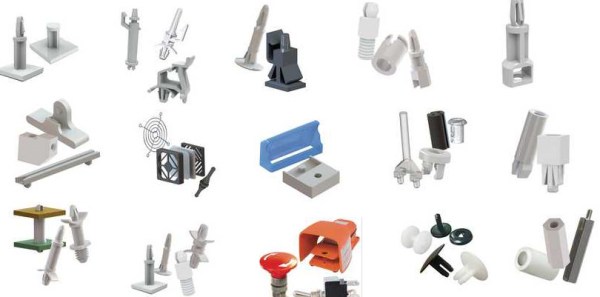
Regardless. My early experience with computer assembly left me with a love for standardized screws, a hate for excessive fasteners, and a deep loathing for improperly routed wires. I was a weird kid. Anyway, when it came time for me to start designing my own enclosures for circuit boards I had all the unique psychological damage and underpinnings I would need to waste a lot of time googling on the internet for an alternate, screwless, method of standing a board off from a surface.

Continue reading “Parts You Should Know: A Universe Of Useful Injection Molded Standoffs”

Why You Should Own A Sewing Machine

This could probably be any of our grandmothers at work. George Grantham Bain Collection [PD], via Wikimedia Commons
This could probably be any of our grandmothers at work. George Grantham Bain Collection [PD], via Wikimedia Commons.
In our hackspace, we’ve opened a textile room in the last month. We have high hopes for it as a focal point for cosplayers and LARPers as well as the makers of wearable electronics and more traditional textile users. Putting it in has involved several months of hard work bringing a semi-derelict and previously flooded room that was once the walk-in safe for our local school authority to a point at which it is a light and welcoming space, but a surprising amount of work has also had to go into winning the hearts and minds of our community for the project.

Putting it quite simply, textiles aren’t seen as very cool, in hackspace terms. You know, Women’s stuff. Your mother does it, or even maybe if you are a little younger, your grandmother. It’s just not up there with laser cutting or 3D printing, and as a result those of us for whom it’s a big part of making stuff have had to fight its corner when it comes to resources within the space.

Yet not so long ago when I brought a pair of worn-out jeans into the space on a social night and hauled out our Lervia sewing machine to fix them, I had a constant stream of fellow members passing by amazed at what I was doing. “You can repair jeans?” they asked, incredulously. For some reason this prospect had not occurred to them, I was opening up a new vista in clothing reincarnation, to the extent that before too long in our new facility I may be giving a workshop on the subject as the beloved former trousers of Oxford Hackspace denizens gain a chance of new life.

Continue reading “Why You Should Own A Sewing Machine”