On Point: The Yagi Antenna

If you happened to look up during a drive down a suburban street in the US anytime during the 60s or 70s, you’ll no doubt have noticed a forest of TV antennas. When over-the-air TV was the only option, people went to great lengths to haul in signals, with antennas of sometimes massive proportions flying over rooftops.

Outdoor antennas all but disappeared over the last third of the 20th century as cable providers became dominant, cast to the curb as unsightly relics of a sad and bygone era of limited choices and poor reception. But now cheapskates cable-cutters like yours truly are starting to regrow that once-thick forest, this time lofting antennas to receive digital programming over the air. Many of the new antennas make outrageous claims about performance or tout that they’re designed specifically for HDTV. It’s all marketing nonsense, of course, because then as now, almost every TV antenna is just some form of the classic Yagi design. The physics of this antenna are fascinating, as is the story of how the antenna was invented.

Continue reading “On Point: The Yagi Antenna” →

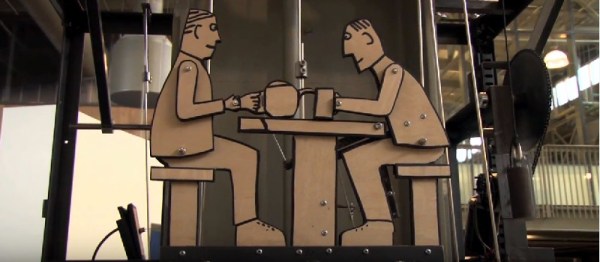
Hardware Heroes: Tim Hunkin

If you were an engineering student around the end of the 1980s or the start of the 1990s, your destiny most likely lay in writing 8051 firmware for process controllers or becoming a small cog in a graduate training scheme at a large manufacturer. It was set out for you as a limited set of horizons by the university careers office, ready for you to discover as only a partial truth after graduation.

But the chances are that if you were a British engineering student around that time you didn’t fancy any of that stuff. Instead you harboured a secret dream to be [Tim Hunkin]’s apprentice. Of course, if you aren’t a Brit, and maybe you are from a different generation, you’ll have responded quizzically to that name. [Tim Hunkin]? Who?

[Tim Hunkin] is a British engineer, animator, artist and cartoonist who has produced a long series of very recognisable mechanical devices for public display, including clocks, arcade machines, public spectacles, exhibits and collecting boxes for museums, and much more. He came to my attention as an impressionable young engineer with his late 1980s to early 1990s British TV series  The Secret Life Of Machines, in which he took everyday household and office machines and appliances and explained and deconstructed them in an accessible manner for the public.

Continue reading “Hardware Heroes: Tim Hunkin” →

Wrap Your Mind Around Neural Networks

Artificial Intelligence is playing an ever increasing role in the lives of civilized nations, though most citizens probably don’t realize it. It’s now commonplace to speak with a computer when calling a business. Facebook is becoming scary accurate at recognizing faces in uploaded photos. Physical interaction with smart phones is becoming a thing of the past… with Apple’s Siri and Google Speech, it’s slowly but surely becoming easier to simply talk to your phone and tell it what to do than typing or touching an icon. Try this if you haven’t before — if you have an Android phone, say “OK Google”, followed by “Lumos”. It’s magic!

Advertisements for products we’re interested in pop up on our social media accounts as if something is reading our minds. Truth is, something is reading our minds… though it’s hard to pin down exactly what that something is. An advertisement might pop up for something that we want, even though we never realized we wanted it until we see it. This is not coincidental, but stems from an AI algorithm.

At the heart of many of these AI applications lies a process known as Deep Learning. There has been a lot of talk about Deep Learning lately, not only here on Hackaday, but all over the interwebs. And like most things related to AI, it can be a bit complicated and difficult to understand without a strong background in computer science.

If you’re familiar with my quantum theory articles, you’ll know that I like to take complicated subjects, strip away the complication the best I can and explain it in a way that anyone can understand. It is the goal of this article to apply a similar approach to this idea of Deep Learning. If neural networks make you cross-eyed and machine learning gives you nightmares, read on. You’ll see that “Deep Learning” sounds like a daunting subject, but is really just a $20 term used to describe something whose underpinnings are relatively simple.

Continue reading “Wrap Your Mind Around Neural Networks” →

Social Engineering Is On The Rise: Protect Yourself Now

As Internet security has evolved it has gotten easier to lock your systems down. Many products come out of the box pre-configured to include decent security practices, and most of the popular online services have wised up about encryption and password storage. That’s not to say that things are perfect, but as the computer systems get tougher to crack, the bad guys will focus more on the unpatchable system in the mix — the human element.

History Repeats Itself

Ever since the days of the ancient Greeks, and probably before that, social engineering has been one option to get around your enemy’s defences. We all know the old tale of Ulysses using a giant wooden horse to trick the Trojans into allowing a small army into the city of Troy. They left the horse outside the city walls after a failed five-year siege, and the Trojans brought it in. Once inside the city walls a small army climbed out in the dead of night and captured the city.

How different is it to leave a USB flash drive loaded with malware around a large company’s car park, waiting for human curiosity to take over and an employee to plug the device into a computer hooked up to the corporate network? Both the wooden horse and the USB drive trick have one thing in common, humans are not perfect and make decisions which can be irrational. Continue reading “Social Engineering Is On The Rise: Protect Yourself Now” →

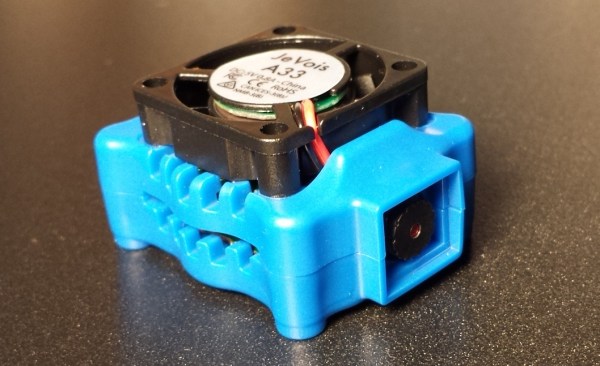
JeVois Machine Vision Camera Nails Demo Mode

JeVois is a small, open-source, smart machine vision camera that was funded on Kickstarter in early 2017. I backed it because cameras that embed machine vision elements are steadily growing more capable, and JeVois boasts an impressive range of features. It runs embedded Linux and can process video at high frame rates using OpenCV algorithms. It can run standalone, or as a USB camera streaming raw or pre-processed video to a host computer for further action. In either case it can communicate to (and be controlled by) other devices via serial port.

But none of that is what really struck me about the camera when I received my unit. What really stood out was the demo mode. The team behind JeVois nailed an effective demo mode for a complex device. That didn’t happen by accident, and the results are worth sharing.

Continue reading “JeVois Machine Vision Camera Nails Demo Mode” →

Don’t Be A Code Tyrant, Be A Mentor

Hardware hacking is a way of life here at Hackaday. We celebrate projects every day with hot glue, duct tape, upcycled parts, and everything in between. It’s open season to hack hardware. Out in the world, for some reason software doesn’t receive the same laissez-faire treatment. “Too many lines in that file” “bad habits” “bad variable names” the comments often rain down. Even the unsafest silliest of projects isn’t safe. Building a robot to shine lasers into a person’s eyes? Better make sure you have less than 500 lines of code per file!

Why is this? What makes readers and commenters hold software to a higher standard than the hardware it happens to be running on? The reasons are many and varied, and it’s a trend I’d like to see stopped.

Software engineering is a relatively young and fast evolving science. Every few months there is a new hot language on the block, with forums, user groups, and articles galore. Even the way software engineers work is constantly changing. Waterfall to agile, V-Model, Spiral model. Even software design methodologies change — from pseudo code to UML to test driven development, the list goes on and on.

Terms like “clean code” get thrown around. It’s not good enough to have software that works. Software must be well commented, maintainable, elegant, and of course, follow the best coding practices. Most of these are good ideas… in the work environment. Work is what a lot of this boils down to. Software engineers have to stay up to date with new trends to be employable.

There is a certain amount of “born again” mentality among professional software developers. Coders generally hate having change forced upon them. But when they find a tool or system they like, they embrace it both professionally, and in their personal projects. Then they’re out spreading the word of this new method or tool; on Reddit, in forums, to anyone who will listen. The classic example of this is, of course, editors like the vi vs emacs debate.

Continue reading “Don’t Be A Code Tyrant, Be A Mentor” →

The Long Tail Of DIY Electronics

These are the Golden Years of electronics hacking. The home DIY hacker can get their hands on virtually any part that he or she could desire, and for not much money. Two economic factors underlie this Garden of Electronic Eden that we’re living in. Economies of scale make the parts cheap: when a factory turns out the same MEMS accelerometer chip for hundreds of millions of cell phones, their setup and other fixed costs are spread across all of these chips, and a $40 million factory ends up only costing $0.50 per unit sold.

But the unsung hero of the present DIY paradise is how so many different parts are available, and from so many different suppliers, many of them on the other side of the globe. “The Internet” you say, as if that explains it. Well, that’s not wrong, but it’s deeper than that. The reason that we have so much to choose from is that the marginal cost of variety has fallen, and with that many niche products and firms have become profitable where before they weren’t.

So let’s take a few minutes to sing the praises of the most important, and sometimes overlooked, facet of the DIY economy over the last twenty years: the falling marginal cost of variety.

Continue reading “The Long Tail Of DIY Electronics” →