Being a cop’s kid leaves you with a lot of vivid memories. My dad was a Connecticut State Trooper for over twenty years, and because of the small size of the state, he was essentially on duty at all times. His cruiser was very much the family vehicle, and like all police vehicles, it was loaded with the tools of the trade. Chief among them was the VHF two-way radio, which I’d listen to during long car rides, hearing troopers dispatched to this accident or calling in that traffic stop.
One very common call was the blood relay — Greenwich Hospital might have had an urgent need for Type B+ blood, but the nearest supply was perhaps at Yale-New Haven Hospital. The State Police would be called, a trooper would pick up the blood in a cooler, drive like hell down I-95, and hand deliver the blood to waiting OR personnel. On a good day, a sufficiently motivated and skilled trooper could cover that 45-mile stretch in about half an hour. On a bad day, the trooper might end up in an accident and in need of blood himself.
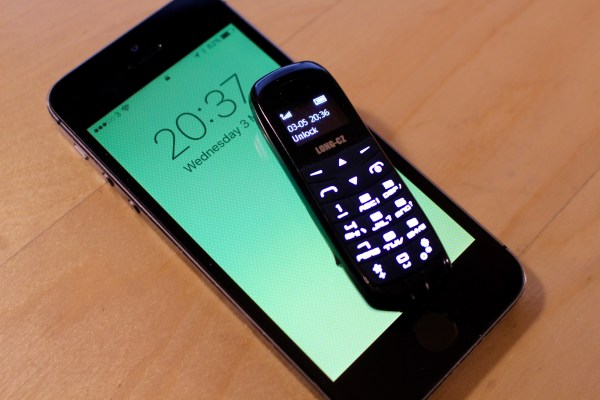
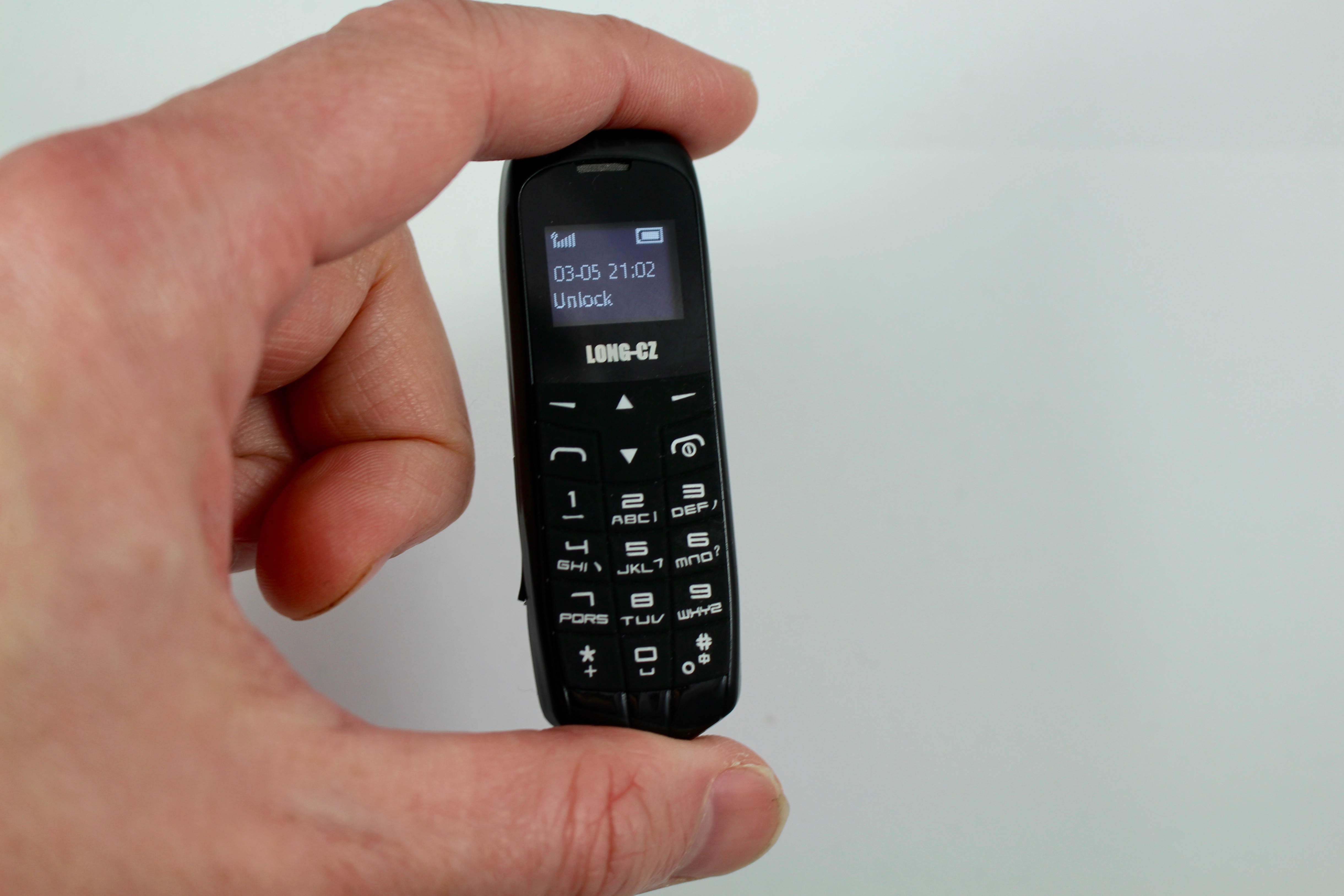
Poke around enough on AliExpress, Alibaba, and especially Taobao—the Chinese facing site that’s increasingly being used by Westerners to find hard to source parts—and you’ll come across some interesting things. The Long-CZ J8 is one of those, it’s 2.67 inch long and weighs just 0.63 ounces, and it’s built in the form factor of a Bluetooth headset.
A couple of months ago Cory Doctorow highlighted this tiny phone, he’d picked up on it because of the marketing. The lozenge-shaped phone was being explicitly marketed that it could “beat the boss”. The boss in question here being the B.O.S.S chair—a scanning technology that has been widely deployed across prisons in the U.K. in an attempt to put a halt to smuggling of mobile phones to inmates.
The Long-CZ J8 is just 2.67 inch (6.8cm) long.
I wasn’t particularly interested in whether it could make it through a body scanner, or the built-in voice changer which was another clue as to the target market for the phone. However just the size of the thing was intriguing enough that I thought I’d pick one up and take a look inside. So I ordered one from Amazon.
Git is one of those tools that is so simple to use, that you often don’t learn a lot of nuance to it. You wind up cloning a repository from the Internet and that’s about it. If you make changes, maybe you track them and if you are really polite you might create a pull request to give back to the project. But there’s a lot more you can do. For example, did you know that Git can track collaborative Word documents? Or manage your startup files across multiple Linux boxes?
Git belongs to a family of software products that do revision (or version) control. The idea is that you can develop software (for example) and keep track of each revision. Good systems have provisions for allowing multiple people to work on a project at one time. There is also usually some way to split a project into different parts. For example, you might split off to develop a version of the product for a different market or to try an experimental feature without breaking the normal development. In some cases, you’ll eventually bring that split back into the main line.
Although in the next installment, I’ll give you some odd uses for Git you might find useful, this post is mostly the story of how Git came to be. Open source development is known for flame wars and there’s at least a few in this tale. And in true hacker fashion, the hero of the story decides he doesn’t like the tools he’s using so… well, what would you do?
If you have more than a few bank cards, door-entry keycodes, or other small numeric passwords to remember, it eventually gets to be a hassle. The worst, for me, is a bank card for a business account that I use once in a blue moon. I probably used it eight times in five years, and then they gave me a new card with a new PIN. Sigh.
Quick, What’s My PIN?
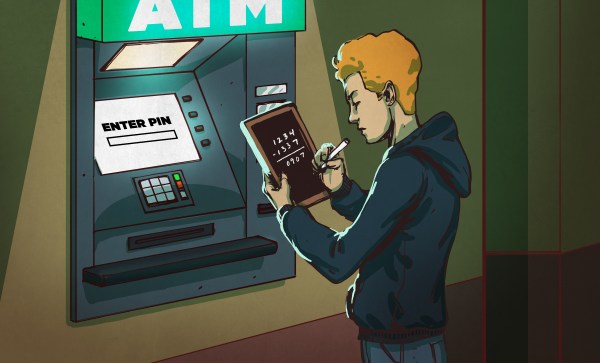
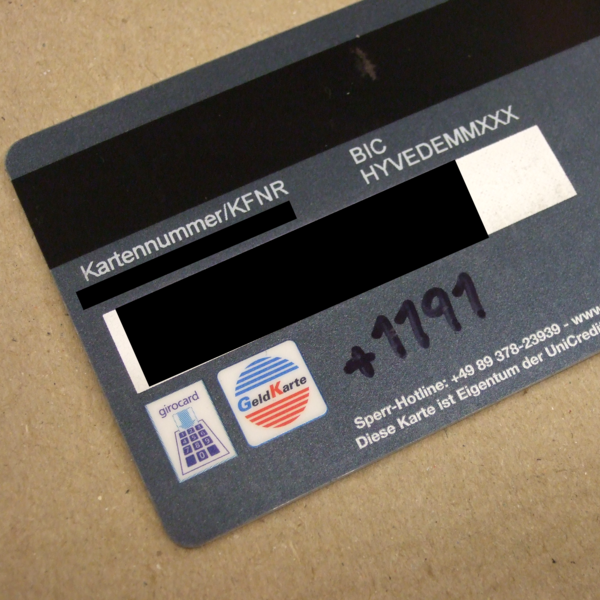
How would a normal person cope with a proliferation of PINs? They’d write down the numbers on a piece of paper and keep it in their wallet. We all know how that ends, right? A lost wallet and multiple empty bank accounts. How would a hacker handle it? Write each number down on the card itself, but encrypted, naturally, with the only unbreakable encryption scheme there is out there: the one-time pad (OTP).
The OTP is an odd duck among encryption methods. They’re meant to be decrypted in your head, but as long as the secret key remains safe, they’re rock solid. If you’ve ever tried to code up the s-boxes and all that adding, shifting, and mixing that goes on with a normal encryption method, OTPs are refreshingly simple. The tradeoff is a “long” key, but an OTP is absolutely perfect for encrypting your PINs.
The first part of this article appears to be the friendly “life-hack” pablum that you’ll get elsewhere, but don’t despair, it’s also a back-door introduction to the OTP. The second half dives into the one-time pad with some deep crypto intuition, some friendly math, and hopefully a convincing argument that writing down your encrypted PINs is the right thing to do. Along the way, I list the three things you can do wrong when implementing an OTP. (And none of them will shock you!) But in the end, my PIN encryption solution will break one of the three, and remain nonetheless sound. Curious yet? Read on.
Grab a shortwave radio, go up on your roof at night, turn on the radio, and if the ionosphere is just right, you’ll be able to tune into some very, very strange radio stations. Some of these stations are just a voice — usually a woman’s voice — simply counting. Some are Morse code. All of them are completely unintelligible unless you have a secret code book. These are number stations, or radio stations nobody knows much about, but everyone agrees they’re used to pass messages from intelligence agencies to spies in the field.
A few years ago, we took a look at number stations, their history, and the efforts of people who document and record these mysterious messages used for unknown purposes. These number stations exist for a particular reason: if you’re a spy, you would much rather get caught with an ordinary radio instead of a fancy encryption machine. Passing code through intermediaries or dead drops presents a liability. The solution to both these problems lies in broadcasting messages in code, allowing anyone to receive them. Only the spy who holds a code book — or in the case of the Cuban Five, software designed to decrypt messages from number stations — can decipher the code.
Number stations are a hack, of sorts, of the entire concept of broadcasting. For all but a few, these number stations broadcast complete gibberish. Only to the person holding the code book or the decryption software do these number stations mean anything. However, since the first number stations went on the air over one hundred years ago, broadcasting has changed dramatically. We now have the Internet, and although most web services cannot be considered a one-to-many distribution as how broadcasting is defined, Twitter can. Are there number stations on Twitter? There sure are. Are they used by spies or agents of governments around the world? That’s a little harder to say.
It sounds like a scene from a movie. A dark night in London, 1972. A young man walks alone, heading home after a long night of practicing with his band. His heavy Fender bass slung over his back, he’s weary but excited about the future. As he passes a skip (dumpster for the Americans out there), a splash of color catches his attention. Wires – not building power wires, but thinner gauge electronics connection wire. A tinkerer studying for his Electrical Engineering degree, the man had to investigate. What he found would become rock and roll history, and the seed of mystery stretching over 40 years.
The man was John Deacon, and he had recently signed on as bassist for a band named Queen. Reaching into the skip, he found the wires attached to a circuit board. The circuit looked to be an amplifier. Probably from a transistor radio or a tape player. Queen hadn’t made it big yet, so all the members were struggling to get by in London.
Deacon took the board back home and examined it closer. It looked like it would make a good practice amplifier for his guitar. He fit the amp inside an old bookshelf speaker, added a ¼ “ jack for input, and closed up the case. A volume control potentiometer dangled out the back of the case. Power came from a 9-volt battery outside the amp case. No, not a tiny transistor battery; this was a rather beefy PP-9 pack, commonly used in radios back then. The amp sounded best cranked all the way up, so eventually, even the volume control was removed. John liked the knobless simplicity – just plug in the guitar and play. No controls to fiddle with.
You’ll all remember my grand adventure in acquiring a photocopier. Well, it’s been a rollercoaster, I tell ya. While I still haven’t found a modification worthy enough to attempt, I have become increasingly frustrated. From time to time, I like to invite my friends and family over for dinner, and conversation naturally turns to things like the art on the walls, the fish in the aquarium, or perhaps the photocopier in the living room. Now, I dearly love to share my passions with others, so it’s pretty darned disappointing when I go to fire off a few copies only to have the machine fail to boot! It was time to tackle this problem once and for all.
When powered up, the photocopier would sit at a “Please Wait…” screen for a very long time, before eventually coughing up an error code — SC990 — and an instruction to call for service. A bunch of other messages would flash up as well; Address Book Data Error, Hard Drive Data Error, and so on. In the end I realized they all centered around data storage.
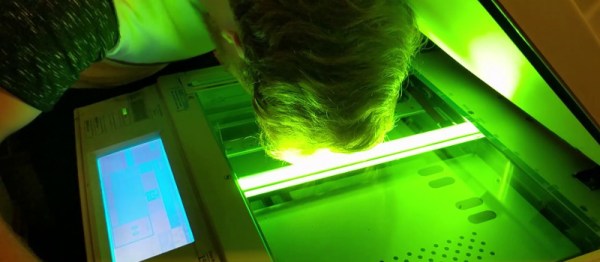
Pictured: the author, in his happy place, at peace with the copier.
Now, I’d already tried diving into the service menu once before, and selected the option to format the hard drive. That had led to the problem disappearing for a short period, but now it was back. No amount of mashing away at the keypad would work this time. The format commands simply returned “Failed” every time. What to do next? You guessed it, it was time for a teardown!
Thankfully, photocopiers are designed for easy servicing — someone’s paying for all those service calls. A few screws and large panels were simply popping off with ease; completely the opposite of working on cars. Spotting the hard drive was easy, it looked like some sort of laptop IDE unit. With only SATA laptops around the house to salvage parts from, I wasn’t able to come up with something to swap in.
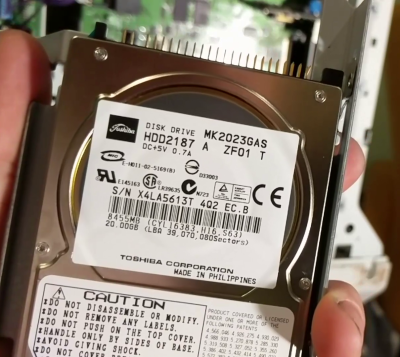
A bit of research (and reading the label) taught me that the drive was a Toshiba MK2023GAS/HDD2187. Replacements were available on eBay, but if I waited two weeks I’d probably be wrist deep in some other abandoned equipment. It had to be sorted on the night. In the words of [AvE], if you can’t fix it… well, you know how it goes. I yanked the drive and, lo and behold – the copier booted straight up! Just to be sure I wasn’t hallucinating, I churned out a few copies, and other than the continued jamming on all-black pages, everything was fine. Literally all it took to get the copier to boot was to remove the ailing drive. Suffice to say, I was kind of dumbfounded.
The hard drive a.k.a. the villain of the piece.
I’m happy to chalk up the win, but I have to draw issue with Ricoh’s design here. The copier is clearly capable of operating perfectly well without a hard drive. It will give up its document server and address book abilities, but it will still make copies and print without a problem.
Yet, when the copier’s drive fails, the unit fails completely and refuses to work. This necessitates a service call for the average user to get anything at all happening again — causing much lost work and productivity. A better design in my eyes would have the copier notify users of the lost functionality due to the failed drive and the need to call service, but let them copy! Any IT administrator will know the value of a bodged work around that keeps the company limping along for the day versus having a room of forty agitated workers with nothing to do. It’s a shame Ricoh chose to have the photocopier shut down completely rather than valiantly fight on.
Feel free to chime in with your own stories of minor failures that caused total shutdowns in the comments. Video below the break.