Supercon is Hackaday’s annual gathering, and you absolutely need to be there.
Today, we’re pleased to announce our lineup of workshops, and it’s more than we’ve ever offered, thanks to moving to a bigger venue and to our awesome community of hackers stepping up to give them. There’s something here for everyone, so if anything strikes your fancy, be sure to book yourself a slot soon. (If you have a ticket already, you sign up for the workshop as an “add-on”, BTW.) Workshops always fill up fast, due to the small and hands-on nature of the beast.
If you already know what a nonius is, you can probably skip this post. But, if like us, you would have to look it up, we’ll tell you what we found out. It turns out, a translation mistake taught us a new word and some history we weren’t aware of.
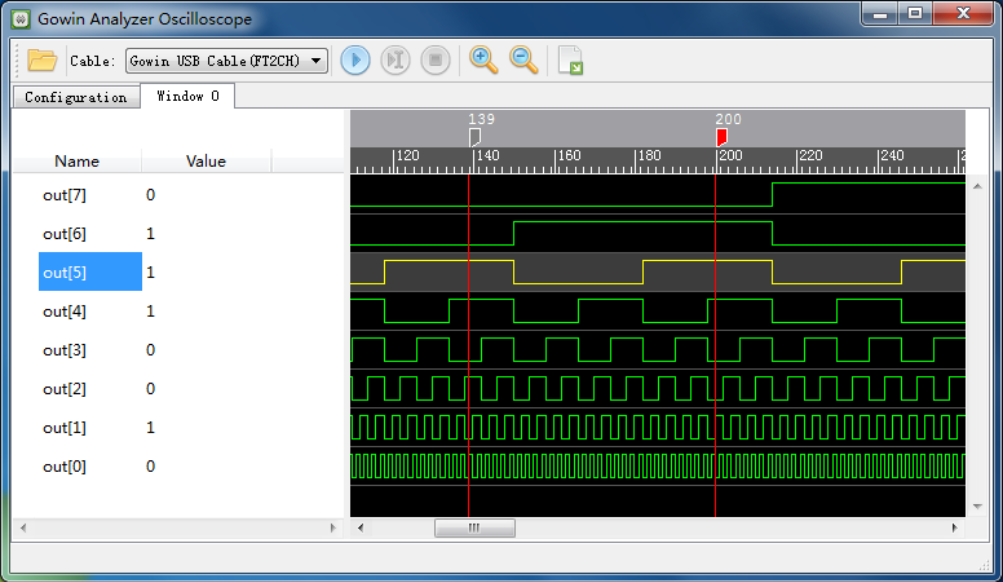
In the manual, this is captioned: Figure 4-7 Nonius Display (Standard Mode)
Have a look at the adjacent graphic from a waveform display. What would you call the vertical red lines at positions 139 and 200?
We’d probably call them markers. Or maybe cursors. The manual, however, calls each one a “nonius”. It refers to them that way multiple times.
Oddly, the manual also has sentences like “Select one nonius and right-click, and then select ‘Remove Marker’ in the next window to delete the nonius.”
So, clearly, a nonius is the vertical line marker or cursor. But that, of course, begs a question…
What is a Nonius?
“Nonio originale” by [Henrique Leitão]Have you ever heard of the vernier scale? If you’ve done navigation, used a traditional caliper, or tuned an old shortwave receiver, you probably have. [Pierre Vernier] developed it in 1631 as a way to better interpolate values on a scale.
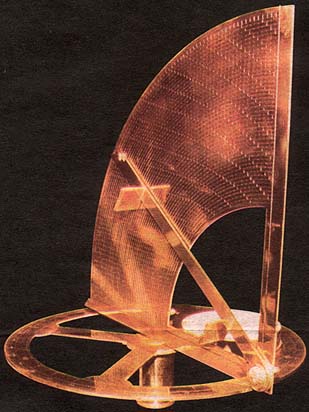
However, there was an earlier version used to improve measurements on astrolabes. A Portuguese navigator named [Pedro Nunes] created this type of astrolabe in 1542. The Latinized version of his name is [Petrus Nonius]. What are the odds of him inventing… oh wait, they named it after him. That does make more sense.
The nonius is a series of concentric circles traced on the instrument. Working towards the center, each circle has fewer divisions than the previous one. In fact, if the outer ring had 90 marks for 90 degrees, the next ring would have 89, and the following one would have 88.
In the last few installments, we looked at using the Tang Nano 20K with both the GOWIN tools and some open-source tools. The open-source tools certainly had the advantage of letting you simulate and debug your design before sending it to the actual chip. However, as we’ll see, the GOWIN tools include a very easy-to-use, capable logic analyzer.
Setup
First, you’ll need a GAO config file. When you create one in the editor, you are given a number of complex options. With an active GAO file, the tool builds a logic analyzer into your design, and the file sets the trigger conditions.
Here’s a tip. You can only have one active GAO file. Sometimes you don’t want the logic analyzer. Other times you might want an alternate configuration. If you right-click almost any file in the IDE’s Design tab, you’ll see you can disable it. That gives it a big red X and excludes it from future builds. Well, at least until you enable it again. This lets you pick between multiple GAO files, or even multiple Verilog files, for a particular build (e.g., one for tests and another for production).
If you create a GAO file from scratch, it will ask you if you want “Lite Mode.” As far as I can tell, you will never want this mode. Always use Standard Mode. In addition, you nearly always want RTL mode, which shows you (mostly) the symbols you’ve defined and not the ones added during processing.
You can find the entire manual online, of course. However, the video below and the rest of the post will get you started quickly.
GAO Basics
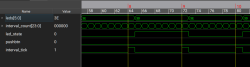
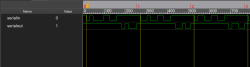
To set up probing, we need to understand the design, so the rest of this post covers the Verilog we’ll use to test the logic analyzer feature, and you’ll see how the analyzer works in a video. Here are a few sneak peeks at what the analyzer output we’ll see at the end looks like:
Segmented capture of interval logic
Low-rate serial data capture
The left-hand image shows the pulse that flips the LEDs, which is tricky because the sampling clock is 27 MHz. The right-hand side shows serial data and uses a slower clock specifically used for debugging.
When you first learn to program, memory seems pretty straightforward. You have a bunch of bytes, each with an address. If you want to read or write something, you specify the address, and the computer goes to that place and does your bidding. Sure, some addresses might be reserved for hardware or the operating system, but the general idea is simple: memory is a big array of bytes.
Just like we pretend that a wire is a perfect conductor, the big array of memory model used to be a slight twisting of the truth. On a modern computer, however, it is almost entirely a lie. The address you use probably isn’t a physical address. The data you read might not come from RAM at all. Even if it does, it might be sitting in one of several caches. And if you follow the rabbit hole far enough, you discover that your SSD is arguably just another level in the memory hierarchy.
The Need For Speed
The fundamental problem is that processors have gotten much faster than memory. A modern processor can execute several instructions per clock cycle, but accessing ordinary DRAM can take hundreds of cycles. If the processor had to wait for RAM every time it needed data, much of that impressive computing power would go to waste.
The solution is caching. Keep copies of frequently used data in smaller, faster memories closer to the processor. Most modern desktop processors have at least three levels of cache. The L1 cache is tiny but extremely fast, and often split between instructions and data. L2 is larger and somewhat slower, while L3 is even larger and usually slower as well.
It probably goes without saying that if you send four humans to observe the Moon up close, they’ll see things that those of us stuck here on Earth have never noticed. Luckily for us, they took impeccable notes and brought plenty of cameras, which NASA has shared with the rest of the class as Artemis II: Sights & Sounds of Science.
Well, technically it’s called the Artemis II Preliminary Lunar Science Report, but we appreciate the space agency adding a little flair to it and formatting the findings for public consumption. Arguably the most significant observations detailed in the report are the impact flashes on the lunar surface. As you may recall, the trajectory of the Orion spacecraft meant the crew experienced a unique solar eclipse on the sixth day of the mission, giving them an unprecedented close-up view of the darkened Moon. During this time, they were able to see flashes of light with their unaided eyes, which NASA has since confirmed were small rocky fragments — perhaps no more than a few inches wide — slamming into the lunar surface at incredible speeds.
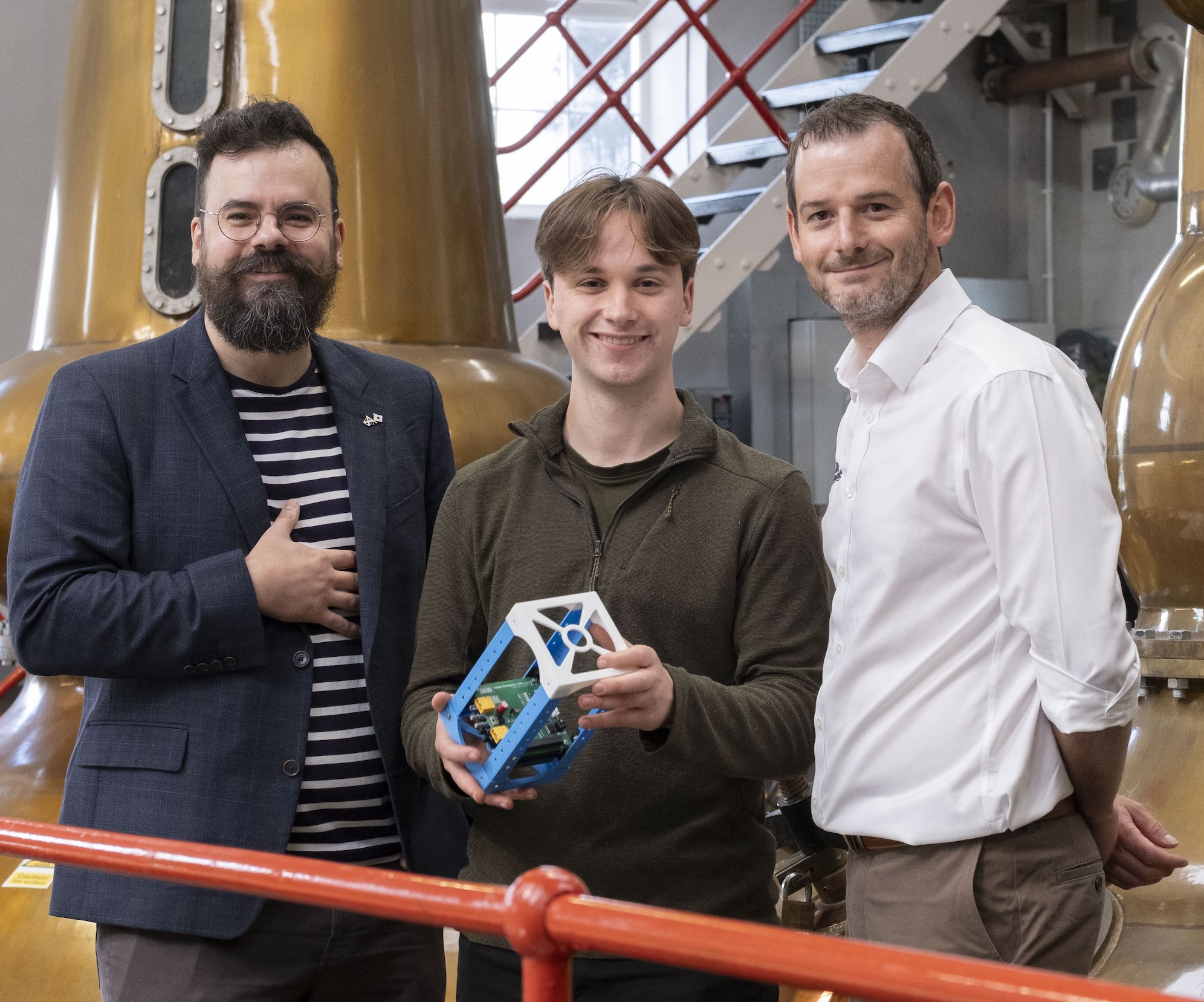
To boldly go where no whisky has gone before.
The Artemis II mission was one for the history books, for most of us the most significant space mission of our lifetimes. But as access to space becomes cheaper and more routine, it stands to reason that not all activities in orbit will be quite so momentous. For example, students from the University of Glasgow and Japan’s Kyushu Institute are currently collaborating on a planned mission to distill whisky in space for the first time.
Scheduled to launch in 2028, the CubeSat will carry 10 ml of fluid and spend five years in orbit studying how its chemical composition changes, with a special interest in how the frequent changes experienced as the spacecraft travels around the Earth could influence the maturing process. While this might not seem terribly interesting to teetotalers, it offers an opportunity to gain more practical experience with orbital manufacturing which will likely inform future missions.
We were looking into the marvelous recent project by [Throaty Mumbo] to recreate and reimagine the forgotten world of VHS-tape-based video games. Wait, what? Yes, back in the day, when computer graphics were more primitive, there were attempts to mix the gameplay of video games with the graphics from a video cassette. Take the Action Max system. It worked with a light-gun that pointed at the screen while the video played, and you tried to shoot at things as they flew by. Think Duck Hunt, but in glorious VHS video quality with cheesy acting, and the same gameplay loop every time, because it’s on the tape.
The unreleased Control-Vision VHS gaming system, co-developed with none other than Steve Wozniak, took the idea a little further and ran simultaneous sub-videos, and your actions would choose which of the sub-tracks would play at any given time. This let them do things like switch between videos depending on whether you caught the bad guys or missed them entirely, for instance.
These games came in the late 1980s, though, and they were all derivatives of the seminal Dragon’s Lair, which is probably the least fun video game I’ve ever had the chance to play, but among the most entertaining in a weird way. Instead of a linear VHS tape, Dragon’s Lair, and the later but equally unplayable Space Ace, were based on the then-new video disc technology that could swap between entirely different tracks almost seamlessly.
“Almost” is the key word here, though. Although the animations were absolutely marvelously cartoony, and looked stunning in an arcade up against video games of the time, there was a significant fraction of a second of delay between commanding an action with the joystick and the machine swapping up to the correct track. There were a couple of sections where back-to-back actions were necessary, and the challenge was to work around the game’s exact track-swapping-glitch time. As good as they looked, the gameplay was no fun.
But the game was influential, as evidenced by its VHS-based clones. If you’d like to give it a try, you’ll not be surprised to hear that there’s an emulator for Dragon’s Lair and its spin-off games.
What do all of these have to do with each other? We love how these games took a current technology – in this case video discs or video tapes – and tried to make it do something else: These games were all hacks. If you look at them in that light, maybe you can look past the horrible acting in Night Trap or the frustrating glitches in Dragon’s Lair. (Or maybe not. Give me Robotron: 2084 any day.)
This article is part of the Hackaday.com newsletter, delivered every seven days for each of the last 200+ weeks. It also includes our favorite articles from the last seven days that you can see on the web version of the newsletter.
Want this type of article to hit your inbox every Friday morning? You should sign up!
This week, Elliot Williams and Kristina Panos met a few minutes later than usual, and somehow defeated a buzz together with the power of will before settling into the news, rifling through the Mailbag, and otherwise creating the attached podcast.
So, the news. Amazon, in their infinite wisdom, have chosen to not only remove Alexa’s aux port on future models, but also disable the input on extant ones. Is this really bad news? Maybe just because it seems like taking a choice away for the sake of exerting power over the people.
Anyway. In Hackaday news, the Retrocomputing Contest is currently on fire, and runs through 10AM PDT on Tuesday, October 27th. That means you have about 2.5 weeks left.
After digging deep in the Mailbag and eventually just dumping the thing out on the table, we found our brand new Hackaday Podcast Mailbag Audio Bumper! This jingle comes courtesy of [Dakota Winslow], who also advises that there are Easter eggs to be found.
Then, it was on to the hacks, including Elliot’s record-tying number of Quick Hacks, and plenty of in-linkage.
Check out the links below if you want to follow along, and as always, tell us what you think about this episode in the comments!