Fork And Run: The Definitive Guide To Getting Started With Multiprocessing

Since the early 2000s, the CPU industry has shifted from raw clock speed to core counts. Pat Gelsinger famously took the stage in 2002 and gave the talk the industry needed, stating processors needed specialty silicon or multiple cores to reduce power requirements and spread heat. A few years later, the Core series was introduced with two or four-core configurations to compete with the AMD Athlon 64 x2.

Nowadays, we’re seeing heterogeneous chip designs with big and little cores, chiplets, and other crazy fabrication techniques that are fundamentally the same concept: spread the thermal load across multiple pieces of silicon. This writer is willing to put good money into betting that you’ll see consumer desktop machines with 32 physical cores in less than five years. It might be hard to believe, but a 2013 Intel Haswell i7 came with just four cores compared to the twenty you’ll get in an i7 today. Even an ESP32 has two cores with support in FreeRTOS for pinning tasks to different cores. With so many cores, how to even write software for that? What’s the difference between processes and threads? How does this all work in straight vanilla C98?

Continue reading “Fork And Run: The Definitive Guide To Getting Started With Multiprocessing”
Future Brings CPU Modules, And The Future Is Now

Modularity is a fun topic for us. There’s something satisfying about seeing a complex system split into parts and these parts made replaceable. We often want some parts of our devices swapped, after all – for repair or upgrade purposes, and often, it’s just fun to scour eBay for laptop parts, equipping your Thinkpad with the combination of parts that fits you best. Having always been fascinated by modularity, I believe that hackers deserve to know what’s been happening on the CPU module front over the past decade.

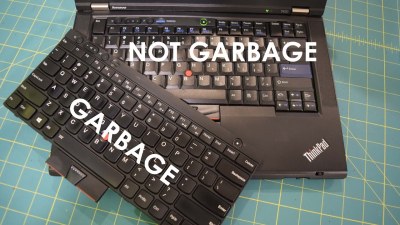
A Youtube thumbnail showing a Thinpad in the background with "Not Garbage" written over its keyboard, and one more keyboard overlaid onto the picture with "garbage" written on that one.
This “swap your Thinkpad keyboard” video thumbnail captures a modularity-enabled sentiment many can relate to.

We’ve gotten used to swapping components in desktop PCs, given their unparalleled modularity, and it’s big news when someone tries to split a yet-monolithic concept like a phone or a laptop into modules. Sometimes, the CPU itself is put into a module. From the grandiose idea of Project Ara, to Intel’s Compute Card, to Framework laptop’s standardized motherboards, companies have been trying to capitalize on what CPU module standardization can bring them.

There’s some hobbyist-driven and hobbyist-friendly modular standards, too – the kind you can already use to wrangle a powerful layout-demanding CPU and RAM combo and place it on your simple self-designed board. I’d like to tell you about a few notable modular CPU concepts – their ideas, complexities, constraints and stories. As you work on that one ambitious project of yours – you know, the one, – it’s likely you will benefit a lot from such a standard. Or, perhaps, you’ll find it necessary to design the next standard for others to use – after all, we all know there’s never too few standards! Continue reading “Future Brings CPU Modules, And The Future Is Now”

New Parkinson’s Test Smells Success

Parkinson’s disease affects millions of people all over the world. The degenerative condition causes characteristic tremors, trouble walking, and often comes with complications including dementia, depression, and anxiety.

One of the major challenges around Parkinson’s disease involves diagnosis. There’s no single, commonly-available test that can confirm or rule out the disease. It’s can cause particular frustration as the disease is most treatable in its early stages.

That may soon change, however. One woman identified that she seemingly had the ability to “smell” the disease in those affected, and is now working with scientists to develop a test for the condition.

Follow Your Nose

The human sense of smell, by and large, isn’t particularly impressive. It helps us enjoy the scent of fresh bread baking in an oven, or the aroma of freshly cut grass. However, as a tool for inspecting and learning about the world around us, it really comes up short.

Some of us, though, are more capable in the olfactory department than others. Joy Milne from Perth, Scotland, is one such person. She happened to detected a change in her partner’s characteristic smell, one day, and twelve years later, they were diagnosed with Parkinson’s disease.

The idea that someone could “smell” a difference with people with Parkinson’s disease is an easy one to test. When Milne eventually put the idea together that the different smell she noticed was perhaps related to her husbands condition, she quickly drew the interest of scientists. With the aid of her partner, a former doctor, she teamed up with researchers Dr. Tilo Kunath and Professor Perdita Barran to investigate further. Continue reading “New Parkinson’s Test Smells Success”

Git Intro For Hardware Hackers

Git is a wonderful tool that can multiply your project’s impact, or make your project easier to manage by an order of magnitude. Some of us hackers don’t yet know how to use command-line Git, but a relatable example of why a certain tool would be useful might be a good start. Today, I’d like to give you a Git crash course – showing you why and how to put a KiCad PCB into a Git repository, later to be shared with the world.

KiCad works wonderfully with Git. The schematic and PCB files of KiCad are human-readable, especially when compared to other PCB file formats. KiCad creates different files for different purposes, each of them with a well-defined role, and you can make sense of every file in your project folder. What’s more, you can even modify KiCad files in a text editor! This is exactly the kind of use case that Git fits like a glove.

Not Just For Software Developers

What’s Git about, then? Fundamentally, Git is a tool that helps you keep track of code changes in a project, and share these changes with each other. Intended for Linux kernel development as its first target, this is what it’s been designed for, but it’s flexibility extends far beyond software projects. We hardware hackers can make use of it in a variety of ways – we can store PCB and other design software files, blog articles, project documentation, personal notes, configuration files and whatever else that even vaguely fits the Git modus operandi. Continue reading “Git Intro For Hardware Hackers”

Robotic Surgeons Are Showing Hints Of One Day Outperforming Humans

When it comes to fields that are considered the most complex of human endeavours, the most typically cited are those of rocket science and brain surgery. Indeed, to become a surgeon is to qualify in a complex, ever-changing, and high-performance field, with a pay scale and respect to match.

The tools of surgery have changed over time, with robotic assistants becoming commonplace in recent decades. Now the latest robots are starting to outperform human surgeons in some ways. Let’s look at how that’s been achieved, and what it means for the future of medicine. Continue reading “Robotic Surgeons Are Showing Hints Of One Day Outperforming Humans”

Hackaday Links Column Banner

Hackaday Links: September 11, 2022

Good news out of Mars from the little lunchbox that could — in the seven times that MOXIE has run since it arrived in February 2021, it has reached its target production of six grams of oxygen per hour, which is in line with the output of a modest tree here on Earth. The research team which includes MOXIE engineers report that although the solid oxide electrolysis machine has shown it can produce oxygen at almost any time or day of the Martian scale, they have not shown what MOXIE can do at dawn or dusk, when the temperature changes are substantial, but they say they have ‘an ace up (their) sleeve’ that will let them do that. We can’t wait to see what they mean.

In other, somewhat funnier space news — early last Sunday morning, the ESA’s Solar Orbiter was cruising by Venus as part of a gravity-assist maneuver to get the Orbiter closer to the Sun. Two days before the Orbiter was to reach its closest point to the spacious star, it spat a coronal mass ejection in the general direction of both Venus and the Orbiter (dibs on that band name), as if to say ‘boo’. Fortunately, the spacecraft is designed to withstand such slights, but the same cannot be said for Venus — these events have their way with Venus’ atmosphere, depleting it of gasses.

Continue reading “Hackaday Links: September 11, 2022”

Who Is Responsible For Your Safety?

We recently posted a video where some ingenious metal-shop hackers made a simple jig to create zig-zag oil grooves on the inside of a cylinder, and the comment section went wild. What ensued was a flood of complaints that the video displayed unsafe shop practices, from lack of safety glasses to wearing flip-flops while operating a lathe.

Where the comments went off the rails were people asking Hackaday to remove our discussion of the video, because the commenters thought that we were somehow implicitly encouraging open-toed footwear in the presence of machine tools. We certainly weren’t! We wanted you all to see the clever machining hack, and be inspired to build your own. We figure that you’ve got the safety angle covered.

Now don’t get me wrong – there were safety choices made in the video that I would not personally make. But it also wasn’t my shop and I wasn’t operating the machines. And you know who is ultimately responsible for the safety in my basement shop? Me! And guess who is responsible for safety in your shop.

But of course, none of us know everything about every possible hazard. (Heck, I wrote just that a few weeks ago!) So while we’re sympathetic with the “that’s not safe!” crew, we’re not going to censor inspiring hacks just because something done along the way wasn’t done in the way we would do it. Instead, it’s our job, in the comment section as in Real Life™, to help each other out and share our good safety tips when we can.

You’ll see some crazy stuff in videos, and none of it is to be repeated without thinking. And if you do see something dodgy, by all means point it out, and mention how you would do it better. Turn the negative example around for good, rather than calling for its removal. Use the opportunity to help, rather than hide.

But also remember that when the chips are flying toward your personal eyeballs, it’s up to you to have glasses on. We all do potentially hazardous things all the time, and it’s best to be thinking about the risks and their mitigation. So stay safe out there. Keep on learning and keep on hacking!