Modern Radio Receiver Architecture: From Regenerative To Direct Conversion

Modern radio receivers have a distinct advantage over the common early designs which I covered in my previous article. Most of the receivers you will have worked with over the past couple decades are designs by Edwin Armstrong; regenerative, superregenerative, or most commonly superheterodyne. These are distinguished by a few fascinating key traits that bring both benefits and drawbacks.

Today let’s dive into Mr. Armstrong’s receivers. I’ll also talk about DC receivers which, despite the name, are not made to listen to batteries. These are receivers you are much more likely to encounter in modern equipment.

Regenerative and Superregenerative

The regenerative receiver is all about doing more with less. You still see some of these in simple applications like RF remote controls. The idea derives from how an oscillator works. In a simple way of thinking, an oscillator is an amplifier with enough positive feedback that any tiny signal at the right frequency will amplify and then, through feedback, continue to output over and over. If everything were perfect, then, an oscillator would have infinite gain at a given frequency.

Continue reading “Modern Radio Receiver Architecture: From Regenerative To Direct Conversion”

This Week In Security: Twitter, Windows DNS, SAP RECON

Twitter just had their biggest security breach in years. Mike warned us about it on Wednesday, but it’s worth revisiting a few of the details. The story is still developing, but it appears that malicious actors used social engineering to access an internal Twitter dashboard. This dashboard, among other interesting things, allows directly changing the email address associated with an account. Once the address is changed to the attacker’s, it’s simple to do a password reset and gain access.

The bitcoin address used in the crypto scam ended up receiving nearly $120,000 USD worth of bitcoin, all of which has been shuffled off into different accounts. It’s an old and simple scam, but was apparently rather believable because the messages were posted by verified Twitter accounts.

Screenshot from Motherboard

A series of screenshots have been posted, claiming to be the internal Twitter dashboard used in the attack. More than a few eyebrows have been raised, as a result of that dashboard. First off, the fact that Twitter employees can directly change an account’s email address is asking for trouble. Even more interesting are the tags that can be added to an account. “Trends Blacklist” and “Search Blacklist” do call to mind the rumors of shadow-banning, but at this point it’s impossible to know the details. Motherboard is reporting that Twitter is removing that screenshot across the board when it’s posted, and even suspending accounts that post it. Of course, they’d do that if it were faked as well, so who knows? Continue reading “This Week In Security: Twitter, Windows DNS, SAP RECON”

Hyundai Makes Push Towards Fuel Cell Trucking

Hyundai has begun shipping fuel-cell based heavy duty trucks to face off against battery-electric trucks in the commercial hauling market.

Battery electric vehicles, more commonly known as electric cars, have finally begun to take on the world in real numbers. However, they’re not the only game in town when it comes to green transportation. Fuel cells that use tanks of hydrogen to generate electricity with H2O as the main byproduct have long promised to take the pollution out of getting around, without the frustrating charge times. Thus far though, they’ve failed to make a major impact. Hyundai still think there’s value in the idea, however, and have developed their XCIENT Fuel Cell truck to further the cause. Continue reading “Hyundai Makes Push Towards Fuel Cell Trucking”

Tend Your Garden… Again

In the early 1940s, several countries saw an incredible shift in agriculture. What were called “victory gardens” were being planted en masse by people from all walks of life, encouraged by various national governments around the world. Millions of these small home gardens sprang up to help reduce the price of produce during World War 2, allowing anyone with even the tiniest pot of soil to contribute to the war effort.

It’s estimated that in 1943 alone, victory gardens accounted for around one third of all vegetables produced in the United States. Since then, however, the vast majority of these productive gardens have been abandoned in favor of highly manicured, fertilized, irrigated turfgrass (which produces no food yet costs more to maintain), but thanks to the recent global pandemic there has been a resurgence of people who at least are curious about growing their own food again, if not already actively planting gardens. In the modern age, even though a lot of the folk knowledge has been lost since the ’40s, planting a garden of any size is easier than ever especially with the amount of technology available to help.

As someone who not only puts food on the table as a writer for a world-renowned tech website but also literally and figuratively puts food on the table as a small-scale market farmer, there are a few things that I’ve learned that I hope will help if you’re starting your first garden.

Continue reading “Tend Your Garden… Again”

Printed It: Print-in-Place PCB Gripper

The goal of Printed It is to showcase creations that truly embrace the possibilities offered by desktop 3D printing. The most obvious examples are designs that can be printed quickly and cheaply enough that they’re a valid alternative to commercially available products. But as previous entries into the series have shown, there are also technical considerations. Is it simply a duplicate of something that could be produced via traditional means, or does the design really benefit from the unique nature of 3D printing?

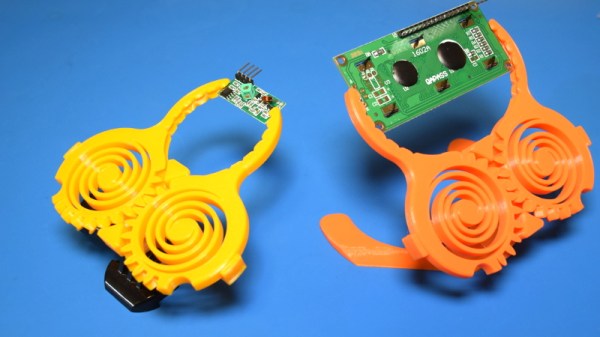
A perfect example is the Print-in-Place PCB Holder/Gripper created by SunShine. This design is able to hold onto PCBs (or really, whatever you wish) without any additional components. Just pull it off the bed, and put it to work. While having to add a rubber band or generic spring would hardly be an inconvenience, there’s always something to be said for a design that’s truly 100% printable.

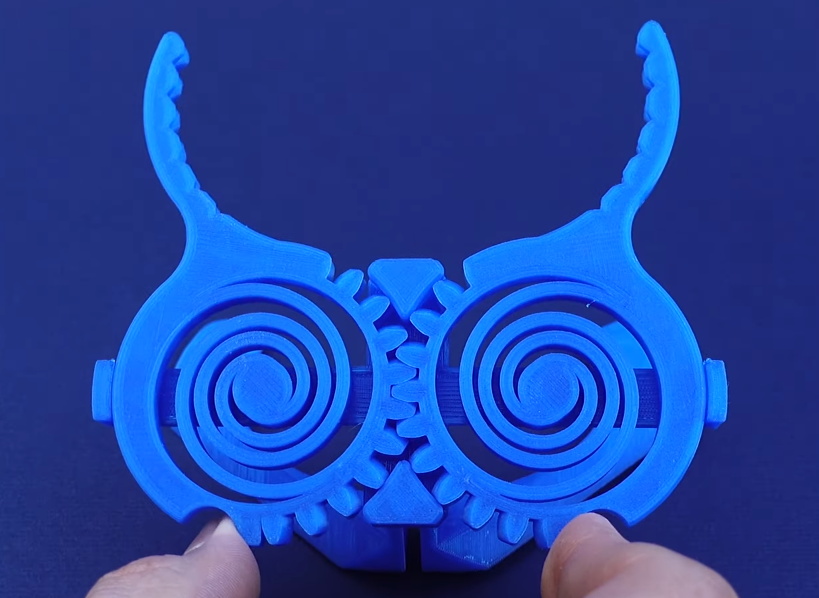
The secret is the dual flat spiral springs integrated into the device’s jaws. While most of the common thermoplastics used in desktop 3D printing are relatively stiff, the springs have been designed in such a way that they can be printed in standard PLA. The backside of the jaws have teeth that mesh together, so the energy of the springs is combined to provide a clamping force. Serrations have been added to the jaws to catch the edge of the PCB and help stabilize it.

Visually, it’s certainly striking. The design largely eschews right angles, giving it an almost biological appearance. Many have compared it to the head of a mantis, or perhaps some piece of alien technology.

There’s no question that the design leverages the strengths of 3D printing either; there’s no other way to produce its intricate interlocking components, especially without the use of any sort of fasteners. In short, this design is an ideal candidate for Printed It. But there’s still one question to answer: does it actually work?

Continue reading “Printed It: Print-in-Place PCB Gripper”

The Many Methods Of Communicating With Submarines

It sometimes seems hard to believe that we humans have managed to explore so little of what we have so much of: the seas. Oceans cover something like 70 percent of the world’s surface, but we’ve only mapped 20 percent of the ocean floor. The 228,000 ocean-dwelling species that we know about represents about ten percent of the estimated total aquatic species. And almost all the life we know about, and the area that we’ve explored thoroughly, is limited to the first few hundred meters from the surface.

The paucity of our deep-water investigatory efforts has a lot to do with the hostility of the sea to those who haven’t evolved to survive in it. It takes extreme engineering and fantastically expensive machines to live and work even a few meters down, and even then submariners quickly become completely isolated from the rest of the world once they’re down there. Underwater communication is particularly challenging, since the properties of seawater confound efforts to use it as a communications medium.

Challenging though it may be, underwater communication is possible, and in this article we’ll take a look at a few modalities that have made operating under the sea possible, and a new technology that might just extend the Internet below the waves.

Continue reading “The Many Methods Of Communicating With Submarines”

Don’t Wait, You Need To See Comet NEOWISE Right Now

By now you’ve heard of NEOWISE, the most spectacular comet to visit our little corner of the galaxy since Hale-Bopp passed through over 20 years ago. But we’re willing to bet you haven’t actually seen it with your own eyes. That’s because up until now, the only way to view this interstellar traveler was to wake up in the pre-dawn hours; an especially difficult requirement considering a large chunk of the population has gotten used to sleeping-in over the last few months.

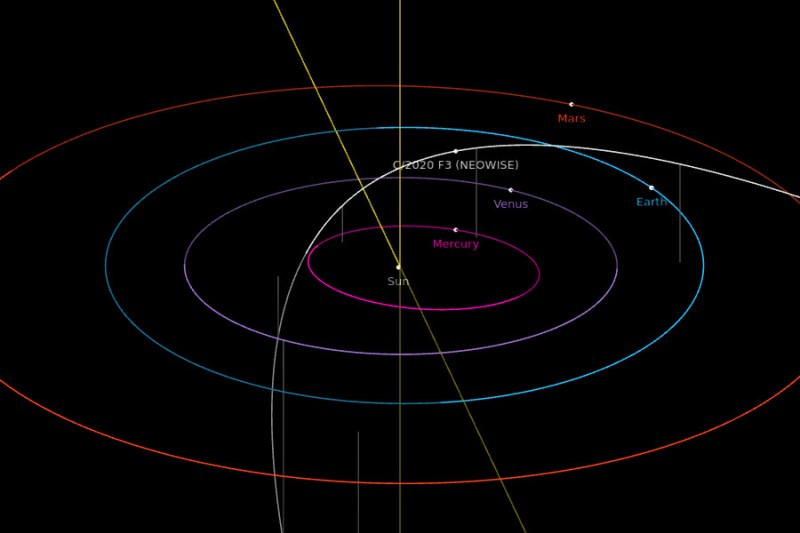
But things are about to change as NEOWISE begins a new phase of its trip through our celestial neck of the woods. Having come to within 44.5 million km (27.7 million miles) of the sun on July 3rd, the comet is now making its way back out of our solar system. Thanks to the complex dance of the heavens, that means that observers in the Northern Hemisphere will now be able to see NEOWISE in the evening sky just above the horizon.

NEOWISE is on a kind of “up and over” trajectory compared to the orbital paths of the planets. Get a better feel for it with JPL’s interactive solar dynamics tool.

While NEOWISE might be beating a hasty retreat from Sol right now, the comet it actually getting closer to us in the process. On July 22nd it will reach perigee, that is, the point in its orbit closest to Earth. On that evening the comet will be approximately 103 million km (64 million miles) away. Not exactly a stone’s throw, but pretty close in astronomical terms. The comet will appear to be getting higher in the sky as it approaches Earth, and should be visible with the naked eye between 10 and 20 degrees above the northern horizon.

Most estimates say that NEOWISE should remain visible until at least the middle of August, though it will be dimming rapidly. After that, you’re going to have to wait awhile for a repeat showing. Given the orbit of this particular comet, it won’t come around our way again for approximately 6,800 years, give or take a few lifetimes.

NASA will be hosting a NEOWISE live stream tomorrow afternoon where researchers will answer questions about this once in a lifetime celestial event, though we think you’ll get a lot more out of it if you just go outside and look up.