Look, I’ve been there too. First the project just prints debug information for a human in nice descriptive strings that are easy to understand. Then some tool needs to log a sensor value so the simple debug messages gain structure. Now your debug messages {{look like : this}}. This is great until a second sensor is added that uses floats instead of ints. Now there are sprinklings of even more magic characters between the curly braces. A couple days later and things are starting to look Turing complete. At some point you look up and realize, “I need a messaging serialization strategy”. Well you’ve come to the right place! Continue reading “The Seedy World Of Message Serialization”→
Who invented the automobile? The answer depends a little bit on your definition of the word. The first practical gas-powered carriage was built by Karl Benz, who later merged his company with Daimler Motor Group to form Mercedez-Benz.
Karl Benz was a design visionary whose first fascinations were with locomotives and bicycles. His 1886 Benz Patent Motorwagen was the first automobile to generate its own power, which was made with a two-stroke engine and transmitted to the rear axle by a pair of chains. He didn’t think it was ready for the road, and he was mostly right.
Bertha Benz, Karl’s wife and business partner, believed in her husband’s invention. She had been there since the beginning, and provided much of the funding for it along the way. If she hadn’t taken it out for a secret, illegal joyride, the Motorwagen may have never left the garage.
For modern students, the spiral notebook has given way to the laptop and the pocket calculator has been supplanted by the smart phone. We’re not just talking about high school and college, either. Today, the education of even grade school children is intrinsically linked with technology. While some might question the wisdom of moving away from the pencil and pad at such a young age, there’s little question that all the kids stuck at home right now due to COVID-19 would have had a much harder time transitioning to remote learning otherwise.
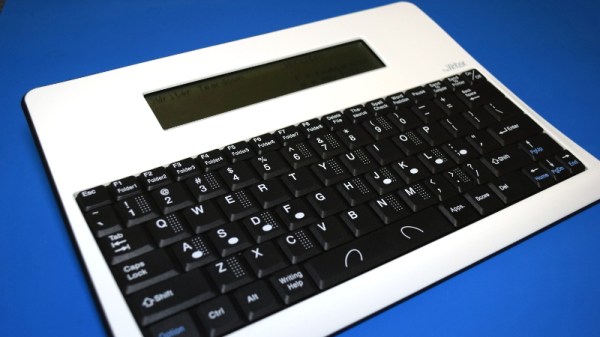
But that certainly wasn’t the case when Advanced Keyboard Technologies released the Writer in 2003. Back then, five years before the first netbooks hit the market, you’d be hard pressed to find a laptop cheap enough to give to a grade school student. In comparison, these small electronic word processors could be purchased for as little as $150. Not only was the initial price low, but the maintenance costs were almost negligible. They ran for hundreds of hours on a standard AA batteries, and didn’t require schools to have any IT staff to manage them. Sure they couldn’t get on the Internet or even run any software, but they would give students a chance to hone their keyboarding skills. Continue reading “Teardown: The Writer Word Processor”→
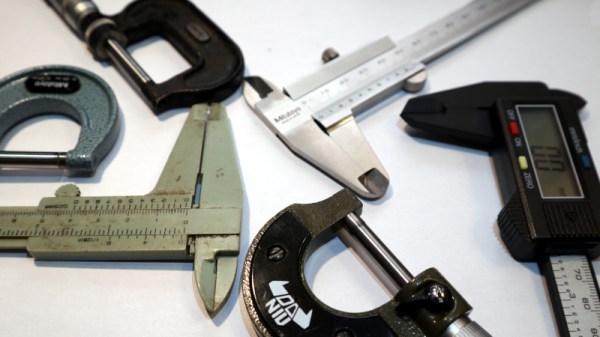
I needed a temperature controller module recently, so off I went to Banggood to order one. As one does I found myself browsing, one thing led to another, and I bought a micrometer screw gauge. While micrometers are pretty expensive devices, reflecting their high precision engineering and construction, this micrometer cost me only about £8, or just under $10, definitely in the spirit of our long-running series of reviewing very cheap tools in search of a diamond in the rough. But perhaps more importantly, this is also the cue for an examination of high precision dimensional measurement. So I’ve assembled a collection of micrometers and vernier calipers of varying quality, and it’s time to dive in and measure some very small things.
Some of you will be metrology enthusiasts with an array of the finest devices available, but I am guessing that many of you will not. The ubiquitous precision measurement device in our community appears to be the digital caliper, a sliding clamp with an LCD display, an instrument that can be had in its most basic form for a very small outlay indeed. For the purposes of this piece though we’re not looking at digital devices but their analogue precursors. If you want a feel for metrology and you’d like some of those heritage tools that parents pass onto their kids then it’s time to learn something about the vernier caliper and the micrometer. Continue reading “Vernier Calipers And Micrometer Screw Gauges, Measuring Without Compromise”→
Over the past decades, additive manufacturing (AM, also known as 3D printing) has become increasingly common in manufacturing processes. While immensely helpful in the prototyping of new products by allowing for rapid turn-around times between design and testing, these days additive manufacturing is used more and more often in the production of everything from small production runs of custom enclosures to hard to machine components for rocket engines.
The obvious advantage of additive manufacturing is that they use generic equipment and common materials as input, without requiring expensive molds as in the case of injection molding, or extensive, wasteful machining of raw materials on a lathe, mill, and similar equipment. All of the manufacturing gets reduced to a 3D model as input, one or more input materials, and the actual device that converts the 3D model into a physical component with very limited waste.
In the nuclear power industry, these benefits haven’t gone unnoticed, which has led to 3D printed parts being developed for everything from keeping existing plants running to streamlining spent fuel reprocessing and even the printing of entire nuclear reactors.
While watching a video about old radios from the 1920s, a phone jack popped up. The host mentioned that phone jacks are super old and he wondered what was their origin. I always assumed they had something to do with the telephone system, and that’s right, but I had no idea how old they really are and how they’ve evolved. Turns out the venerable plug goes back to at least 1878.
Keep in mind, I’m talking about the good old fashioned 1/4″ phone jack with two wires. Over time, the jack and plug have spawned different versions with more wires and — particularly — smaller dimensions. The headphone jack that many smartphone makers are dropping is a direct descendant of that old phone jack. But a mono cable like you would see connecting an electric guitar or another mono source would be right at home connected to a 1900s switchboard. Let’s take a look at the origins of a design that’s almost 150 years old and still in use.
Long ago, before smartphones were ubiquitous and children in restaurants were quieted with awful games on iPads, there was a beautiful moment. A moment in which the end user could purchase, at a bargain price, an x86 computer in a compact, portable shell. In 2007, the netbook was born, and took the world by storm – only to suddenly vanish a few years later. What exactly was it that made netbooks so great, and where did they go?
A Beautiful Combination
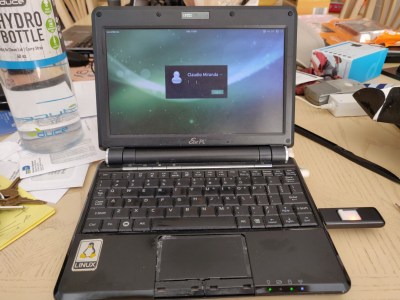
An Asus EEE PC shown here running Linux. You could run anything on them! Because they were real, full-fat computers. No locked down chipsets or BIOS. Just good, clean, x86 fun.
The first machine to kick off the craze was the Asus EEE PC 701, inspired by the One Laptop Per Child project. Packing a 700Mhz Celeron processor, a small 7″ LCD screen, and a 4 GB SSD, it was available with Linux or Windows XP installed from the factory. With this model, Asus seemed to find a market that Toshiba never quite hit with their Libretto machines a decade earlier. The advent of the wireless network and an ever-more exciting Internet suddenly made a tiny, toteable laptop attractive, whereas previously it would have just been a painful machine to do work on. The name “netbook” was no accident, highlighting the popular use case — a lightweight, portable machine that’s perfect for web browsing and casual tasks.
But the netbook was more than the sum of its parts. Battery life was in excess of 3 hours, and the CPU was a full-fat x86 processor. This wasn’t a machine that required users to run special cut-down software or compromise on usage. Anything you could run on an average, low-spec PC, you could run on this, too. USB and VGA out were available, along with WiFi, so presentations were easy and getting files on and off was a cinch. It bears remembering, too, that back in the Windows XP days, it was easy to share files across a network without clicking through 7 different permissions tabs and typing in your password 19 times.