A Singing Arc Lighter

We’ve all been guilty of buying things we want, but don’t need. And that’s how [PodeCoet] found himself in possession of a couple of double-arc electric lighters, thanks to those far-eastern websites purveying cheap goods. ‘Tis the season of giving after all, justified [PodeCoet]. Being a hacker, the obvious thing to do was to make them belt out tinny tunes. If you’re still holding on to your gas lighters, don’t — because these electric ones are ‘oh so hackable’. Dual-arcs are the same, but twice the fun.

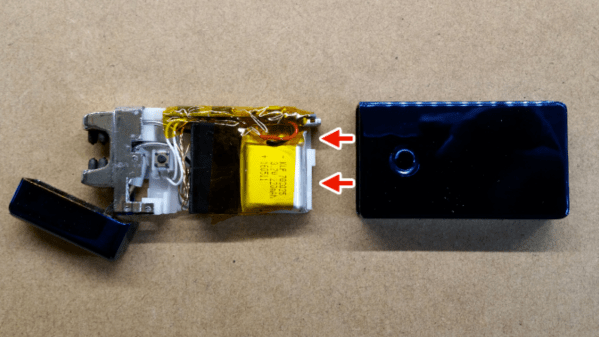
[PodeCoet] starts off with a tear down of the lighter, to figure out the schematic and understand how it works. There’s a charger IC for the LiPo, an unidentifiable micro-controller, a pair of FET’s driving a pair of power transistors, which in turn drive the HF output transformer at around 15.6kHz. He guesses that the “original micro-controller is probably an OTP part like a 12C508” but in the absence of a chipID he couldn’t be sure.

Instead of trying to break his head over it, he just swapped in a pin-compatible PIC12F1840. All that’s left to do is to write some quick-n-dirty code and sprinkle it with funny comments in order to modulate the output signal at audio frequencies. His first choice of tune was “We are Number One” by Lazy Town, the Icelandic educational musical comedy children’s television series (phew). But redditors are awesome, and someone asked him to add the “Imperial March” and [PodeCoet] obliged.

Since he was going to gift these lighters, the sneaky hacker added a prank in the code. Every time the button is pressed for more than two seconds, it works as normally expected and a counter is incremented. On the 20th count, and for one time only, the tune is played. No amount of pressing the button will play the tune again, confounding the user to wonder if he was hallucinating. This also helps ensure the lighter does not self-destruct prematurely, since the output transformer is likely designed for low duty cycles. His blog post contains all of the information needed to do this hack along with handy tips to avoid the problems he faced. A “Happy Birthday” tune would be great when lighting some birthday candles, we think.

[PodeCoet] has a fancy for high voltage stuff – check out “Home built Stun Baton turns you into a cop from Demolition Man“. This man surely loves his pranks, as evidenced by “Hacking your Co-Workers Label Makers“. And the farce is strong in this one — “Student trolls anti-Arduino Prof with parasite MCU“.

Continue reading “A Singing Arc Lighter”

RooBee One, An Open-source SLA/DLP 3D Printer

[Aldric Negrier] is no stranger to the 3D printing world. Having built a few already, he designed and built an SLA/DLP 3D printer, named RooBee One, sharing the plans on Instructables. He also published tons of other stuff, like a 3D Printed Syringe Pump Rack and a 3D Scanning Rig And DIY Turntable. It’s really worth while going through his whole Instructables repository.

This open-source 3D printer was inspired by the Cristelia – SLA/LCD 3d printer and the Vulcanus MAX 3D printer (that he designed). RooBee One has an aluminium frame and an adjustable print area of 80x60x200 mm, with up to 150x105x200mm build volume using an ACER DLP projector. In addition, a fan on top of the printer was added to extract the toxic vapours outside and away from the printer operator. The electronics are based on the Arduino MEGA with the RAMPS 1.4 shield and one NEMA 17 stepper motor. As for the Arduino Mega firmware, [Aldric] choose to use Repetier, which he usually uses in his other printers.

The SLA resin he used is the Standard Blend Resin from Fun to Do Resins. These resins tend to release toxic airborne particles, so extra care should be taken to ventilate the area while printing and also do a proper cleaning afterwards.

You can get a glimpse of the printer making a small gear come to life in the following video:

Continue reading “RooBee One, An Open-source SLA/DLP 3D Printer”

Mechano-Robotic Flute Made From An Old Shotgun

If you take an object and turn it into something else, does that constitute a hack?  Can a musical robot call to question the ethics of firearms exports? If you take a disabled shotgun and turn it into a flute, does it become an art piece? Deep questions indeed — and deliberately posed by [Constantine Zlatev] along with his collaborators [Kostadin Ilov] and [Velina Ruseva].

The Last Gun — a mechano-robotic flute, as [Zlatev] calls it — is built from recovered industrial parts, played using compressed air, and controlled by an Arduino and Raspberry Pi. After graphing the annual arms exports from the United States, the installation plays a mournful tune for each year that they rise, and a jubilant theme for each year they fall.

Continue reading “Mechano-Robotic Flute Made From An Old Shotgun”

2016: As The Hardware World Turns

Soon, the ball will drop in Times Square, someone will realize you can turn ‘2018’ into a pair of novelty sunglasses, and the forgotten mumbled lyrics of Auld Lang Syne will echo through New Year’s Eve parties. It’s time once again to recount the last 366 days, and what a year it’s been.

Arduino got into an argument with Arduino and Arduino won. We got new Raspberry Pis. Video cards are finally getting to the point where VR is practical. The FCC inadvertently killed security in home routers before fixing the problem. All of this is small potatoes and really doesn’t capture the essence of 2016. It’s been a weird year.

Want proof 2016 was different? This year, Microsoft announced they would provide a Linux ‘shim’ with every version of Windows. By definition, 2016 was the year of the Linux desktop. That’s how weird things have been in 2016.

Continue reading “2016: As The Hardware World Turns”

NES Classic Edition – Controller Mod

The Nintendo Classic Mini took the world by storm this year — finally, an NES in a cute, tiny package that isn’t 3D printed and running off a Raspberry Pi! It’s resoundingly popular and the nostalgic set are loving it. But what do you do when you’re two hours deep into a hardcore Metroid session and you realize you need to reboot and reload. Get off the couch? Never!

[gyromatical] had already bought an Emio Edge gamepad for his NES Mini. A little poking around inside revealed some unused pads on the PCB. Further investigation revealed that one pad can be used to wire up a reset button, and two others can be used to create a home switch. Combine this with the turbo features already present on the Emio Edge, and you’ve got a pretty solid upgrade over the stock NES Mini pad. Oftentimes, there’s extra functionality lurking inside products that manufacturers have left inactive for the sake of saving a few dollars on switches & connectors. It’s always worth taking a look inside.

Now, back in 2006, the coolest hack was running Linux on everything — and somebody’s already trying to get Linux on the NES Mini.

Continue reading “NES Classic Edition – Controller Mod”

Little Bobby Tables Just Registered A Company…

Sometimes along comes a tech story that diverges from our usual hardware subject matter yet which just begs to be shared with you because we think you will find it interesting and entertaining.

XKCD 327, Exploits of a Mom (CC BY-NC 2.5).

You will no doubt be familiar with the XKCD cartoon number 327, entitled “Exploits of a Mom”, but familiarly referred to as “[Bobby Tables]”. In it a teacher is ringing the mother of little [Robert’); DROP TABLE Students; –], whose name has caused the loss of a year’s student records due to a badly sanitized database input. We’ve all raised a chuckle at it, and the joke has appeared in other places such as an improbably long car license plate designed to erase speeding tickets.

It's nice to see that Companies House sanitise their database inputs.
It’s nice to see that Companies House sanitise their database inputs.

Today we have a new twist on the Bobby Tables gag, for someone has registered a British company with the name  “; DROP TABLE “COMPANIES”;– LTD“. Amusingly the people at Companies House have allowed the registration to proceed, so either they get the joke too or they are unaware of the nuances of a basic SQL exploit. It’s likely that if this name leaves Her Majesty’s civil servants with egg on their faces it’ll be swiftly withdrawn, so if that turns out to be the case then at least we’ve preserved it with a screenshot.

Of course, the chances of such a simple and well-known exploit having any effect is minimal. There will always be poor software out there somewhere  that contains badly sanitized inputs, but we would hope that a vulnerability more suited to 1996 would be vanishingly rare in 2016.

If by some chance you haven’t encountered it before we’d recommend you read about database input sanitization, someday it may save you from an embarrassing bit of code. Meanwhile we salute the owner and creator of this new company for giving us a laugh, and wish them every success in their venture.

Improving Raspberry Pi Disk Performance

Usually, you think of solid state storage as faster than a rotating hard drive. However, in the case of the Raspberry Pi, the solid state “disk drive” is a memory card that uses a serial interface. So while a 7200 RPM SATA drive might get speeds in excess of 100MB/s, the Pi’s performance is significantly less.

[Rusher] uses the Gluster distributed file system and Docker on his Raspberry Pi. He measured write performance to be a sluggish 1MB/s (and the root file system was clocking in at just over 40MB/s).

There are an endless number of settings you could tweak, but [Rusher] heuristically picked a few he thought would have an impact. After some experimentation, he managed 5MB/s on Gluster and increased the normal file system to 46 MB/s.

Continue reading “Improving Raspberry Pi Disk Performance”