Every day it seems there is a new Alexa story in the news, as for the moment the Amazon voice assistant is in the ascendant over its rivals from Google, Apple, and Microsoft. Today’s slice of Alexa weirdness comes courtesy of a newsreader in San Diego, who inadvertently triggered Alexa-enabled devices within hearing distance of a television to buy doll houses when he reported on a Dallas child’s accidental purchase.
It’s unclear whether any doll houses were dispatched or whether the Echos and Dots merely started the process and asked their owners for confirmation, but we hope it serves to draw attention to the risks associated with an always-on and always-listening device. We’ve looked at how the technology has seemingly circumvented the normal privacy concerns of our own community, so it’s hardly surprising that this kind of incident catches the greater public completely unprepared. It’s one thing for the denizens of a hackspace to troll the owner of a Dot by adding embarrassing products to their wish list, but against a less-informed user who hasn’t worked out how to lock down the device’s purchasing abilities, it’s not too far-fetched to imagine a criminal attack.
Voice assistants are clearly going to become a ubiquitous feature of our lives, and it is inevitable that there will be more such unfortunate incidents which will serve to educate the public about their privacy before the technology reaches maturity. This particular story is definitely Not A Hack, though as our “Alexa” tag shows the devices have huge potential to bring a new dimension to our work. It’s up to all of us in our community to ensure that the voice assistant owners in our lives are adequately educated about them, and maybe resist the urge to say “Alexa, add all the Hackaday merchandise to my wish list!”.
At CES last year, Monoprice introduced a $200 3D printer. Initial expectations of this printer were middling. My curiosity got the best of me, and last summer I picked up one of these printers for a review. The Monoprice MP Select Mini is actually phenomenal, and not just ‘phenomenal for the price’. This machine showed the world how good one of the cheapest printers can be. The future is looking awesome.
You might think Monoprice wouldn’t be able to top the success of this great little machine. You would be wrong. This week, Monoprice announced a bevy of new and upgraded printers. Some are resin. Some are huge. One will sell for $150 USD.
Normally, when something explodes it tends to be a bad day for all involved. But not every explosion is intended to maim or kill. Plenty of explosions are designed to save lives every day, from the highway to the cockpit to the power grid. Let’s look at some of these pyrotechnic wonders and how they keep us safe.
Explosive Bolts
The first I can recall hearing the term explosive bolts was in relation to the saturation TV coverage of the Apollo launches in the late 60s and early 70s. Explosive bolts seemed to be everywhere, releasing umbilicals and restraining the Saturn V launch stack on the pad. Young me pictured literal bolts machined from solid blocks of explosive and secretly hoped there was a section for them in the hardware store so I could have a little fun.
Pyrotechnic fasteners are mechanical fasteners (bolts, studs, nuts, etc.) that are designed to fail in a predictable fashion due to the detonation of an associated pyrotechnic device. Not only must they fail predictably, but they also have to be strong enough to resist the forces they will experience before failure is initiated. Failure is also typically rapid and clean, meaning that no debris is left to interfere with the parts that were previously held together by the fastener. And finally, the explosive failure can’t cause any collateral damage to the fastened parts or nearby structures.
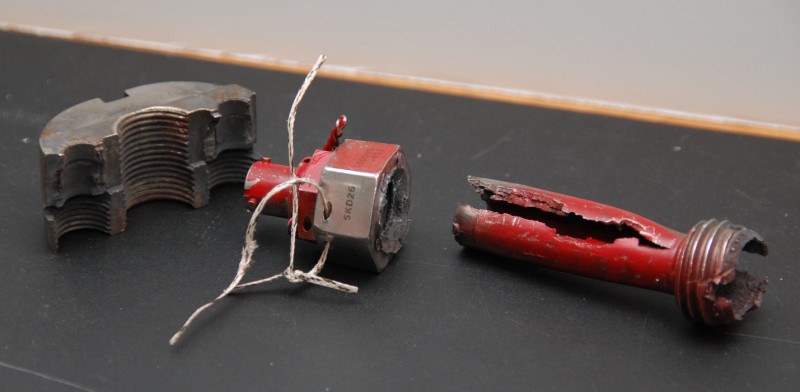
Pyrotechnic fasteners fall into two broad categories. Explosive bolts look much like regular bolts, and are machined out of the same materials you’d expect to find any bolt made of. The explosive charge is usually internal to the shank of the bolt with an initiating device of some sort in the head. To ensure clean, predictable separation, there’s a groove machined into the bolt to create a shear plane.
Frangible nuts are another type of pyrotechnic fastener. These tend to be used for larger load applications, like holding down rockets. Frangible nuts usually have two smaller threaded holes adjacent to the main fastener thread; pyrotechnic booster charges split the nut across the plane formed by the threaded holes to release the fastener cleanly.
“Eject! Eject! Eject!”
Holding back missiles is one thing, but where pyrotechnic fasteners save the most lives might be in the cockpits of fighter jets around the world. When things go wrong in a fighter, pilots need to get out in a hurry. Strapping into a fighter cockpit is literally sitting on top of a rocket and being surrounded by explosives. Most current seats are zero-zero designs — usable at zero airspeed and zero altitude — that propel the seat and pilot out of the aircraft on a small rocket high enough that the parachute can deploy before the pilot hits the surface. Dozens of explosive charges take care of ripping the aircraft canopy apart, deploying the chute, and cutting the seat free from the parachuting pilot, typically unconscious and a couple of inches shorter from spinal disc compression after his one second rocket ride.
There’s little doubt that airbags have saved countless lives since they’ve become standard equipment in cars and trucks. When you get into a modern vehicle, you are literally surrounded by airbags — steering wheel, dashboard, knee bolsters, side curtains, seatbelt bags, and even the rear seat passenger bags. And each one of these devices is a small bomb waiting to explode to save your life.
When we think of explosives we tend to think of substances that can undergo rapid oxidation with subsequent expansion of hot gasses. By this definition, airbag inflators aren’t really explosives, since they are powered by the rapid chemical decomposition of nitrogenous compounds, commonly sodium azide in the presence of potassium nitrate and silicon dioxide. But the difference is purely academic; anyone who has ever had an airbag deploy in front of them or watched any of the “hold my beer and watch this” airbag prank video compilations will attest to the explosive power held in that disc of chemicals.
When a collision is detected by sensors connected to the airbag control unit (ACU), current is applied to an electric match, similar to the engine igniters used in model rocketry, buried within the inflator module. The match reaches 300°C within a few milliseconds, causing the sodium azide to rapidly decompose into nitrogen gas and sodium. Subsequent reactions mop up the reactive byproducts to produce inert silicate glasses and add a little more nitrogen to the mix. The entire reaction is complete in about 40 milliseconds, and the airbags inflate fully within 80 milliseconds, only to deflate again almost instantly through vent holes in the back of the bag. By the time you perceive that you were in an accident, the bag hangs limply from the steering wheel and with any luck, you get to walk away from the accident.
Grid Down
We’ve covered a little about utility poles and all the fascinating bits of gear that hang off them. One of the pieces of safety gear that lives in the “supply space” at the top of the poles is the fuse cutout, or explosive disconnector. This too is a place where a small explosion can save lives — not only by protecting line workers but also by preventing a short circuit from causing a fire.
Cutouts are more than just fuses, though. Given the nature of the AC transmission and distribution grid, the lines that cutouts protect are at pretty high voltages of 11 kV or more. That much voltage means the potential for sustained arcing if contacts aren’t rapidly separated; the resulting plasma can do just as much if not more damage than the short circuit. So a small explosive cartridge is used to rapidly kick the fuse body of a cutout out of the frame and break the circuit as quickly as possible. Arc suppression features are also built into the cutout to interrupt the arc before it gets a chance to form.
[Big Clive] recently did a teardown of another piece of line safety gear, an 11 kV lightning arrestor with an explosive disconnector. With a Dremel tool and a good dose of liquid courage, he liberated a carbon slug from within the disconnector, which when heated by a line fault ignites a .22 caliber charge similar to those used with powder actuated fastener tools. The rapid expansion of gasses ruptures the cases of the disconnector and rapidly breaks the circuit.
Conclusion
We’ve covered a few of the many ways that the power of expanding gas can be used in life safety applications. There are other ways, too — snuffing out oil field fires comes to mind, as does controlled demolition of buildings. But the number of explosives protecting us from more common accidents is quite amazing, all the more so when you realize how well engineered they are. After all, these everyday bombs aren’t generally blowing up without good reason.
2016 was a great year for Open Hardware. The Open Source Hardware Association released their certification program, and late in the year, a few silicon wizards met in Mountain View to show off the latest happenings in the RISC-V instruction set architecture.
The RISC-V ISA is completely unlike any other computer architecture. Nearly every other chip you’ll find out there, from the 8051s in embedded controllers, 6502s found in millions of toys, to AVR, PIC, and whatever Intel is working on are closed-source designs. You cannot study these chips, you cannot manufacture these chips, and if you want to use one of these chips, your list of suppliers is dependent on who has a licensing agreement with who.
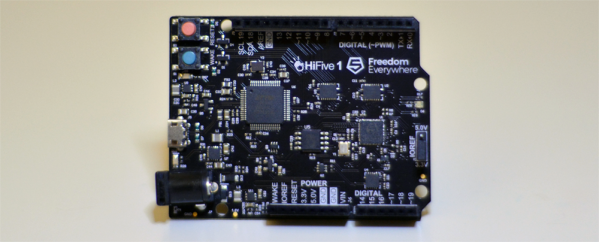
We’ve seen a lot of RISC-V stuff in recent months, from OnChip’s Open-V, and now the HiFive 1 from SiFive. The folks at SiFive offered to give me a look at the HiFive 1, so here it is, the first hands-on with the first Open Hardware microcontroller.
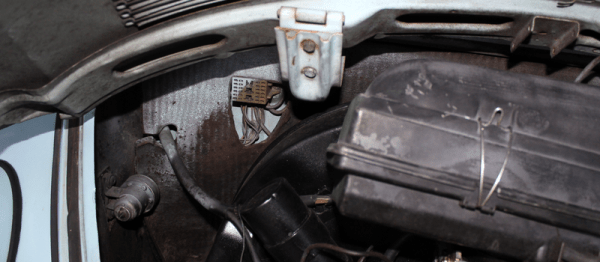
The 90s were a pivotal time in world history, and 1996 was no different. You might have spent the year glued to the TV playing Super Mario 64, or perhaps you were busy campaigning for Bill Clinton or Bob Dole, or maybe you were so depressed that Princess Diana and Prince Charles divorced that you spent the whole year locked in your room, a prisoner of your own existential nihilism. Whatever you did, though, it’s likely that one major event passed you by without a thought: The standardization of on-board vehicle diagnostics (in the US), otherwise known as OBD-II.
In the 1970s, vehicles (in some western countries, at least) were subject to ever-increasing restrictions on emissions. Most companies began switching from carburetors to efficient fuel injection systems, but even that wouldn’t be enough for the new standards. Cars began to carry rudimentary computer systems to manage and control the influx of valves, meters, and sensors that became the new norm. And, as one would guess, every car company had their own standard for managing and monitoring these computer systems. Eventually they would settle on the OBD system that we have today.
[Derek Schulte] designed and sells a consumer 3D printer, and that gives him a lot of insight into what makes them tick. His printer, the New Matter MOD-t, is different from the 3D printer that you’re using now in a few different ways. Most interestingly, it uses closed-loop feedback and DC motors instead of steppers, and it uses a fairly beefy 32-bit ARM processor instead of the glorified Arduino Uno that’s running many printers out there.
The first of these choices meant that [Derek] had to write his own motor control and path planning software, and the second means that he has the processing to back it up. In his talk, he goes into real detail about how they ended up with the path planning system they did, and exactly how it works. If you’ve ever thought hard about how a physical printhead, with momentum, makes the infinitely sharp corners that it’s being told to in the G-code, this talk is for you. (Spoiler: it doesn’t break the laws of physics, and navigating through the curve involves math.)
Modern internal combustion engines have around 500 parts, with many of them moving in concert with the piston. But have you seen an engine with only one moving part, out of four in total? In the thermoacoustic engine, the power piston is the only part in motion. [YTEngineer] has built a very simple prototype that works on power provided by a tealight.
His little engine, slightly larger than a cigarette lighter, is composed of a test tube that serves as the cylinder, a smaller tube, called the choke, that fits inside the test tube, the stack, which is nothing more than some steel wool, and the power piston. [YTEnginer] nicely explains how the engine works: basically a temperature difference is used to induce high-amplitude sound waves that create the piston’s back-and-forth movement. The engine can be easily converted to an electricity generator by adding a magnet to the piston and a coil surrounding it.
The thermoacoustic engine is a particular type of Stirling engine. They have been proposed as electricity generators for space travel using radioisotopes as the heat source, among other applications. You may be interested in the history of Stirling engines, or perhaps even build a simple one.