Nokia N-Gage QD Becomes Universal Bluetooth Gamepad

The Nokia N-Gage might not have put up much of a fight against Nintendo’s handheld dynasty, but you can’t say it didn’t have some pretty impressive technology for the time. [BeardoGuy] happens to have a perfectly functional N-Gage QD, which he turned into a universal Bluetooth gamepad.

The handheld runs a program that makes it act as a gamepad, and a DIY Bluetooth dongle is required on the client side. The dongle consists of an ATtiny85-based development board and HC-06 Bluetooth module, and will be recognized as a USB gamepad by just about anything it plugs in to.

[BeardoGuy]’s custom GamepadBT program sends button events via Bluetooth to the dongle, and those events are then sent via USB and look just like those from any standard gamepad.

This project can be used as a resource for how to implement a USB gamepad, whether on a Nokia N-Gage or not. You can see all the details at the project’s GitHub repository, and watch it in action in the video embedded below.

As for the Nokia N-Gage itself, one might be interested to know there’s an up-to-date development environment and even Wordle has been ported to the N-Gage. It may look like a relic of the past, but it is far from being forgotten.

Continue reading “Nokia N-Gage QD Becomes Universal Bluetooth Gamepad”

Hall Sensors Offer Drop-In Replacement For Drifting Game Console Joysticks

No bananas were harmed in the making of this Hall effect drift-proof joystick replacement. OK, not really — two bananas were turned to mush. But it’s OK, they’re just bananas, after all.

Why bananas, you ask? Because [Marius Heier] uses them to demonstrate what we all intuitively know — that rubbing something over and over again tends to wear it away — but engineers seem to have forgotten. Wear such as this, with resistance material rather than fruits, is what causes the dreaded drift, a problem that the world collectively spends $20 billion a year dealing with, according to [Marius].

While numbers like that seem to be firmly in class-action lawsuit territory, sometimes it’s best to take matters into your own hands and not wait for the courts. The fix [Marius] shows here is to yank the potentiometers off a PS4 joystick and replace them with contactless Hall effect sensors. The end of the shaft for each axis gets a diametral neodymium magnet attached to it, while a 3D printed bracket holds a tiny custom PCB in close proximity. The PCB has an AS5600 Hall sensor, which translates the shaft angle to an analog voltage output. After programming the chip over its I2C bus, the sensor outputs a voltage proportional to the angle of each shaft, just like the original pots, but without all the wear and tear.

While [Marius] is selling these as drop-in replacements for PS4 controllers, he plans to release all the design files so you can build one yourself. He also has his sights set on replacements for PS5 and Xbox controllers, so watch for those. This isn’t his first foray into joystick hacking, having shared his 3D Hall effect and haptic feedback joysticks with us previously.

Continue reading “Hall Sensors Offer Drop-In Replacement For Drifting Game Console Joysticks”

What’s Black, White, And Red On 20 Sides?

You won’t need to pack a full set of dice for your next game with this DIY Multifunctional Eink Gadget. [Sasa Karanović] brings us a fun device that combines a few essential aspects of tabletop gaming, D6, D12, and D20 dice rolling and a hero dashboard. While they have grand plans for a BLE networked future application, we admire the restraint to complete a V1 project before allowing scope-creep to run amok. Well played!

For this project, [Sasa] realized it needed to be battery powered and just choosing the right display for a battery powered application can be daunting. Even if you aren’t building this project, the video after the break includes a nice intro to electronic ink and low power microcontrollers for the uninitiated. We even see a graph of the completed board’s power draw from the button wake up, display refresh, and low power sleep. The project has some neat tips for building interaction into case design with the use of the display and a flexible bezel as integrated buttons. Continue reading “What’s Black, White, And Red On 20 Sides?”

It’s DOOM, But In Teletext

We’ve seen the 1993 id Software classic DOOM running on so many pieces of unexpected hardware, as “Will it run DOOM?” has become something of a test for any new device. But will it run in the circuitry of a 1970s or 1980s TV set? Not quite, but as [lukneu] has demonstrated, it is possible to render the game using the set’s inbuilt Teletext decoder.

Teletext is a technology past its zenith and which is no longer broadcast in many countries, but for those unfamiliar it’s an information service broadcast in the unseen lines hidden in the frame blanking period of an analogue TV transmission. Its serial data packets can contain both pages of text and rudimentary block graphics, and we’re surprised to learn, can include continuous streams to a single page. It’s this feature that he’s used, piping the game’s graphics as a teletext stream which is decoded by the CRT TV and displayed as a playable if blocky game.

Delving further, we find that DOOM is running on a Linux machine on which the teletext stream is created, and the stream is then piped to a Raspberry Pi which does the encoding on to its composite video output. More powerful versions of the Pi can run both processes on the same machine. The result can be seen in the video below, and we can definitely say it would have been mind-blowing, back when DOOM was king. There are plans for further refinement, of which we’d say that color would be the most welcome.

Continue reading “It’s DOOM, But In Teletext”

A 4-Player Arcade Hidden Inside A Coffee Table

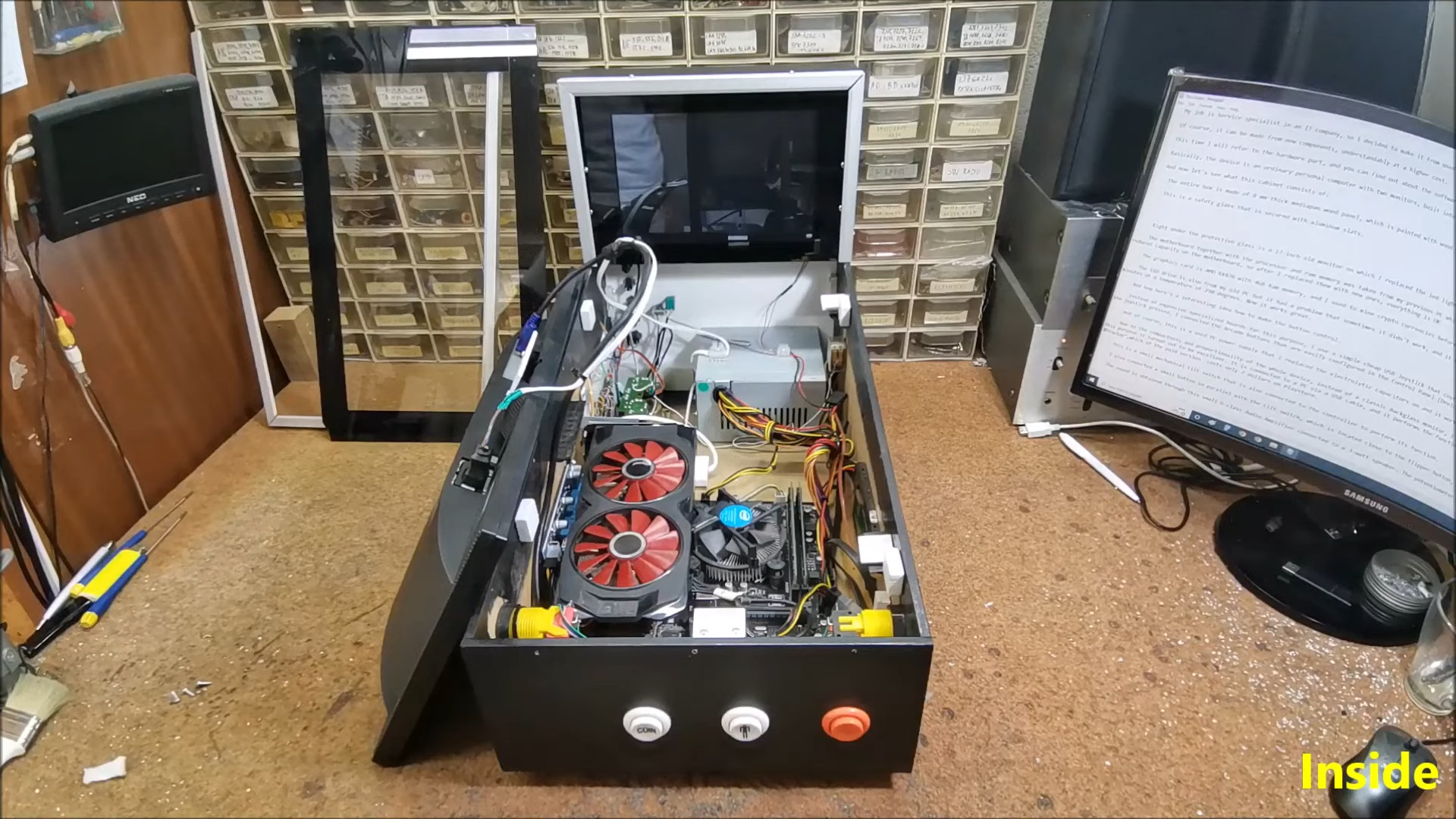
[Ed] from 50% Awesome on YouTube wanted to build a retro gaming system with a decent screen size, but doesn’t have a great deal of space to site it in, so a good compromise was to make a piece of useful furniture and hide all the fun parts inside.

Building an arcade machine usually involves a lot of wiring

This video two-part build log shows a lot of woodwork, with a lot of mistakes (happy accidents, that are totally fine) made along the way, so you do need to repeat them. Essentially it’s a simple maple-veneered plywood box, with a thick lid section hosting the display and some repositioned speakers. This display is taken from a standard LG TV with the control PCB ripped out. The power button/IR PCB was prised out of the bezel, to be relocated, as were the two downwards-facing speakers. The whole collection of parts was attached to a front panel, with copious hot glue, we just hope the heavy TV panel was firmly held in there by other means!

Continue reading “A 4-Player Arcade Hidden Inside A Coffee Table”

The Goalie Mask, Reenvisioned

The goalie mask, at least the retro-styled fiberglass types from the 60s and 70s, hasn’t been used in hockey for about 50 years —  it’s instead made many more appearances in horror movies than on ice rinks. Since then, though, there’s been very little innovation surrounding the goalie mask even though there’s much more modern technology that could theoretically give them even greater visibility. [Surjan Singh] is hoping to use his engineering and hockey backgrounds to finally drive some improvements.

The “uncage” is based on Dyneema thread, a polyethylene fiber known for its strength and durability. It’s often used in applications that demand high strength with minimal weight, such as for sails or backpacking equipment. Using strands of Dyneema woven through a metal support structure is what gives this mask its high strength while also improving the visibility through it dramatically. [Surjan] has been prototyping this design extensively, as there were some issues with the fibers chafing on attachment points on the metal frame, but most of these issues have been ironed out or are being worked on currently.

In the meantime, [Surjan] has been looking for a professional-level goalie to help refine his design further and does seem to have some interest, but it doesn’t seem to have progressed past testing in the more controlled test environments yet. It’s not too far-fetched to imagine this as the future of goalie masks in professional hockey though since some innovation after 50 years of relative stagnation seems to be due. For something more accessible to those of us not currently playing in the NHL, though, you can wheel, snipe, and celly on this air hockey table instead.

Continue reading “The Goalie Mask, Reenvisioned”

Air Hockey Solitaire

While air hockey is a fine amusement, it isn’t much fun if you can’t find someone to play against. Unless that is, you build a mini table with a robotic defender. [Vaib], [Nathan], and [Navish] can show you how. There is a video you can see below that shows two players using the table without the robot.

The project takes a bit of woodworking, as you might expect. You also have to drill 576 holes for the air to lift the puck. Some of the components are 3D printed in PETG, too. The automated defense uses a camera and relies on the fact that the puck is the only red thing on the table. A servo moves to intercept the incoming puck and return the shot. We were disappointed the video didn’t show the automated play.

We wondered if they had considered making a pair of the detachable robots and letting them play with each other. If you prefer football, the robot could probably adapt. We’ve seen other robot air hockey contenders, so maybe a better idea would be to build different robots and let them compete for a gold medal.

Continue reading “Air Hockey Solitaire”