The DOOM Chip

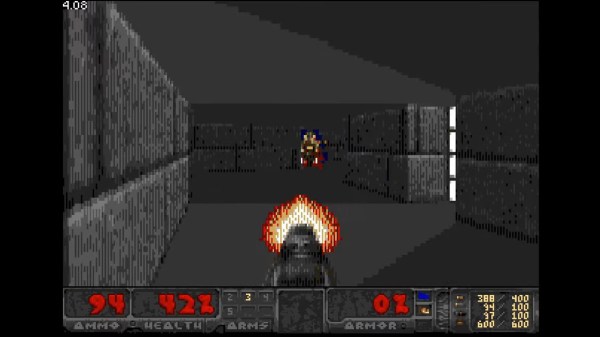
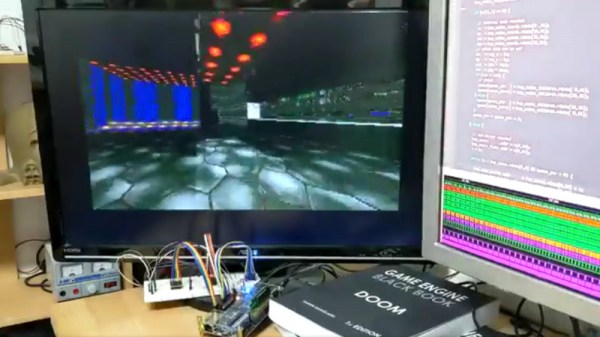
It’s a trope among thriller writers; the three-word apocalyptic title. An innocuous item with the power to release unimaginable disaster, which of course our plucky hero must secure to save the day. Happily [Sylvain Lefebvre]’s DOOM chip will not cause the world to end, but it does present a vision of a very 1990s apocalypse. It’s a hardware-only implementation of the first level from id Software’s iconic 1993 first-person-shooter, DOOM. As he puts it: “Algorithm is burned into wires, LUTs and flip-flops on an #FPGA: no CPU, no opcodes, no instruction counter. Running on Altera CycloneV + SDRAM”. It’s the game, or at least the E1M1 map from it sans monsters, solely in silicon. In a very on-theme touch, the rendering engine has 666 lines of code, and the level data is transcribed from the original into hardware tables by a LUA script. It doesn’t appear to be in his GitHub account so far, but we live in hope that one day he’ll put it up.

“Will it run DOOM” is almost a standard for new hardware, but it conceals the immense legacy of this game. It wasn’t the first to adopt a 1st-person 3D gaming environment, but it was the game that defined the genre of realistic and immersive FPS releases that continue to this day. We first played DOOM on a creaking 386, we’ve seen it on all kinds of hardware since, and like very few other games of its age it’s still receiving active development from a large community today. We still mourn slightly that it’s taken the best part of three decades for someone to do a decent Amiga port.

Original Zork MDL Source Code Has Been Released

Though mostly known for its releases on countless 8-bit personal computers from the 1970s and 1980s, the game of Zork began its life on a PDP-10 mainframe. Recently, MIT released the original source code for this version of Zork. As we covered a while ago, the history of Zork is a long and lustrous one, a history that is based on this initial version written in MDL.

To recap, MDL is a LISP-derived language that excels at natural language processing. It was developed and used at MIT’s AI and LCS (now CSAIL) departments for a number of projects, and of course to develop games with. The use of MDL gave Zork as a text-based adventure a level of interaction that was far ahead of its time.

What MIT has made available is the source code from Zork as it existed around 1977, at a time when it was being distributed to universities around the US. For purely educational purposes, obviously. This means that it’s a version of Zork before it was commercialized (~1979), showing a rare glimpse of the game as it was still busily being expanded.

Running the game will take a bit of effort, however. These files were retrieved from an original MIT backup tape that was used with their PDP-10 machines. Ideally one would use a 1970s-era PDP-10 mainframe with an MDL compiler, but in a pinch one could run a PDP-10 emulator as well.

Let us know whether you got it to run. Screenshots (ASCII or not) are highly encouraged.

Scopetrex Is A Game Console… For Your Oscilloscope!

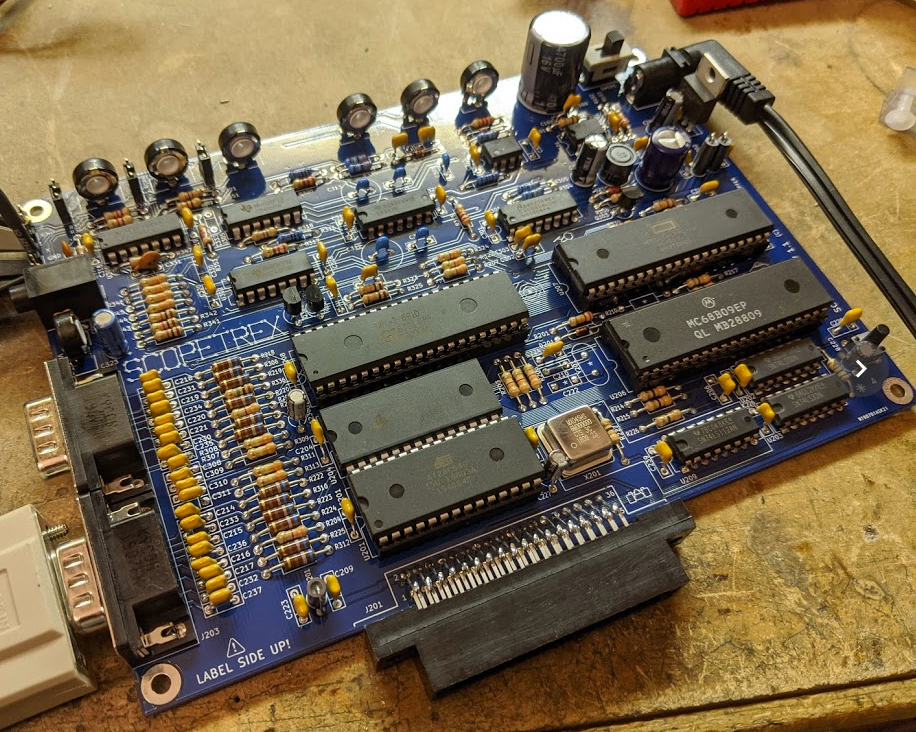
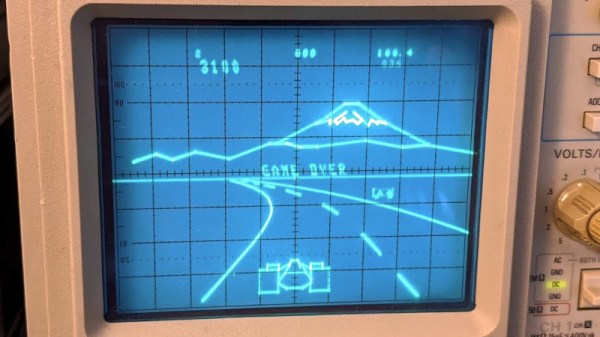
You’ve always wanted a game console at your bench, but maybe you haven’t had space for a monitor or TV set? Wouldn’t it be useful if the screen you do have on your bench could also play games? [Tube Time] has fixed this problem, with Scopetrex, a vector graphic console for your oscilloscope. In fact, it’s better than just a console, because it’s a clone of the legendary Vectrex, the vector-based console with built-in CRT screen from the 1980s.

The board itself is a slightly enhanced version of the original, offering not extra functionality but the ability to substitute some of the parts for more easily found equivalents. It gives full control over display size and brightness, can use the cheaper 6809E processor and AY-3-9810 sound chip if necessary, and only needs a single 5 volt supply. There’s also a custom controller board, which is handly Vectrex-compatible. All you will need to play Vectrex games on your ‘scope once you’ve built this board, are a copy of the Vectrex ROM, and some games.

The Vectrex holds an enduring fascination for our community, and has appeared here many times. Particularly memorable is a CRT replacement, and then of course there’s the never-released mini Vectrex prototype.

Thanks [Justin List] for the tip.

An Open Hardware Sega Genesis Cartridge Dumper

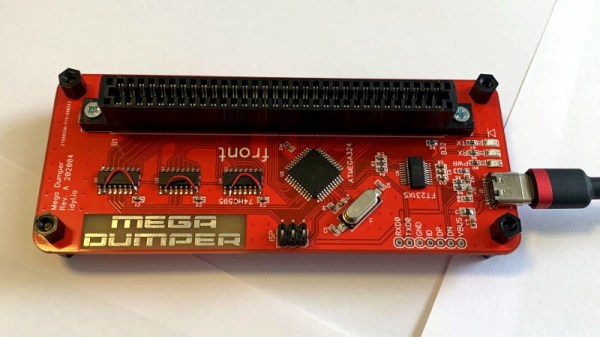
You might be wondering why anyone would build device to dump Sega Genesis and Mega Drive cartridges. Perhaps they want to play their well-worn copy of The Lost Vikings on their phone, or they want to keep their QVC Limited Edition Maximum Carnage box set in near mint condition. Maybe. But we’re betting that [tonyp7] was just looking for a challenge, and as an added bonus, the world gets another cool open hardware gadget in the process. Sounds like a good deal to us.

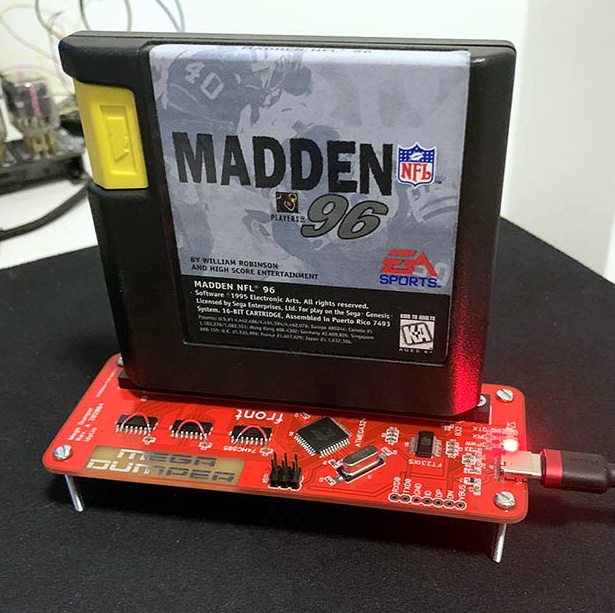
Based on the ATmega324PB, the GenDumper can take those dusty old Sega cartridges and back them up to an image file on your computer. Right now the hardware depends on a Windows program, but according to the documentation, [tonyp7] is working on a platform-agnostic Python script so everyone can play along. What you do with the image file after you’ve dumped it is your business, but presumably loading it up in an emulator would be the next step.

Considering how easy it is to find ROMs for these old games online, do you actually need a GenDumper of your own? Probably not. But it’s still an interesting piece of hardware, and if you look close enough, you just might learn a thing or two from the design. For example, [tonyp7] shows how a relatively easy to work with 12 pin USB-C connector can be used on your USB 2.0 projects to embrace the new physical connector without diving into a full USB 3.0 implementation. The keen-eyed reader might also note there’s a lesson to be learned about finalizing the name of your project before sending off your PCBs for manufacturing.

A perusal of the archive uncovered a similar project from 2012 that, believe it or not, was also tested on a copy of Madden 96. Whether that means the game is so beloved that hackers want to make sure its preserved for future generations, or so despised that they are secretly hoping the magic smoke leaks out during testing, we can’t say.

Doom Clone Shows What An Alternate-Reality Amiga Could’ve Had

Can you run Doom on the Amiga? No, not really, and arguably that was one of the causes for the computer’s demise in the mid-90s as it failed to catch up on the FPS craze of the PC world. [Krzysztof Kluczek] of the Altair demogroup has managed not exactly to remedy that status with the original article, but to show us how a potential contender could’ve been designed for the unexpanded Amiga hardware back in the day.

Many developers tried to emulate the thrill and ambiance of the id Software shooter, but they all required high-end Amigas with faster processors and expanded memory, limiting their player base on an already diminished demographic. Not only that, but even with fancier hardware, none of them quite managed to match how well Doom ran on your run-of-the-mill 486 at the time. [Krzysztof] isn’t trying to port Doom itself, but instead creating an engine custom-designed to take advantage of, and minding the limitations of the OCS Amiga as it existed in 1987. The result is Dread, a 2.5D engine that resembles the SNES port of Doom and uses assets from the Freedoom project in order to remain copyright-abiding.

It might not be Doom, but it’s a good peek at what the 33-year old hardware could’ve done in the right hands back then. Technically it already surpasses what the Wolfenstein 3D engine could do, so there’s an idea if someone ever aims to make a straight up port instead of their own game. If you like seeing Doom run on machines it wasn’t meant to, boy do we have some posts for you. Otherwise, stick around after the break for two videos of Dread’s engine being demonstrated.

Continue reading “Doom Clone Shows What An Alternate-Reality Amiga Could’ve Had”

Classic 8-Bit Computing The Atari Way

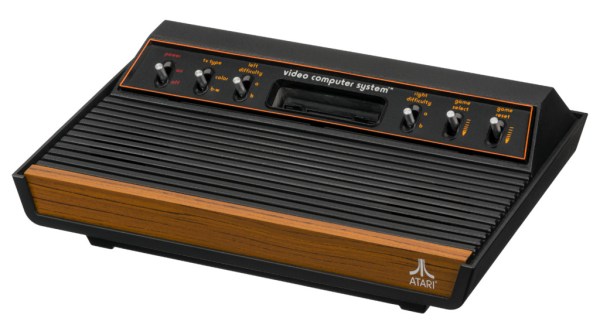
In the classic gaming world, even before the NES arrived on the scene, there was no name more ubiquitous than Atari. Their famous 2600 console sold almost as many units as the Nintendo 64, but was released nearly 20 years prior. In many ways, despite making mistakes that led to the video game crash of the early 80s, Atari was the first to make a path in the video game industry. If you want to explore what the era of 8-bit computing was like in the Atari age, a new resource is compiling all kinds of Atari-based projects.

This site has everything, from assembling Atari 8-bit computers based on the 6502 chip, to programming them in BASIC and assembly, to running official and homebrew games on the hardware itself. This was put together by [Jason H. Moore] who grew up around Atari systems and later, their home computers. He even puts his biomedical experience to use here by designing a game for the 2600 called Gene Medic which can be found at the site as well.

If you grew up in the 70s and 80s and are looking for a bit of Atari nostalgia this site is the place to go. It’s even worth a visit from younger folks as well since the 8-bit world is a lot easier to get immersed in and learn the fundamentals of computer science. Of course, if you want to take it the other direction, it’s possible to modify the old Atari to add a few modern conveniences.

Photo via Evan-Amos

Brain Transplant Makes One Arcade Machine Play Games From Another

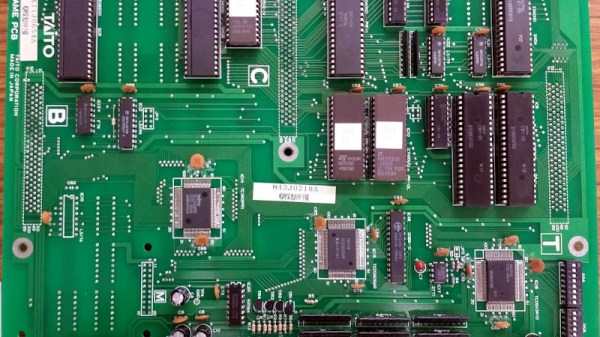
We’re used to games consoles in which the same hardware plays a variety of different games, but if we were to peer inside arcade cabinets of an older vintage we’d find custom boards unique to every game. Some boards from the same manufacturers shared common hardware traits even if they weren’t identical though, and [twistedsymphony] has taken advantage of this to make one vintage Taito game — Gun & Frontier — run on the hardware for another, Ah Eikou no Koshien. It’s a fascinating tale across a forum thread, that’s well worth a read even if you will never touch a vintage arcade board.

We might expect that the tool of choice would be a logic analyser or similar, but unexpectedly the solution to this hack was found in MAME. The arcade emulator conceals a wealth of information about these boards, from which you can discover their differences and try out possible solutions. The hardware hacks are surprisingly straightforward, a few bodge wires and an extra address line for a larger ROM. A programmable logic array required dumping and rewriting to fix a graphics corruption issue and a little bit of ROM tweaking after emulating a controller problem in MAME was required, but it seems that yes, one game can run on another. Certainly less painful than the Taito hack that required a chip to be decapped.

[via r/ReverseEngineering]