Haber-Bosch And The Greening Of Ammonia Production

We here on Earth live at the bottom of an ocean of nitrogen. Nearly 80% of every breath we take is nitrogen, and the element is a vital component of the building blocks of life. Nitrogen is critical to the backbone of proteins that form the scaffold that life hangs on and that catalyze the myriad reactions in our cells, and the information needed to build these biopolymers is encoded in nucleic acids, themselves nitrogen-rich molecules.

And yet, in its abundant gaseous form, nitrogen remains directly unavailable to higher life forms, unusably inert and unreactive. We must steal our vital supply of nitrogen from the few species that have learned the biochemical trick of turning atmospheric nitrogen into more reactive compounds like ammonia. Or at least until relatively recently, when a couple of particularly clever members of our species found a way to pull nitrogen from the air using a combination of chemistry and engineering now known as the Haber-Bosch process.

Haber-Bosch has been wildly successful, and thanks to the crops fertilized with its nitrogenous output, is directly responsible for growing the population from a billion people in 1900 to almost eight billion people today. Fully 50% of the nitrogen in your body right now probably came from a Haber-Bosch reactor somewhere, so we all quite literally depend on it for our lives. As miraculous as Haber-Bosch is, though, it’s not without its problems, particularly in this age of dwindling supplies of the fossil fuels needed to run it. Here, we’ll take a deep dive into Haber-Bosch, and we’ll also take a look at ways to potentially decarbonize our nitrogen fixation industry in the future.

Continue reading “Haber-Bosch And The Greening Of Ammonia Production”

Keeping The Philippines’ Surface Waters Clean With Kabooms

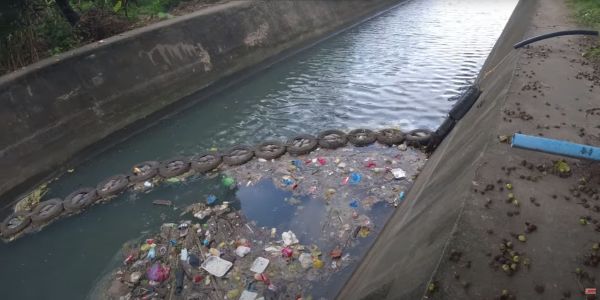
[Rich] over at Tropical Ocean Cleanup on YouTube has been working hard to prevent plastic waste from getting into the waters around the Philippines. Even as a mostly one-man crew, he’s collecting large sums of plastic waste using a boom system which he fittingly made out of waste: old tires and empty plastic bottles. This Kaboom system is a low-cost method of capturing any waste so that it can be collected and properly disposed of. In addition [Rich] also installs containers where locals can dispose of their plastic trash.

The Kaboom system is detailed by [Rich] in this video (also linked after the break). As a shoestring budget project, it relies heavily on donations and local support to install more of these booms. It is however a highly effective way to prevent such common plastic waste from making it into the oceans in the first place. Having these booms made out of waste items that are commonly found where humans roam should make this a snap.

Ideally, local governments would be installing such capturing systems and easy waste disposal options, but sometimes it seems grassroots efforts like these are what will bring the fastest change.

Curious about what to do with all that plastic waste once you collect and identify it? How about making some plastic bricks?

Continue reading “Keeping The Philippines’ Surface Waters Clean With Kabooms”

Modern Toilet Generates Energy

Environmental Engineering [Prof Jaeweon Cho] at South Korea’s Ulsan National Institute of Science and Technology specializes in water and waste management. He has developed an energy-generating toilet called BeeVi (pronounced beevee) that recycles your waste in three ways. Liquid waste is processed in a microbial reaction tank to make a liquid fertilizer. Solid waste is pumped into an anaerobic digestion tank, which results in methane gas used to power a silicone oxide fuel cell to make electricity. The remaining solids are composted to make fertilizer. The daily waste from one person is about 500 g, which can generate about 50 L of methane.

The BeeVi toilets, located on the UNIST campus, pay students in a digital currently called Ggools, or Honey Money in English. Each deposit earns 10 Ggools, which can be used to purchase coffee, instant noodles, and other items (one Ggool is equivalent to about $3.00 value). The output from this pilot project is used to partially power the building on campus, and to fertilize gardens on the grounds. If you want to learn more, here is a video lecture by [Prof Cho] (in English).

Waste management is an area of research around the world. The Gates Foundation has been funding research into this field for ten years, and has held a number of expos over the years highlighting innovative solutions, most recently being the 2018 Reinvent the Toilet Expo in Beijing. We wrote a piece about the future of toilets last year as well.

Continue reading “Modern Toilet Generates Energy”

Weather Station Dumps CR2032 Cells, Gains 18650

Despite the fact that we’re rapidly approaching the year 2022, there are still an incredible number of gadgets out there that you’re expected to power with disposable batteries. Sure you can buy rechargeable stand-ins that come in the various shapes and sizes of the traditional alkaline cells, but that’s a stopgap at best. For some, if a new gadget doesn’t feature an internal Li-ion battery and standardized USB charging, it’s a non-starter.

[Danilo Larizza] is one of those people. Bothered by the fact that his Oregon Scientific weather station required a pair of CR2032 coin cells, he set out to replace them with an integrated rechargeable solution. The conversion ending up being easier to implement than he initially expected, and by his calculations, his solution should keep the unit up and running for nearly 40 days before needing to be topped off with a standard USB charger.

Wiring in the new battery.

The first step was determining how much power it actually took to run the weather station. Although the two CR2032 cells were wired in series, and therefore providing a nominal 6 V, he determined through experimentation with a bench power supply that it would run on as little as 3.2 volts. This coincides nicely with the voltage range for a single 18650 cell, and meant he didn’t need to add a boost converter into the mix. He notes the weather station does flash a “Low Battery” warning most of the time now, but that seems a fair price to pay.

Confident in the knowledge that the weather station could happily run with an 18650 cell connected in place of the original CR2032s, all [Danilo] needed to do was figure out a way to charge the battery up from time to time. To that end, he reached for a common TP4056 module. This handy little board is a great match for 18650 cells, and is so cheap that there’s really no excuse not to  have a few of them kicking around your parts bin. You never know when you might need to teach an old gadget new tricks.

Anr air quality sensor mounted on a bike's handlebar

Measuring Air Quality Using Mobile Sensors For The Masses

Poor air quality is a major problem for city dwellers the world over. Dust, smoke, particles and noxious gases from vehicles, industry and agriculture makes many megacities downright hazardous to live in. Pinpointing the source of pollution and developing strategies for mitigation requires accurate data on pollutant levels, but obtaining these numbers is not always easy.

Enter CanAirIO, a citizen science project that aims to gather air quality data from around the world by putting sensors into the hands of as many people as possible. Its team has developed two different sensor nodes for this purpose: an indoor one that can measure CO2, and a mobile one that can measure particulate matter (PM) levels. Both versions are powered by an ESP32 microcontroller that reads out the air quality sensors and connects to the Internet using WiFi or BlueTooth. The data can then be shared online to create detailed maps showing local variations in air quality.

The design of the sensor nodes is fully open-source, allowing anyone with basic electronic skills to build them. The sensors are a Sensirion SCD30 for CO2 measurement and an SPS30 for PM levels. The mobile version comes with a neat 3D-printed enclosure that can be mounted on a bike’s handlebar, enabling the user to quickly gather data around their neighbourhood. A mobile app simplifies setting up the sensors and sharing the data.

The project has already been successful in gathering detailed data in the city of Bogotá, Colombia, and will no doubt prove useful in many other pollution hotspots around the world. We’ve seen similar community efforts to monitor air pollution and even radiation in various places, both showing how relatively simple devices can help to make a difference in people’s wellbeing. Continue reading “Measuring Air Quality Using Mobile Sensors For The Masses”

An Open Source Detector For Identifying Plastics

One of the challenges involved in recycling plastic is determining the specific type of plastic a given item is actually made of. To keep up with demand, large scale recycling centers rely on various automated systems to separate different types of plastic from a stream of incoming material. But in less technologically advanced parts of the world, workers can find themselves having to manually identify plastic objects; a time consuming and error-prone process.

To try and improve on the situation, [Jerry de Vos], [Armin Straller], and [Jure Vidmar] have been working on a handheld open hardware device that they refer to simply enough as the Plastic Scanner. The hope is that their pocket-sized unit could be used in the field to positively identify various types of plastic by measuring its reflectivity to infrared light. The device promises to be very easy to operate, as users simply need to bring the device close to a piece of plastic, push the button, and wait for the information to pop up on the OLED display.

Or at least, that’s the idea. While the team eventually hopes to release a kit to build your own handheld Plastic Scanner, it seems that the hardware isn’t quite ready for production. The most recent work appears to have been put in, not unexpectedly, the development board that lets the team refine their process. The development unit combines an array of IR LEDs with wavelengths ranging from 850 to 1650 nanometers, a InGaAs photodiode connected to an ADS1256 24-bit analog-to-digital converter (ADC), and an Arduino Uno. In comparison, the final hardware uses a Raspberry Pi Zero and a smaller “breakout board” that contains the sensor and IR LEDs.

Browsing through the software repository for the project, we can see the device uses Python, TensorFlow Lite, and a database of IR reflectivity values for known plastics to try and determine the closest match. Obviously the accuracy of such a system is going to be highly dependent on the quantity of known-good data, but at least for now, it appears the user is responsible for building up their own collection or IR values.

As interesting as this project is, we’re a bit skeptical about its purely optical approach to identifying plastics. Automated recycling centers do use infrared spectroscopy, but it’s only one tool of many that are employed. Without additional data points, such as the density or electrostatic properties of the plastic being tested, it seems like the Plastic Scanner would have a fairly high margin of error. Just taking into account the wide array of textures and colors the user is likely to encounter while using the device will be a considerable challenge.

Continue reading “An Open Source Detector For Identifying Plastics”

DIY Hydroelectric Plant

Impressive Off-Grid Hydroelectric Plant Showcases The Hacker Spirit

We all know the story arc that so many projects take: Build. Fail. Improve. Fail. Repair. Improve. Fail. Rebuild. Success… Tweak! [Kris Harbour] is no stranger to the process, as his impressive YouTube channel testifies.

DIY Hydroelectric Plant
An IOT charge controller makes power management easier.

Among all of [Kris’] off-grid DIY adventures, his 500 W micro hydroelectric turbine has us really pumped up. The impressive feat of engineering features Arduino/IOT based controls, 3D printed components, and large number of custom-machined components, with large amounts of metal fabrication as well.

[Kris] Started the build with a Pelton wheel sourced from everyone’s favorite online auction site paired with an inexpensive MPPT charge controller designed for use with solar panels. Eventually the turbine was replaced with a custom built unit designed to produce more power. An Arduino based turbine valve controller and an IOT enabled charge controller give [Kris] everything he needs to manage the hydroelectric system without having to traipse down to the power house. Self-cleaning 3D printed screens keep intake maintenance to a minimum. Be sure to check out a demonstration of the control system in the video below the break.

As you watch the Hydro electric system playlist, you see the hacker spirit run strong throughout the initial build, the failures, the engineering, the successes, and then finally, the tweaking for more power. Because why stop at working when it can be made better, right? We highly recommend checking it out- but set aside some time. The whole series is oddly addictive, and This Hackaday Writer may have spent inordinate amounts of time watching it instead of writing dailies!

Of course, you don’t need to go full-tilt to get hydroelectric power up and running. Even at a low wattage, its always-on qualities mean that even a re-purposed washing machine can be efficient enough to be quite useful.

Thanks to [Mo] for alerting us to the great series via the Tip Line!

Continue reading “Impressive Off-Grid Hydroelectric Plant Showcases The Hacker Spirit”