This excellent content from the Hackaday writing crew highlights recurring topics and popular series like Linux-Fu, 3D-Printering, Hackaday Links, This Week in Security, Inputs of Interest, Profiles in Science, Retrotechtacular, Ask Hackaday, Teardowns, Reviews, and many more.
This week Jonathan Bennett and Dan Lynch chat with Paweł Karaś about Amber, a modern scripting language that compiles into a Bash script. Want to write scripts with built-in error handling, or prefer strongly typed languages? Amber may be for you!
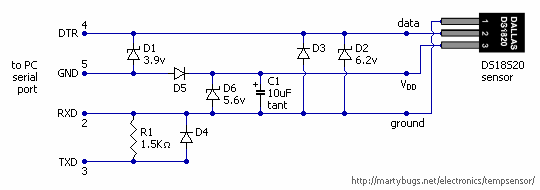
If you’re designing a universal port, you will be expected to provide power. This was a lesson learned in the times of LPT and COM ports, where factory-made peripherals and DIY boards alike had to pull peculiar tricks to get a few milliamps, often tapping data lines. Do it wrong, and a port will burn up – in the best case, it’ll be your port, in worst case, ports of a number of your customers.
Want a single-cable device on a COM port? You might end up doing something like this.
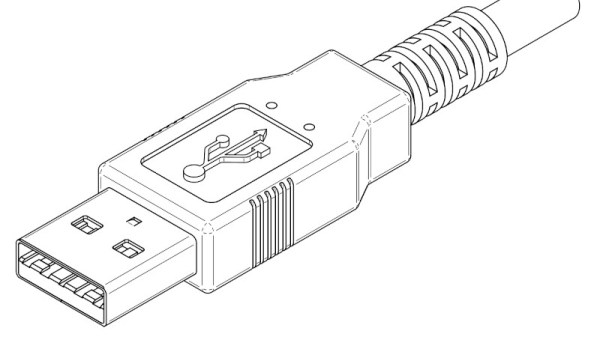
Having a dedicated power rail on your connector simply solves this problem. We might’ve never gotten DB-11 and DB-27, but we did eventually get USB, with one of its four pins dedicated to a 5 V power rail. I vividly remember seeing my first USB port, on the side of a Thinkpad 390E that my dad bought in 2000s – I was eight years old at the time. It was merely USB 1.0, and yet, while I never got to properly make use of that port, it definitely marked the beginning of my USB adventures.
About six years later, I was sitting at my desk, trying to build a USB docking station for my EEE PC, as I was hoping, with tons of peripherals inside. Shorting out the USB port due to faulty connections or too many devices connected at once was a regular occurrence; thankfully, the laptop persevered as much as I did. Trying to do some research, one thing I kept stumbling upon was the 500 mA limit. That didn’t really help, since none of the devices I used even attempted to indicate their power consumption on the package – you would get a USB hub saying “100 mA” or a mouse saying “500 mA” with nary an elaboration.
Fifteen more years have passed, and I am here, having gone through hundreds of laptop schematics, investigated and learned from design decisions, harvested laptops for both parts and even ICs on their motherboards, designed and built laptop mods, nowadays I’m even designing my own laptop motherboards! If you ever read about the 500 mA limit and thought of it as a constraint for your project, worry not – it’s not as cut and dried as the specification might have you believe. Continue reading “USB And The Myth Of 500 Milliamps”→
Here at Hackaday we’re suckers for vintage promotional movies, and we’ve brought you quite a few over the years. Their boundless optimism and confidence in whatever product they are advancing is infectious, even though from time to time with hindsight we know that to have been misplaced.
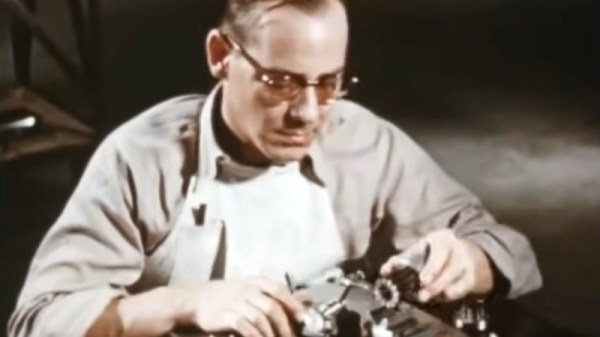
The products on show all belie the era in which the film was made: a metal desk fan, CRT parts for TVs, car body parts, a flight of what we tentatively identify as Lockheed P-80 Shooting Stars, and a Patton tank. Perhaps for the Hackaday reader the interest increases though when we see the training of an apprentice toolmaker, a young man who is being trained to the highest standards in the use of machine tools. It’s a complaint we’ve heard from some of our industry contacts that it’s rare now to find skills at this level, but we’d be interested to hear views in the comments on the veracity of that claim, or whether in a world of CAD and CNC such a level of skill is still necessary. Either way we’re sure that the insistence on metrology would be just as familiar in a modern machine shop.
A quick web search finds that the National Tool and Die Manufacturers Association no longer exists, instead the search engine recommends the National Tooling And Machining Association. We’re not sure whether this is a successor organisation or a different one, but it definitely represents the same constituency. When the film was made, America was at the peak of its post-war boom, and the apprentice would no doubt have gone on to a successful and pretty lucrative career. We hope his present-day equivalent is as valued.
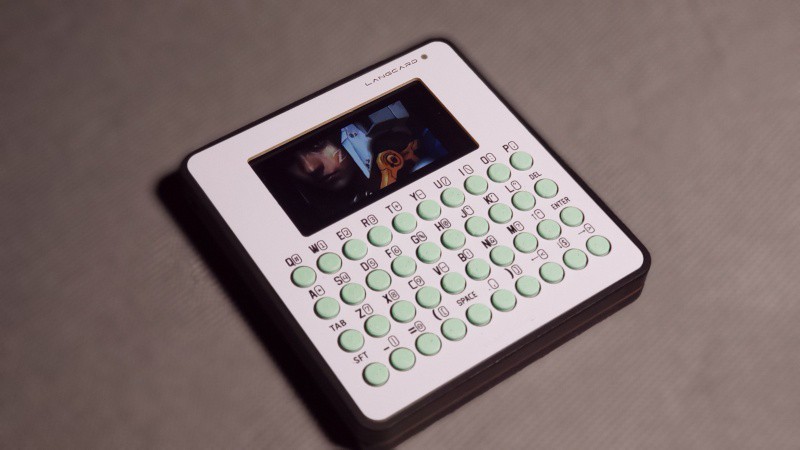
Image by [MakerM0] via Hackaday.IO[MakerM0]’s LangCard is an entry into our 2024 Business Card Challenge that just so happens to fit the Keebin’ bill as well.
You might label this a pocket cyberdeck, and that’s just fine with me. The idea here is to have a full-keyboard development board for learning programming languages like CircuitPython, MicroPython, C++, and so on, wherever [MakerM0] happens to be at a given moment.
Open up the LangCard and you’ll find an RP2040 and a slim LiPo battery. I’m not sure what display that is, but there are probably a few that would work just fine were you to make one of these fun learning devices for yourself.
Are you the kind of hacker who tries to pick up FreeCAD, but doesn’t want to go through a tutorial and instead pokes around the interface, trying to transfer the skills from a CAD suite you’ve been using before? I’ve been there too, and in my experience, FreeCAD doesn’t treat such forays lightly. It’s a huge package that enables everything from architecture to robotics design, so if you just want a 3D-printed case for a PCB project, the hill can be steep. So let’s take that first simple project as an example, and see if it helps you learn a little bit of FreeCAD.
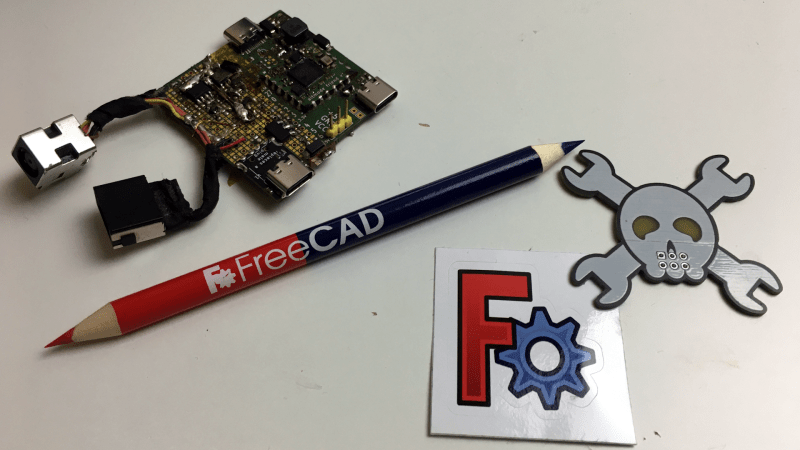
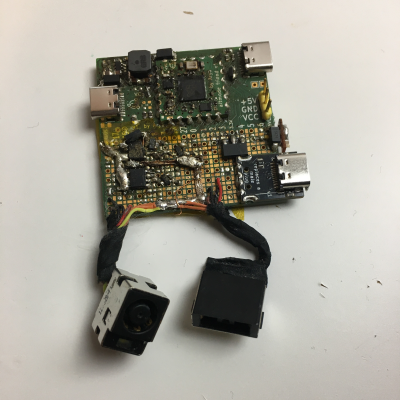
This board needs a case – badly.
As motivation, I recently built a USB-C PSU board that uses a DC PSU and does the USB-C handshaking to provide 20 V to a laptop. It is currently my only 100 W USB-C PSU, and my 60 W PSU just died, which is why I now use this board 24/7. I have brought it on two different conferences so far, which has highlighted a problem – it’s a board with tons of exposed contacts, which means that it isn’t perfectly travel-friendly, and neither it is airport-friendly – not that I won’t try and bring it anyway. So, currently, I have to watch that nothing shorts out – given the board has 3.3 V close to 20 V at 9 A, it’s a bit of a worry.
This means I have to design some sort of case for it. I was taught SolidWorks in the half a year that I spent in a university, and honestly, I’m tired of the licensing and proprietary format stuff. When it comes to more hobbyist-accepted tools like Fusion360, I just don’t feel like exchanging one proprietary software for another. So, FreeCAD is the obvious choice – apart from OpenSCAD, which I know and love, but I don’t always want to think up fifteen variable names for every silly little feature. That, and I also want to fillet corners every now and then.
For a full-open-source workflow, today’s PCB is designed with KiCad, too. Let’s see about installing FreeCAD, and the few things you need to import a KiCad board file into FreeCAD.
A couple of weeks back we featured a story (third item) about a chunk of space jetsam that tried to peacefully return to Earth, only to find a Florida family’s roof rudely in the way. The 700-gram cylinder of Inconel was all that was left of a 2,360-kg battery pack that was tossed overboard from the ISS back in 2021, the rest presumably turning into air pollution just as NASA had planned. But the surviving bit was a “Golden BB” that managed to slam through the roof and do a fair amount of damage. At the time it happened, the Otero family was just looking for NASA to cover the cost of repairs, but now they’re looking for a little more consideration. A lawsuit filed by their attorney seeks $80,000 to cover the cost of repairs as well as compensation for the “stress and impact” of the event. This also seems to be about setting a precedent, since the Space Liability Convention, an agreement to which the USA is party, would require the space agency to cover damages if the debris had done damage in another country. The Oteros think the SLC should apply to US properties as well, and while we can see their point, we’d advise them not to hold their breath. We suppose something like this had to happen eventually, and somehow we’re not surprised to see “Florida Man” in the headlines.