This excellent content from the Hackaday writing crew highlights recurring topics and popular series like Linux-Fu, 3D-Printering, Hackaday Links, This Week in Security, Inputs of Interest, Profiles in Science, Retrotechtacular, Ask Hackaday, Teardowns, Reviews, and many more.
Now here’s a stocking stuffer of a keyboard. The DecaTxt is the size of a deck of cards, and at first glance it looks like some kind of pocket Keno machine or other gambling or gaming apparatus. But that’s just because it’s so colorful. When you only have ten keys emulating a full keyboard, there’s bound to be some serious labeling going on, as there should be.
The DecaTxt is a Bluetooth 4.0 chording keyboard that’s meant to be used with your phone or whatever you want to pair it with. It was originally called the In10did, which stands for Input Nomenclature Ten Digit Interface Device. Catchy, no? At some point in the last ten years, this little guy went wireless and got a cooler name — the DecaTxt. Continue reading “Inputs Of Interest: DecaTxt Ultra-Portable Chording Keyboard”→
There was a time when decent quality soldering irons were substantial affairs, soldering stations with a chunky base unit containing the electronics and a lightweight handheld iron for the work. That has changed with the arrival of a new breed of microprocessor controlled lightweight handheld irons. There’s a new kid on the block from a company we associate more with open-source phones, laptops, and single board computers, Pine64 have produced the Pinecil. It’s a lightweight handheld iron with some innovative features at an attractive price, but does it raise the bar sufficiently to take on the competition?
Drifting is a hugely popular motorsport unlike any other, focusing on style and getting sideways rather than the pursuit of the fastest time between two points. It’s a challenge that places great demands on car and driver, and proper attention to setup to truly succeed. Here’s a guide to get your first drift build coming together.
Getting Sideways (And Back Again)
Drift cars are specialised beasts, and like any motorsport discipline, the demands of the sport shape the vehicle to suit. If you’re looking to drift, you’ll want to choose a project car with a front-engined, rear-wheel drive layout. While it’s somewhat possible to drift with other layouts, the act of kicking out the tail and holding a slide at speed is best achieved with the handling characteristics of such a vehicle. It all comes down to weight transfer and breaking traction at will. Of course, over the years, certain cars have become expensive on the second-hand market due to their drift prowess, so you may have to get creative if your first choice isn’t available at your budget. It pays to talk to the drifters down at your local track to get an idea of which cars in your area are the best bet for a drift build. Once you’ve got yourself a car, you can get down to installing mods!
Virtual reality has seen enormous progress in the past few years. Given its recent surges in development, it may come as a bit of a surprise to learn that the ideas underpinning what we now call VR were laid way back in the 60s. Not all of the imagined possibilities have come to pass, but we’ve learned plenty about what is (and isn’t) important for a compelling VR experience, and gained insights as to what might happen next.
If virtual reality’s best ideas came from the 60s, what were they, and how did they turn out?
Interaction and Simulation
First, I want to briefly cover two important precursors to what we think of as VR: interaction and simulation. Prior to the 1960s, state of the art examples for both were the Link Trainer and Sensorama.
The Link Trainer was an early kind of flight simulator, and its goal was to deliver realistic instrumentation and force feedback on aircraft flight controls. This allowed a student to safely gain an understanding of different flying conditions, despite not actually experiencing them. The Link Trainer did not simulate any other part of the flying experience, but its success showed how feedback and interactivity — even if artificial and limited in nature — could allow a person to gain a “feel” for forces that were not actually present.
Sensorama was a specialized pod that played short films in stereoscopic 3D while synchronized to fans, odor emitters, a motorized chair, and stereo sound. It was a serious effort at engaging a user’s senses in a way intended to simulate an environment. But being a pre-recorded experience, it was passive in nature, with no interactive elements.
Combining interaction with simulation effectively had to wait until the 60s, when the digital revolution and computers provided the right tools.
The Ultimate Display
In 1965 Ivan Sutherland, a computer scientist, authored an essay entitled The Ultimate Display (PDF) in which he laid out ideas far beyond what was possible with the technology of the time. One might expect The Ultimate Display to be a long document. It is not. It is barely two pages, and most of the first page is musings on burgeoning interactive computer input methods of the 60s.
The second part is where it gets interesting, as Sutherland shares the future he sees for computer-controlled output devices and describes an ideal “kinesthetic display” that served as many senses as possible. Sutherland saw the potential for computers to simulate ideas and output not just visual information, but to produce meaningful sound and touch output as well, all while accepting and incorporating a user’s input in a self-modifying feedback loop. This was forward-thinking stuff; recall that when this document was written, computers weren’t even generating meaningful sounds of any real complexity, let alone visual displays capable of arbitrary content. Continue reading “All The Good VR Ideas Were Dreamt Up In The 60s”→
Last week we featured a story on the new rules regarding drone identification going into effect in the US. If you missed the article, the short story is that almost all unmanned aircraft will soon need to transmit their position, altitude, speed, and serial number, as well as the position of its operator, likely via WiFi or Bluetooth. The FAA’s rule change isn’t sitting well with Wing, the drone-based delivery subsidiary of megacorporation Alphabet. In their view, local broadcast of flight particulars would be an invasion of privacy, since observers snooping in on Remote ID traffic could, say, infer that a drone going between a pharmacy and a neighbor’s home might mean that someone is sick. They have a point, but how a Google company managed to cut through the thick clouds of irony to complain about privacy concerns and the rise of the surveillance state is mind boggling.
Speaking of regulatory burdens, it appears that getting an amateur radio license is no longer quite the deal that it once was. The Federal Communications Commission has adopted a $35 fee for new amateur radio licenses, license renewals, and changes to existing licenses, like vanity call signs. While $35 isn’t cheap, it’s not the end of the world, and it’s better than the $50 fee that the FCC was originally proposing. Still, it seems a bit steep for something that’s largely automated. In any case, it looks like we’re still good to go with our “$50 Ham” series.
Staying on the topic of amateur radio for a minute, it looks like there will be a new digital mode to explore soon. The change will come when version 2.4.0 of WSJT-X, the program that forms the heart of digital modes like WSPR and FT8, is released. The newcomer is called Q65, and it’s basically a follow-on to the current QRA64 weak-signal mode. Q65 is optimized for weak, rapidly fading signals in the VHF bands and higher, so it’s likely to prove popular with Earth-Moon-Earth fans and those who like to do things like bounce their signals off of meteor trails. We’d think Q65 should enable airliner-bounce too. We’ll be keen to give it a try whenever it comes out.
Look, we know it’s hard to get used to writing the correct year once a new one rolls around, and that time has taken on a relative feeling in these pandemic times. But we’re pretty sure it isn’t April yet, which is the most reasonable explanation for an ad purporting the unholy coupling of a gaming PC and mass-market fried foods. We strongly suspect this is just a marketing stunt between Cooler Master and Yum! Brands, but taken at face value, the KFConsole — it’s not a gaming console, it’s at best a pre-built gaming PC — is supposed to use excess heat to keep your DoorDashed order of KFC warm while you play. In a year full of incredibly stupid things, this one is clearly in the top five.
And finally, it looks like we can all breathe a sigh of relief that our airline pilots, or at least a subset of them, aren’t seeing things. There has been a steady stream of reports from pilots flying in and out of Los Angeles lately of a person in a jetpack buzzing around. Well, someone finally captured video of the daredevil, and even though it’s shaky and unclear — as are seemingly all videos of cryptids — it sure seems to be a human-sized biped flying around in a standing position. The video description says this was shot by a flight instructor at 3,000 feet (914 meters) near Palos Verdes with Catalina Island in the background. That’s about 20 miles (32 km) from the mainland, so whatever this person is flying has amazing range. And, the pilot has incredible faith in the equipment — that’s a long way to fall in something with the same glide ratio as a brick.
Hardware hacking can be extremely multidisciplinary. If you only know bits and bytes, but not solder and electrons, you’re limited in what you can build. The same is true for mechanical design, where the forces of stress and strain suddenly apply to your project and the pile of code and PCBs comes crashing to the ground.
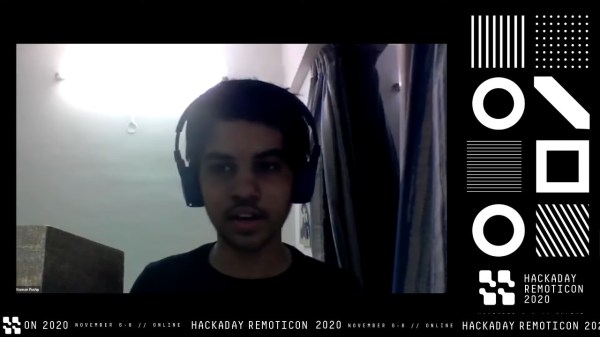
In the first half of his workshop, Naman Pushp walks you through some of the important first concepts in mechanical engineering — how to think about the forces in the world that act on physical objects. And he brings along a great range of home-built Jugaad props that include a gravity-defying tensegrity string sculpture and some fancy origami that help hammer the topics home.
In the second half of the workshop, Naman takes these concepts into computer simulation, and gives us good insight into the way that finite-element analysis simulation packages model these same forces on tiny chunks of your project’s geometry to see if it’ll hold up under real world load. The software he uses isn’t free by any definition — it’s not even cheap unless you have a student license — but it’s nonetheless illuminating to watch him work through the flow of roughly designing an object, putting simulated stresses and strains on it, and interpreting the results. If you’ve never used FEA tools before, or are looking for a compressed introduction to first-semester mechanical engineering, this talk might be right up your alley. Continue reading “Remoticon Video: The Mechanics Of Finite Element Analysis”→
Merry Christmas and happy holidays! I took Christmas day off from writing the security roundup, coming in a day early with this week’s installment, dodging New year’s day. The SolarWinds story has continued to dominate the news, so lets dive into it a bit deeper.
Microsoft has published their analysis of Solorigate, and the details are interesting. The added code was carefully written to blend in with the rest of the code, using the name OrionImprovementBusinessLayer.Initialize, which sounds like a perfectly boring-yet-legitimate function. The actual backdoor is obfuscated using zip compression and base64 encoding.
Once this bootstrap code begins, it runs a series of checks before actually doing anything malicious. It waits 2 weeks after installation to do anything, and then checks the system domain name for any indication it’s running in a test environment. It then checks for certain security applications, like Wireshark, and refuses to run if they are detected. This series of checks all seem to be an effort to avoid detection, and to only run in a deployed environment. Even the Command and Control URL that the backdoor uses is constructed to appear benign. Beyond this, it seems that the malware simply waited for instructions, and didn’t take any automated actions. All the attacks were performed manually.