
Eight More Speakers You’ll See At Supercon

Level-up your hardware chops at the Hackaday Superconference. We’re delighted to share more of the amazing speakers who are headed to Pasadena in just a few weeks. Scroll down for eight incredible talks that will inform, inspire, and excite the engineering muse inside of you.

This is the Ultimate Hardware Conference and you need to be there! We’ll continue to announce speakers and workshops as final confirmations come in. Supercon will sell out so grab your ticket now before it’s too late.

Kitty Yeung
Tech-Fashion Designs and the Wearables Industry

Driven by creative designs, the wearables industry has tremendous opportunities but also faces significant challenges in scaling and scientific research. Building programmable garments and what the future will bring.

Erika Earl
How to Stay Grounded When You Have Zero Potential

Why “ground” is critical and important for developing electronic hardware and how to approach a grounding scheme in your designs.

David Prutchi
DIY Ultraviolet Photography

Modifying cameras, building lenses, and selecting filters to see like the bees. Exploring ultraviolet spectrum for the artistic and technically-minded.

Brad Luyster
Communication, Architecture, and Building Complex Systems for SPAAACE

Building the first dual-rotor modular centrifuge to fly on the ISS. Ingenuity and standing on the shoulders of giants to build complex systems.

Estefannie
Daft Punk Is Playing In My Helmet

A whirlwind tour of tools and techniques for fabricating amazing reproductions in the home workshop; electronics, vacuum forming, 3D printing, and sooooo much sanding bring a faithful Daft Punk Helmet clone to life.

Scott Swaaley
Lessons Learned in Designing High Power Line Voltage Circuits

Practical tips for designing with high-power line voltage circuits to make AC design and tinkering safe, effective, and just as cheap as DC.

Alex Hornstein
Hacking the Lightfield

Taking holographic photos and video with regular cameras and panache. Custom photo rigs and the crazy problem of making a lightfield video rig.

Ted Yapo
Dealing with a Cheap Spectrum Analyzer

A surprisingly simple circuit, some interesting math,
and an article in the inaugural edition of the Hackaday Journal of What You Don’t Know.

We Want You at Supercon!

The Hackaday Superconference is a can’t-miss event for hardware hackers everywhere. Join in on three amazing days of talks and workshops focusing on hardware creation. This is your community of hardware hackers who congregate to hack on the official hardware badge and on a slew of other projects that show up for the fun. Get your ticket right away!
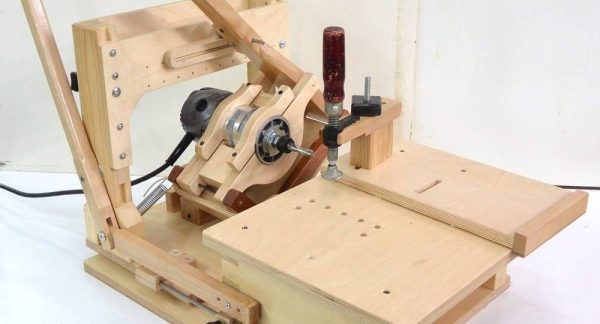

Cool Tools: The Pantorouter Turns Tracing On Its Side

Not too long ago we wrote about a small CNC tool for automating certain parts of the woodworking process. At the time it seemed unusual in its intentionally limited scope but a few commenters mentioned it reminded them of another device, [Matthias]’s Pantorouter. It didn’t take much investigation to see that the commenters were right! The MatchSticks device does feel a bit like a CNC version of the Pantorouter, and it seemed like it was more than worth of a post by itself. The Pantorouter is a fascinating example of another small manual-but-automated tool for optimized for accelerating and improving certain woodworking operations.

Continue reading “Cool Tools: The Pantorouter Turns Tracing On Its Side”

Just A Taste Of The Talks At Supercon

The Hackaday Superconference is taking on a life of its own. Speaker selection is done and invitations are on the way out. Below is a taste of the confirmed talks in store for you this November in Pasadena.

This is the Ultimate Hardware Conference and you need to be there! We’ll continue to announce speakers and workshops as final confirmations come in. Supercon will sell out so grab your ticket now before it’s too late.

Ben Krasnow
Depositing copper circuitry and optical displays onto 3D-printed parts

Producing printed circuits on plastic mechanical parts can be accomplished with a standard laser cutter and a handful of chemicals available from online retailers.

Ruth Grace Wong
Firmware From the Firehose

Practical tips for people who don’t know anything about firmware for deciphering the code and tracking down bugs.

Amie Danielle Dansby
Swords and High Voltage: Creating 3D Printing Designs for Electronics Props

You can easily bring digital video game assets to the human world with 3D printing, but what about modifying files, or adding electronics?

Sam Zeloof
Home Chip Fab: Silicon IC Fabrication in the Garage

IC and semiconductor fabrication techniques, tools, and processes that allow for mid 1970’s era device fabrication on a small budget in the home workshop.

Zach Archer
Live Coding a 40-Foot LED Sign

This is the story of how the massive 500-watt LED Toorcamp sign was designed, developed, and constructed inside of 3 weeks.

Leigh Johnson
Portable Deep Object Detection

The fundamentals of deep learning modules and object detection using Tensorflow and Keras on a Raspberry Pi.

We Want You at Supercon!

The Hackaday Superconference is a can’t-miss event for hardware hackers everywhere. Join in on three amazing days of talks and workshops focusing on hardware creation. This is your community of hardware hackers who congregate to hack on the official hardware badge and on a slew of other projects that show up for the fun. Get your ticket right away!

Hackaday Links Column Banner

Hackaday Links: September 30, 2018

If you’re looking for an Open Source computer, good luck. The RISC-V stuff isn’t there yet, and with anything else you’re going to be dealing with NDA’d Intel, AMD, or some other proprietary cruft. System76, however, makes the most big-O Open computer, and they will be announcing a new Open computer called the Thelio next month. It was on display at the Open Hardware Summit, although smartly there were no pictures taken of this box. Liliputing has reported on it, but there are a few things wrong with that speculation. No, it’s not RISC-V. We’re looking at x86 here. It’s a desktop. It has wood (walnut or maple). It doesn’t have enough cold cathode lighting to blind you, but I guess that’s a matter of taste. Everything will be announced in October.

I have a plan in the works to sell snake oil to people. Actually, it’s not snake *oil*, but it is derived from snakes. There are rattlesnake farmers out there, who breed snakes for meat (tastes like chicken!) and their skins for boots. The fascia of the skins is disposed of when this leather is being prepared, and this can be used as the base component of a glue, or something resembling gelatin. It’s basically no different than fish or animal glue, except it’s from snakes. This can be used as one of the ingredients in gummy candy. This is my plan: I’m going to sell snake oil, except it’s really snake-based gummies. They promote digestion and get rid of ions in your body, or something. Better living through snake gummies.

The paragraph you just read is a better business plan than this bit of snake oil. It’s a battery that recharges itself. It’s unclear if it recharges itself over time; if if it just recharges itself automatically, wouldn’t the battery just have more energy in it? It’s hitting all the checkmarks of snake oil too: there are references to Tesla being a ‘forgotten genius’, zero-point energy fields, and a countdown timer to their crowdfunding campaign. This rabbit hole goes deep.

Did you know Hackaday has a Retro Edition, specifically designed for old computers that somehow have web browsers? It’s true! Sometimes, we even add pics of people pulling the Retro Edition up on their ancient devices. [Steven McDonald] wondered if his Blackberry counted. Sure thing! If you can pull up the Retro Edition on your ancient computer, we’ll mention it in the Links post, too. We’re also taking suggestions on how to improve the Retro Edition; I’ll get around to improving it eventually.

Retrotechtacular: Here’s How They Programmed The EDSAC Computer

When you write a program for your computer, whether it is a desktop machine, a microcontroller, or a supercomputer, the chances are that you use software tools to help you get the job done. High level languages, compilers, linkers, assemblers, debuggers, and code libraries have become so integrated that in many cases you will barely be aware of their existence. To all intents and purposes this huge toolchain will be the computer. But the first computer programmers had none of these luxuries. They had to hand assemble their own binaries, check them by hand, and debug them by guessing what had happened when they failed.

EDSAC I, 1948, W.Renwick with 5 hole tape reader and Creed teleprinter. Copyright Computer Laboratory, University of Cambridge. Reproduced by permission. [CC BY 2.0 UK]
EDSAC (Electronic delay storage automatic calculator) was the first computer operated by the University of Cambridge in the UK and one of the first few computers in the entire world when it was built in the late 1940s. It is the subject of the 1951 film you’ll find embedded below. Originally produced for a conference, the video sports a 1976 introduction and narration from the machine’s creator Professor Maurice Wilkes. It doesn’t take us through the design of the machine itself, instead it concentrates on the workflow required to program it.

The Paper-Heavy Process of Programming EDSAC

To illustrate the programming process, a committee of people who would now call themselves computer scientists, but probably then called themselves mathematicians, breaking a formula into subroutines before the code is laboriously hand assembled. The linking process is performed manually too by the secretary who types the code into a teletype for transfer to a punched tape. When a library function is required she reaches into a filing cabinet for the roll of tape containing it before running it through a tape duplicator to add it to the program. Finally the completed tape is checked and added to a job queue that consists of a row of hooks on the wall. Never complain that your toolchain is unwieldy again!

The original EDSAC was decommissioned in the late 1950s after serving the university and spawning a commercial version, the LEO, which became the first ever computer manufactured for use in commerce. That was not the end of the EDSAC story though, because in this century a team at the National Museum of Computing at Bletchley Park set about recreating EDSAC as an exhibit. And as luck would have it a member of that team was at the recent Electromagnetic Field hacker camp to give a talk about their work which you will also find below.

Building a Faithful Reproduction of EDSAC

Tony Abbey gives us both a history of the machine and a description of its architecture, followed by a run through their efforts in rebuilding it. You may be surprised by some of the unexpected facts from the talk. For instance, while all the tubes used in the EDSAC are still available, their bases are not. Equivalents were sourced from China, but team members had to modify them with dental drills.

They also needed to manufact the 1940s-style tube chassis, and the solution to that problem happened to be just down the road. Bletchley is part of modern-day Milton Keynes, a post-war new town that is also home to another famous name: Marshall amplifiers. Tube amps are built in a surprisingly similar way, so they took on the manufactured challenge. Not all the parts of the new EDSAC are original though. The memory used mercury delay lines in 1949, but for 2018 recreation the computer has a delay line using nickel wire and modern components. Tony admits that even that has caused problems, and there is a simulator using a microcontroller.

You can see the restored EDSAC at the National Museum of Computing. We visited it in 2016, and you can read our review. Meanwhile if you are an FPGA wizard, you can even have a virtual EDSAC of your own.

Continue reading “Retrotechtacular: Here’s How They Programmed The EDSAC Computer”

Hack My House: Raspberry Pi As Infrastructure

I finally had my own house. It was a repossession, and I bought it for a song. What was supposed to be a quick remodel quickly turned into the removal of most of the drywall in the house. There was a silver lining on this cloud of drywall dust and loose insulation. Rather than constantly retro-fitting cabling and gadgets in as needed, I could install everything ahead of time. A blank canvas, when the size of a house, can overwhelm a hacker. I’ve spent hours thinking through the infrastructure of my house, and many times I’ve wished for a guide written from a hacker’s perspective. This is that guide, or at least the start of it.

What do you want your smart house to do? And what do you want to be able to do in your smart house? For example, I wanted to be able to upgrade my cheap 120 V welder to a beefier 240 V model, so adding a 240 V plug in the garage was a must. As a bonus, that same 240 V circuit could be used for charging an electric car, if ever one is parked there.

“Ethernet everywhere” was my mantra. Try to imagine everywhere you might want to plug in a desktop, a laptop, an access point, or even a VoIP phone. I decided I wanted at least two Ethernet drops to each room, and tried to imagine the furniture layout in order to put them in convenient places.

Continue reading “Hack My House: Raspberry Pi As Infrastructure”

Box Forts For Adults: Best Practices And Design Strategies

Many a grown up can reminisce about building various architectural wonders in their youth. Forts, whether based on boxes or blankets, were the order of the day, and an excellent way to spend a rainy Sunday afternoon.

It just so happens that there is no law against scaling up such activities once one has reached the age of majority. However, to build a structure at this level takes some careful planning and consideration, and that is the purpose of our article here today.

Location, Location, Location

To avoid an awkward conflict, be sure to warn your housemates of impending construction well ahead of time.

The first major consideration when starting your build should be the area in which you wish to do it. Building inside has the advantage of avoiding the weather, however hard floors can lead to sore knees when crawling around. Additionally, you’re a grown up now, so it’s less likely your peers will be impressed to hear you sat inside a box in your living room.

No, if you’re going to do this right, you’ll want to go outside. A nice flat lawn is best, providing soft ground and plenty of space. The challenges of the elements will guide your work – sitting inside your cardboard home feels all the more satisfying when you’re cosy and dry as you listen to the patter of rain on the roof. There’s a real sense of accomplishment when you’ve built something that can survive the harsh outdoors, and besides, the views are better, too. Continue reading “Box Forts For Adults: Best Practices And Design Strategies”