Let The Musical Instrument Challenge Begin!

Today is the start of the Musical Instrument Challenge. This newest part of the 2018 Hackaday Prize asks you to go far beyond what we’re used to seeing from modern musical instrumentation. Twenty entries will be awarded $1,000 each and go on to compete in the final round of the Hackaday Prize.

Imagine music without the electric guitar amp, violin, two turntables and a microphone, the electric drum pad, or in the absence of autotune. Maybe that last one made you groan, but autotune is a clever use of audio manipulation and when used to augment the music (rather than just to correct off-key voices) it shows its value as a new tool for creativity.

Musicians have always been hackers. The story of Brian May’s handmade guitar — the Red Special — is one of not being able to buy it, so he built it. Unlocking emotion in the listener has always meant finding new and different ways to use sound. This is a natural motivator to re-imagine and invent new ways of doing that. That first hand-built guitar got him in the door, but iterative improvements to the tremolo bar, the pickups, and even just the mechanical engineering of the neck made it a new instrument that you’ve heard in every Queen performance since.

So what’s next? What does a brand new instrument, interface, tool, or trick look like? That’s what we want to see from this Hackaday Prize challenge. From instrument makers to the people who write software for sampling, synthesizing, sequencing, and manipulating sound, we’re looking for things that let others make music. These creations are the tools of the trade that help more people unlock their musical creativity. Show off your work by sharing all the details of your design, and demonstrate the music you can make with it.

You have until October 8th to put your entry up on Hackaday.io. The top twenty entries will each get $1,000 and go on to the finals where cash prizes of $50,000, $20,000, $15,000, $10,000, and $5,000 await.


FOSSCON 2018: Hacking The Indego Bike Sharing API

It’s often said that necessity of the mother of invention, but as a large portion of the projects we cover here at Hackaday can attest, curiosity has to at least be its step-mother. Not every project starts with a need, sometimes it’s just about understanding how something works. That desire we’ve all felt from time to time, when we’ve looked at some obscure piece of hardware or technology and decided that the world would be a slightly better place if we cracked it open and looked at what spilled out.

That’s precisely the feeling Eric O’Callaghan had when he looked out the window of his Philadelphia apartment a few years back and saw something unusual. Seemingly overnight, they had built an automated Indego bike sharing station right across the street. Seeing the row of light blue bicycles sitting in their electronic docks, he wondered how the system worked, and what kind of data they might be collecting. He didn’t need to rent a bike, he hadn’t even ridden one in years, but he suddenly had a strong urge to go across the street and learn as much as he could about this system.

He recently presented those findings during FOSSCON 2018 at the International House in Philadelphia, in the hopes that others might be interested in getting involved. Currently Eric is one of the only people who’s investigating the public data Indego offers, and as his personal MySQL database has now surpassed 15 million rows of data, he’s hoping to get some developers with big data experience into the fray. His approach to making this data useful is an interesting one which I’ll dive into after the break.

Continue reading “FOSSCON 2018: Hacking The Indego Bike Sharing API”

How To Mash Up BLE, NodeJS, And MQTT To Get Internet Of Things

We’re living in the world of connected devices. It has never been easier to roll your own and implement the functionality you actually want, rather than live with the lowest common denominator that the manufacture chose.

In a previous article I walked though a small python script to talk to a BLE light and used it to cycle through some colors. Now I want to delve deeper into the world of Internet Connected BLE devices and how to set up a simple Internet-Of-Things light. With this example in hand the sky’s the limit on what you can build and what it will be able to do.

Join me after the break as I demonstrate how to use NodeJS to bridge the digital world with the physical world.

Continue reading “How To Mash Up BLE, NodeJS, And MQTT To Get Internet Of Things”

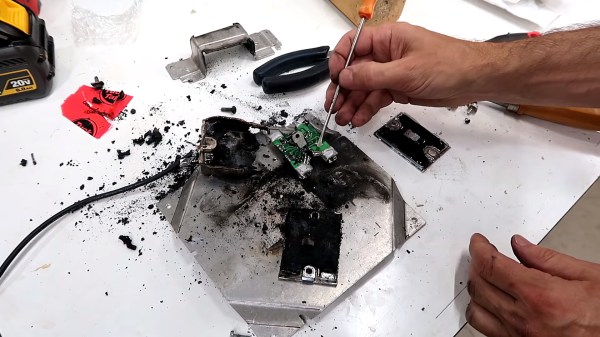
Fail Of The Week: Solid State Relay Fails Spectacularly

A lot of times these days, it seems like we hackers are a little like kids in a candy store. With so many cool devices available for pennies at the click of a mouse, it’s temptingly easy to order first and ask questions about quality later. Most of the time that works out just fine, with the main risk of sourcing a dodgy component being a ruined afternoon of hacking when a part fails.

The stakes are much higher when you’re connecting your project to the house mains, though, as [Mattias Wandel] recently learned when the solid-state relay controlling his water heater failed, with nearly tragic results. With aplomb that defies the fact that he just discovered that he nearly burned his house down, [Mattias] tours the scene of the crime and delivers a postmortem of the victim, a Fotek SSR-25DA. It appears that he mounted it well and gave it a decent heatsink, but the thing immolated itself just the same. The only remnant of the relay’s PCB left intact was the triac mounted to the rear plate. [Mattias] suspects the PCB traces heated up when he returned from vacation and the water heater it was controlling came on; with a tank full of cold water, both elements were needed and enough current was drawn to melt the solder build-up on the high-voltage traces. With the solder gone, the traces cooked off, and the rest is history. It’s a scary scenario that’s worth looking at if you’ve got any SSRs controlling loads anywhere near their rated limit.

The morals of the story: buy quality components and test them if possible; when in doubt, derate; and make sure a flaming component can’t light anything else on fire. And you’ll want to review the basics of fire protection while you’re at it.

Continue reading “Fail Of The Week: Solid State Relay Fails Spectacularly”

Circuit VR: Measuring With LTSpice

Usually, with Circuit VR we look at some circuit in detail with simulation — usually LTSpice. This one will be a little meta because I wanted to look at a capability in LTSpice which ironically is very useful, but not often used. Along the way, though, we’ll look at why you get maximum power transfer when your source impedance matches your load impedance. This is something you probably already know about, but it is interesting to look at in simulation if you know how to coax LTSpice — no pun intended — into showing you a meaningful graph.

The circuit is super simple. An AC source and a 50-ohm resistor stand-in for a 40-meter ham transmitter. With 100 volts into a 50-ohm load. So far, so good.

Continue reading “Circuit VR: Measuring With LTSpice”

Friday Hack Chat: Hacking For Mental Health

Quite often we see applications of hacking and DIY in the medical field. From 3D printed prosthetics to hacked insulin pumps, there’s a wide variety of stuff you can do, but what about psychology? That’s what our Hack Chat this Friday is all about.

Our guest for this week’s Hack Chat is Curt White. He’s been building medical devices for years, and when he’s not doing that he’s creating interactive installation art and costumes. At work he’s a device and sensor developer at the Child mind Institute MATTER Lab where he designs and researches wearable medical devices for children with mental health issues. He’s currently working on gesture detection using wearables, machine learning optimized for microcontrollers, and building and fixing prototypes.

For this hack chat, we’ll talk about how mental health can be addressed by building things with a focus on wearable devices and sensor data. How are wearables challenging the outdated and arbitrary classification of psychiatric disorders, and what is the potential for audio, EEG, and fMRI to help us progress beyond checklist diagnosis? We’ll also talk about:

  • Hacking for mental health
  • Addressing the intangible with the tangible
  • Working with medical researchers
  • The fact that you don’t need an IRB if you don’t accept federal funding, or are working in Belize.

You are, of course, encouraged to add your own questions to the discussion. You can do that by leaving a comment on the Hacking For Mental Health Event Page and we’ll put that in the queue for the Hack Chat discussion.join-hack-chat

Our Hack Chats are live community events on the Hackaday.io Hack Chat group messaging. This week is just like any other, and we’ll be gathering ’round our video terminals at noon, Pacific, on Friday, August 24th. Need a countdown timer? Go go go

Click that speech bubble to the right, and you’ll be taken directly to the Hack Chat group on Hackaday.io.

You don’t have to wait until Friday; join whenever you want and you can see what the community is talking about.

Ask Hackaday Answered: The Tale Of The Top-Octave Generator

We got a question from [DC Darsen], who apparently has a broken electronic organ from the mid-70s that needs a new top-octave generator. A top-octave generator is essentially an IC with twelve or thirteen logic counters or dividers on-board that produces an octave’s worth of notes for the cheesy organ in question, and then a string of divide-by-two logic counters divide these down to cover the rest of the keyboard. With the sound board making every pitch all the time, the keyboard is just a simple set of switches that let the sound through or not. Easy-peasy, as long as you have a working TOG.

I bravely, and/or naïvely, said that I could whip one up on an AVR-based Arduino, tried, and failed. The timing requirements were just too tight for the obvious approach, so I turned it over to the Hackaday community because I had this nagging feeling that surely someone could rise to the challenge.

The community delivered! Or, particularly, [Ag Primatic]. With a clever approach to the problem, some assembly language programming, and an optional Arduino crystalectomy, [AP]’s solution is rock-solid and glitch-free, and you could build one right now if you wanted to. We expect a proliferation of cheesy synth sounds will result. This is some tight code. Hat tip!

Squeezing Cycles Out of a Microcontroller

Let’s take a look at [AP]’s code. The approach that [AP] used is tremendously useful whenever you have a microcontroller that has to do many things at once, on a rigid schedule, and there’s not enough CPU time between the smallest time increments to do much. Maybe you’d like to control twelve servo motors with no glitching? Or drive many LEDs with binary code modulation instead of primitive pulse-width modulation? Then you’re going to want to read on.

There are two additional tricks that [AP] uses: one to fake cycles with a non-integer number of counts, and one to make the AVR’s ISR timing absolutely jitter-free. Finally, [Ag] ended up writing everything in AVR assembly language to make the timing work out, but was nice enough to also include a C listing. So if you’d like to get your feet wet with assembly, this is a good start.

In short, if you’re doing anything with hard timing requirements on limited microcontroller resources, especially an AVR, read on!

Continue reading “Ask Hackaday Answered: The Tale Of The Top-Octave Generator”