Hackaday Belgrade: Sophi Kravitz’s Blimp Army

Building things that fly is hard. The constraints on small, battery powered, radio-operated gear already presents a challenge, but adding weight, balance, and aerodynamic constraints takes it to a whole new level. Sophi Kravitz rises to the occasion and discusses each challenge of building a blimp from start to finish in her presentation at the 2018 Hackaday Belgrade conference.

One of the pleasures of writing for Hackaday comes through the incredible array of talent and experience to be found among our colleagues. We all do our own work, but one is humbled by that which flows from the benches of those one works alongside. Just such a project is the Remote Control Mini Blimp from our colleague Sophi Kravitz. It’s a game involving an obstacle course and a set of remote-controlled blimps. The challenges in such an endeavour have been pushing the limits of what is possible with off-the-shelf components. Continue reading “Hackaday Belgrade: Sophi Kravitz’s Blimp Army”

Friday Hack Chat: Training Robots By Touch

When it comes to training robots, you could grab a joystick or carefully program movements in code. The better way, though, is to move the robot yourself, and have the robot play back all those movements ad infinitum. This is training robots by touch, and it’s the subject of this week’s Hack Chat over on hackaday.io.

Our guest for this week’s Hack Chat will be [Kent Gilson], inventor, serial entrepreneur, and pioneer in reconfigurable computing. [Kent] is the creator of Viva, an object-oriented programming language and operating environment that harnesses the power of FPGAs into general-purpose computing He’s launched eight entrepreneurial ventures, won multiple awards, and created products used in numerous industries across the globe.

[Kent]’s claim to fame on hackaday.io is Dexter, a low-cost robotic arm with 50-micron repeatability and modular end effectors. It does this with three harmonic drives and optical encoders that give it extreme precision. The arm is also trainable, meaning that you can manually control it and play back the exact path it took. It’s training robots by touch, exactly what this Hack Chat is all about.

For this Hack Chat, we’re going to be discussing:

  • Building trainable robots
  • Developing robotics haptics
  • Training robots to manufacture
  • Heterogenous direct digital manufacturing

You are, of course, encouraged to add your own questions to the discussion. You can do that by leaving a comment on the Hack Chat Event Page and we’ll put that in the queue for the Hack Chat discussion.join-hack-chat

Our Hack Chats are live community events on the Hackaday.io Hack Chat group messaging. This week is just like any other, and we’ll be gathering ’round our video terminals at noon, Pacific, on Friday, July 27th.  Need a countdown timer? Well, here you go, mango.

Click that speech bubble to the right, and you’ll be taken directly to the Hack Chat group on Hackaday.io.

You don’t have to wait until Friday; join whenever you want and you can see what the community is talking about.

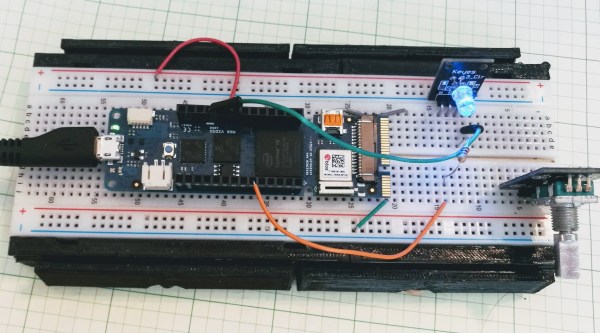
Hands-On With New Arduino FPGA Board: MKR Vidor 4000

Hackaday brought you a first look the Arduino MKR Vidor 4000 when it announced. Arduino sent over one of the first boards so now we finally have our hands on one! It’s early and the documentation is still a bit sparse, but we did get it up and running to take the board through some hello world exercises. This article will go over what we’ve been able to figure out about the FPGA system so far to help get you up and running with the new hardware.

Continue reading “Hands-On With New Arduino FPGA Board: MKR Vidor 4000”

Hackaday Links Column Banner

Hackaday Links: July 29, 2018

Another holy scroll for the Church of Robotron. PoC || GTFO is a semi-annual journal of hardware exploitation, and something you must read. About a year ago, No Starch Press released the first Bible of PoC || GTFO, and now it’s time for a new testament. PoC || GTFO Volume 2 is out now, covering Elegies of the Second Crypt War to Stones from the Ivory Tower, Only as Ballast. It’s still Bible-shaped, with a leatherette cover and gilt edges.

KiCad version 5 is out, and you know what that means: It’s time to start on version 6. To that end, CERN has opened up the floodgates where youyes, you can donate to KiCad development. The team is looking for 600 hours of development and 30,000 Swiss Francs or about that many US Dollars. As of this writing (last Wednesday), more than 200 people have donated, at an average donation per person of about 80 CHF.

Oh good, this is finally over. Qualcomm will not be buying NXP. Previously, Reuters reported Qualcomm would purchase the other semiconductor manufacturer for $38 Billion, the largest semiconductor deal ever. There were earlier rumors of an acquisition. The deal was struck down by Chinese regulators, and speculation rages that this is a reaction to the US/China trade war. Qualcomm now has to pay NXP $2 Billion in fees, which they could use to dig out some of the unobtanium Motorola datasheets locked away in a file cabinet.

The uStepper (or μStepper, whatever) is a neat little add-on to standard NEMA stepper motors. It bolts to the back and gives you the ability to control a stepper over a standard serial bus, with a built-in encoder. Now there’s a new Kickstarter for an improved version that uses the Trinamic TMC2208 ‘silent’ motor driver. That Kickstarter is just a draft now, but if you’re planning a 3D printer build, this could be what you’re waiting for.

Circuit VR: An (Almost) Practical Buck Converter

In the last installment of Circuit VR, we walked around a simplified buck converter. The main simplification was using a constant PWM signal. The result is that the output voltage is a fixed fraction of the input voltage. For a regulator, the pulse width will need to depend on the output voltage so that any changes in the output are self-correcting. So this time, we’ll make a regulator, although we’ll still use a few Spice elements you’d have to replace in a practical design. In particular, we’ll assume you can generate a triangle wave, which is easy enough, and produce a stable 2.5 V reference.

The idea is to take a voltage reference and compare it to the output. We’ll think of the difference between the two as an error voltage, and use a comparator combined with a triangle wave generator to produce a PWM signal that is proportional to the error, and thus works to hold the output voltage constant.

Continue reading “Circuit VR: An (Almost) Practical Buck Converter”

Hackaday Belgrade: Luka Mustafa On Exploiting IoT Niches

Ecology is a strange discipline. At its most basic, it’s the study of how living things interact with their environment. It doesn’t so much seek to explain how life works, but rather how lives work together. A guiding principle of ecology is that life finds a way to exploit niches, subregions within the larger world with a particular mix of resources and challenges. It’s actually all quite fascinating.

But what does ecology have to do with Luka Mustafa’s talk at the 2018 Hackaday Belgrade Conference? Everything, as it turns out, and not just because Luka and his colleagues put IoT tools on animals and in their environments to measure and monitor them. It’s also that Luka has found a fascinating niche of his own to exploit, one on the edge of technology and ecology. As CEO of Institute IRNAS, a non-profit technology development group in Slovenia, Luka has leveraged his MEng degree, background in ham radio, and interest in LoRaWAN and other wide-area radio networks to explore ecological niches in ways that would have been unthinkable even 10 years ago, let alone in the days when animal tracking was limited by bulky radio collars.

Continue reading “Hackaday Belgrade: Luka Mustafa On Exploiting IoT Niches”

Friday Hack Chat: Making Modular Hardware

The future of wireless is decentralized. Mesh-type networks are slowly making their way into the WiFi standard, and soon enough we’ll be dealing with decentralized phones. That’s wireless, but what about electronics? For most embedded work, we’re dealing with masters and slaves, but what if we didn’t have to deal with that? This is the challenge of modular electronics, and this week’s Hack Chat is going to be talking all about that.

Our guest for this week’s Hack Chat is [Asaad Kaadan], an electronics engineer from Seattle. [Asaad] holds a Masters and PhD in Electrical Engineering from the University of Oklahoma. For his day job, he builds high-end camera controllers for Freefly Systems. By night, he designs Hexabitz electronics prototyping modules. What are Hexabitz? That’s where this is about to get interesting.

Hexabitz are, as you would expect, tiny little hexagons packed with electronics. Every hexagon has a microcontroller on board, and these hexagons connect together through solder pad connectors along the edges of the board. Before you ask, yes, there are pentagonal Hexabitz, so yeah, you can do that.

During this Hack Chat, we’re going to be talking all about modular electronics and [Assad]’s Hexabits. We’re going to be covering questions like:

  • How to design connectors for testing boards
  • What the protocol for mesh electronics looks like
  • How to use modular electronics together in a system

You are, of course, encouraged to add your own questions to the discussion. You can do that by leaving a comment on the Hack Chat Event Page and we’ll put that in the queue for the Hack Chat discussion.join-hack-chat

Our Hack Chats are live community events on the Hackaday.io Hack Chat group messaging. This week is just like any other, and we’ll be gathering ’round our video terminals at noon, Pacific, on Friday, July 27th.  Need a countdown timer? Yes you do.

Click that speech bubble to the right, and you’ll be taken directly to the Hack Chat group on Hackaday.io.

You don’t have to wait until Friday; join whenever you want and you can see what the community is talking about.