Twenty Power Harvesting Projects Headed To The Hackaday Prize Finals

The Academy Awards of hardware creation is going on right now! The Hackaday Prize is a challenge to you — yes, you — to create the next great piece of Open Hardware. It is simply incomparable to anything else, and we have the projects to show for it.

Last week, we wrapped up the Power Harvesting Challenge portion of The Hackaday Prize. Now we’re happy to announce twenty of those projects have been selected to move onto the final round and have been awarded a $1000 cash prize. Congratulations to the winners of the Power Harvesting Challenge portion of the Hackaday Prize. Here are the winners, in no particular order:

Continue reading “Twenty Power Harvesting Projects Headed To The Hackaday Prize Finals”

Edwin Armstrong’s Battle For FM Radio

Chances are you have at least one radio that can receive FM stations. Even though FM is becoming less used now with Internet and satellite options, it still is more popular than the older AM radio bands. FM was the brainchild of an inventor you may have heard of — Edwin Armstrong — but you probably don’t know the whole story. It could make a sort of radio-themed soap opera. It is a story of innovation, but also a story of personal vanity, corporate greed, stubbornness, marital problems, and even suicide. The only thing missing is a long-lost identical twin sibling to turn it into a full telenovela.

Early Days

Armstrong grew up in New York and because of an illness that gave him a tic and caused him to be homeschooled, he was somewhat of a loner. He threw himself into his interest in electric and mechanical devices. By 1909 he was enrolled in Columbia University where professors noted he was very focused on what interested him but indifferent to other studies. He was also known as someone more interested in practical results than theory. He received an electrical engineering degree in 1913.

Unlike a lot of college graduates, Armstrong didn’t go work for a big firm. Instead, he set up a self-financed independent lab at Columbia. This sounded good because it meant that he would own the patents on anything invented there. But it would turn out to be a two-edged sword.

Continue reading “Edwin Armstrong’s Battle For FM Radio”

Fail Of The Week: How Not To Make A 3D Scanner

Sometimes the best you can say about a project is, “Nice start.” That’s the case for this as-yet awful DIY 3D scanner, which can serve both as a launching point for further development and a lesson in what not to do.

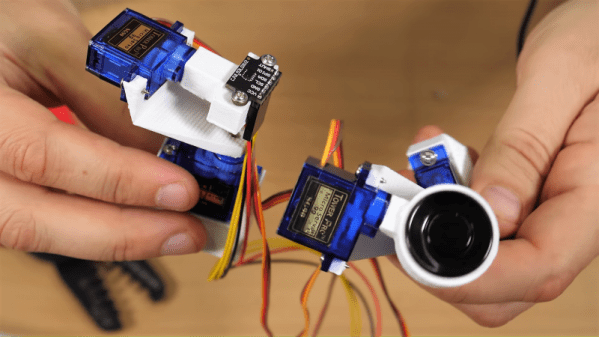
Don’t get us wrong, we have plenty of respect for [bitluni] and for the fact that he posts his failures as well as his successes, like composite video and AM radio signals from an ESP32. He used an ESP8266 in this project, which actually uses two different sensors: an ultrasonic transducer, and a small time-of-flight laser chip. Each was mounted to a two-axis scanner built from hobby servos and 3D-printed parts. The pitch and yaw axes move the sensors through a hemisphere gathering data, but unfortunately, the Wemos D1 Mini lacks the RAM to render the complete point cloud from the raw points. That’s farmed out to a WebGL page. Initial results with the ultrasonic sensor were not great, and the TOF sensor left everything to be desired too. But [bitluni] stuck with it, and got a few results that at least make it look like he’s heading in the right direction.

We expect he’ll get this sorted out and come back with some better results, but in the meantime, we applaud his willingness to post this so that we can all benefit from his pain. He might want to check out the results from this polished and pricey LIDAR scanner for inspiration.

Continue reading “Fail Of The Week: How Not To Make A 3D Scanner”

Fail Of The Week: ESP Walkie, Not-So-Talkie

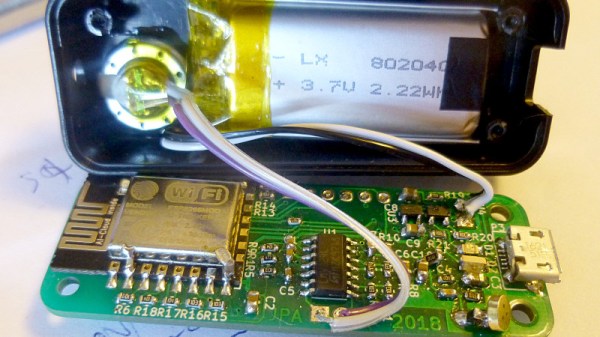
The ESP8266 has become such a staple of projects in our community since it burst onto the scene a few years ago. The combination of a super-fast processor and wireless networking all on the same chip and sold in retail quantities for relative pennies has been irresistible. So when [Petteri Aimonen] needed to make a wireless intercom system for cycling trips it seemed an obvious choice. Push its internal ADC to sample at a high enogh rate for audio, and stream the result over an ad-hoc wi-fi network.

The result was far from satisfactory, as while early results with a signal generator seemed good, in practice it was unusable. Significant amounts of noise were entering the pathway such that the resulting audio was unintelligible. It seems that running a wireless network causes abrupt and very short spikes of power supply current that play havoc with audio ADCs.

He’s submitted it to us as a Fail Of The Week and he’s right, it is a fail. But in a way that’s an unfair description, because we can see there is the germ of a seriously good idea in there. Perhaps with an external ADC, or maybe with some as-yet-to-be-determined filtering scheme, an ESP8266 walkie-talkie is one of those ideas that should be taken to its conclusion. We hope he perseveres.

Hackaday Links Column Banner

Hackaday Links: July 22, 2018

KiCad Version 5 has been released! Footprints are going to be installed locally, and the Github plugin for library management is no longer the default. You now have the ability to import Eagle projects directly, Eeschema has a better configuration dialog, better wire dragging, and Pcbnew now has complex pad shapes. The changelog also says they’ve gone from pronouncing it as ‘Kai-CAD’ to ‘Qai-CAD’.

Kids can’t use computers because of those darn smartphones. Finally, the world is ending not because of Millennials, but because of whatever generation we’re calling 12-year-olds. (I’m partial to Generation Next, but that’s only because my mind is polluted with Pepsi commercials from the mid-90s.)

Need a NAS? The Helios4 is built around the Marvell Armada 388 SoC and has four SATA ports, making it a great way to connect a bunch of hard drives to a network. This is the second run from the team behind the Helios, and now they’re looking to take it into production.

A while ago, [Dan Macnish] built Draw This, a camera that takes an image, sends it through artificial intelligence, and outputs a cartoon on a receipt printer. It’s a camera that prints pictures of cartoons. Of course, some people would want to play with this tech without having to build a camera from scratch, so [Eric Lu] built Cartoonify, a web-based service that turns pictures into cartoons.

Grafitti is fun to spell and fun to do, and for all the proto-Banskys out there, it’s all about stencils. [Jeremy Cook] did a quick experiment with a 3D-printed spray paint stencil. It works surprisingly well, and this is due to leveraging the bridging capability of his printer. He’s putting supports for loose parts of the stencil above where they would normally be. The test sprays came out great, and this is a viable technique if you’re looking for a high-quality spray paint stencil relatively easily.

Belgrade Badge Hacks

We’re still coming off the Hackaday Belgrade conference right now. If you were there, you know it was the greatest hardware conference ever. If you weren’t there, you missed out. Sorry. (Make sure you get in on the Hackaday Superconference in November.)

One of the many highlights of the Belgrade conference was, of course, the badge. The 2018 Hackaday Belgrade Badge is a masterpiece of hardware with a 55-key keyboard, RGB TFT LED, speaker, and a BASIC interpreter.

This badge is a masterpiece of electronic design by Voja Antonic. Just to take one small example from the design, check out the placement of the buttons. Think the slightly rotated buttons that make up the keyboard is only a stylistic choice? It’s not; by carefully rotating each button, the legs of each switch can fit in between each other. It’s brilliant.

Starting hardware this good, adding amazing software by Jaromir Sukuba to bring it to life, and distributing a badge to each hacker through the door is the perfect recipe for some amazing hacks. What were the best badge hacking tricks we saw at the 2018 Hackaday Belgrade conference? Check out the video of the badge hacking ceremonies and then join us below for a few of our favorites.

Continue reading “Belgrade Badge Hacks”