Shaper Tools Will Blow Your Mind

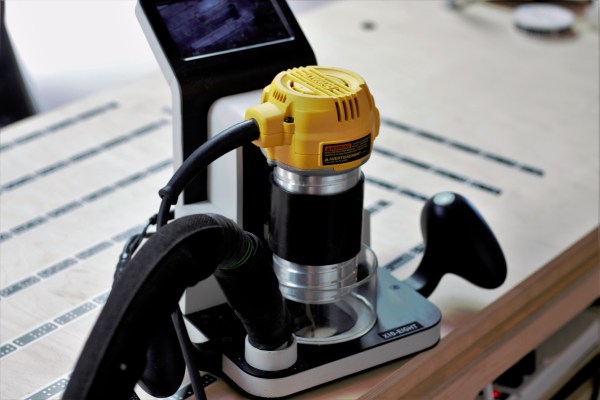
Have you ever wanted to own a full-sized ShopBot? What if some geniuses somewhere made a tool the size of a coffee maker that had the same capabilities? Does an augmented reality, real-time feedback, interactive, handheld CNC router that can make objects ranging in size from a pillbox to an entire conference room table sound like a thing that even exists? It didn’t to me at first, but then I visited the Shaper Tools office in San Francisco and they blew my mind with their flagship tool, Shaper Origin.

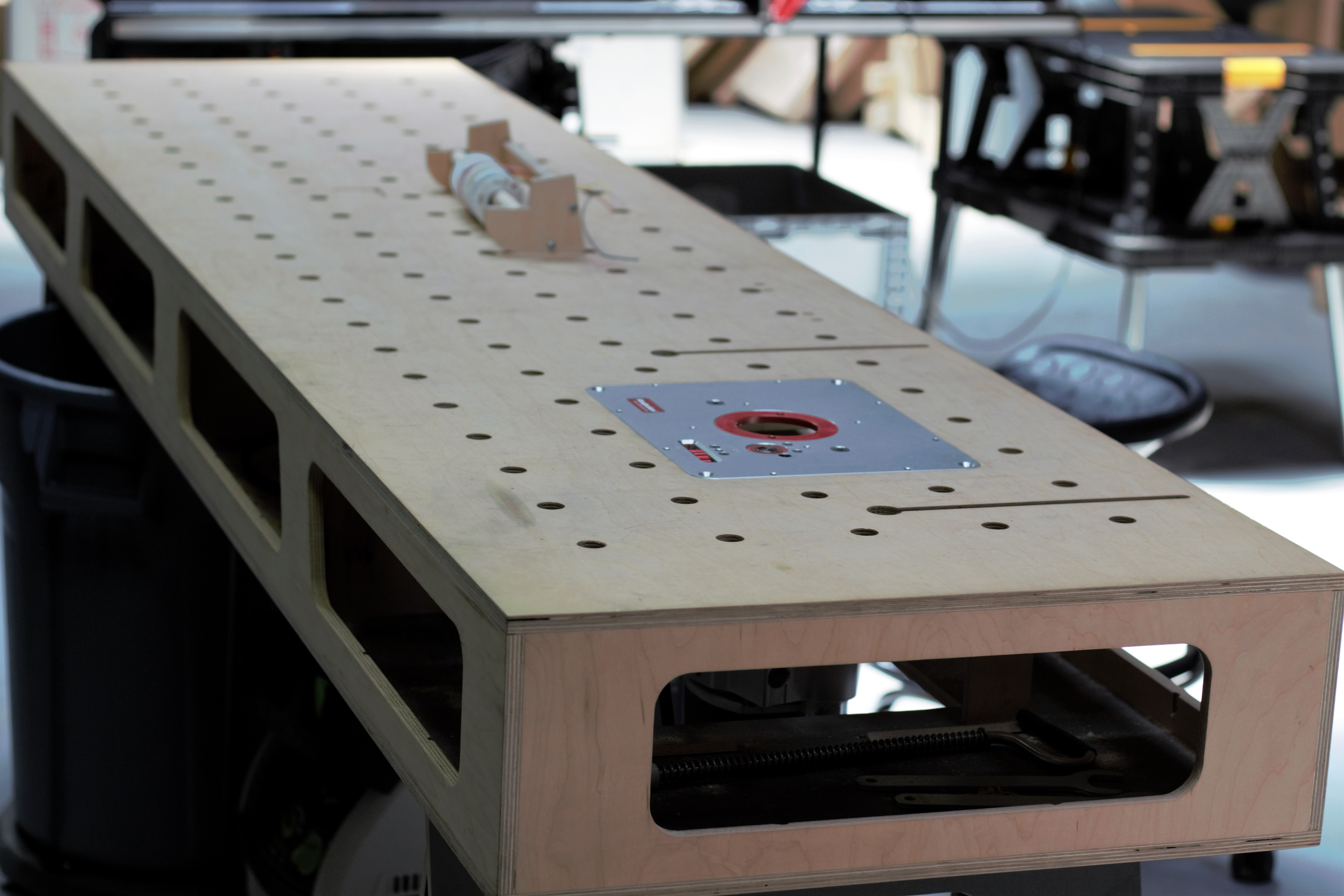
This table and the spool holder sitting on it was made with a machine the size of a coffee maker.

It’s impossible for me not to sound like a fan boy. Using Shaper Origin was one of those experiences where you just don’t know what to say afterwards. This is what the future looks like.

I’ve used a lot of CNC tools in my life, from my first home-built CNC conversion, to 1980s monstrosities that ran off the floppy kind of floppy disks, and all the way over to brand new state-of-the-art vertical machining centers. I had to shake a lot of that knowledge off when they demoed the device to me.

Origin is a CNC router built into the form factor of a normal wood router. The router knows where it is on the work piece. You tell it where on the piece you would like to cut out a shape, drill a hole, or make a pocket. It tells you where to go, but as you move it keeps the cutting bit precisely on the path with its three axes of control.

Continue reading “Shaper Tools Will Blow Your Mind” →

Navid Gornall Eats His Own Face

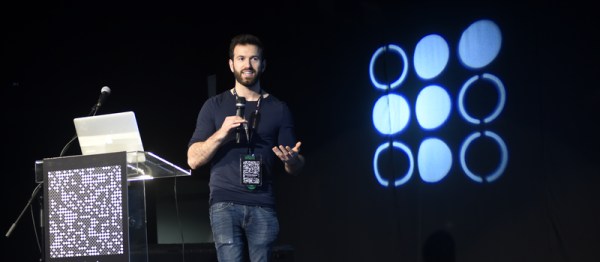
Navid Gornall is a creative technologist at a London advertising agency, which means that he gets to play with cool toys and make movies. That also means that he spends his every working hour trying to explain tech to non-technical audiences. Which is why he was so clearly happy to give a talk to the audience of hardware nerds at the Hackaday Belgrade conference.

After a whirlwind pastiche of the projects he’s been working on for the last year and a half, with tantalizing views of delta printers, dancing-flame grills, and strange juxtapositions of heat sinks and food products, he got down to details. What followed was half tech show-and-tell, and half peering behind the curtain at the naked advertising industry. You can read our writeup of the highlights after the video below.

Continue reading “Navid Gornall Eats His Own Face” →

Flying With Proportional – Integral – Derivative Control

Your quad-copter is hovering nicely 100 feet north of you, its camera pointed exactly on target. The hover is doing so well all the RC transmitter controls are in the neutral position. The wind picks up a bit and now the ‘copter is 110 feet north. You adjust its position with your control stick but as you do the wind dies and you overshoot the correction. Another gust pushed it away from target in more than one direction as frustration passes your lips: ARGGGHH!! You promise yourself to get a new flight computer with position hold capability.

How do multicopters with smart controllers hold their position? They use a technique called Proportional – Integral – Derivative (PID) control. It’s a concept found in control systems of just about everything imaginable. To use PID your copter needs sensors that measure the current position and movement.

The typical sensors used for position control are a GPS receiver and an Inertial Management  Measurement Unit (IMU) made up of an accelerometer, a gyroscope, and possibly a magnetometer (compass). Altitude control would require a barometer or some other means of measuring height above ground. Using sensor fusion techniques to combine the raw data, a computer can determine the position, movement, and altitude of the multicopter. But calculating corrections that will be just right, without over or undershooting the goal, is where PID comes into play. Continue reading “Flying With Proportional – Integral – Derivative Control” →

Minimal MQTT: Networked Nodes

Last time on Minimal MQTT, we used a Raspberry Pi to set up an MQTT broker — the central hub of a home data network. Now it’s time to add some sensor and display nodes and get this thing running. So pull out your ESP-8266 module of choice, and let’s get going.

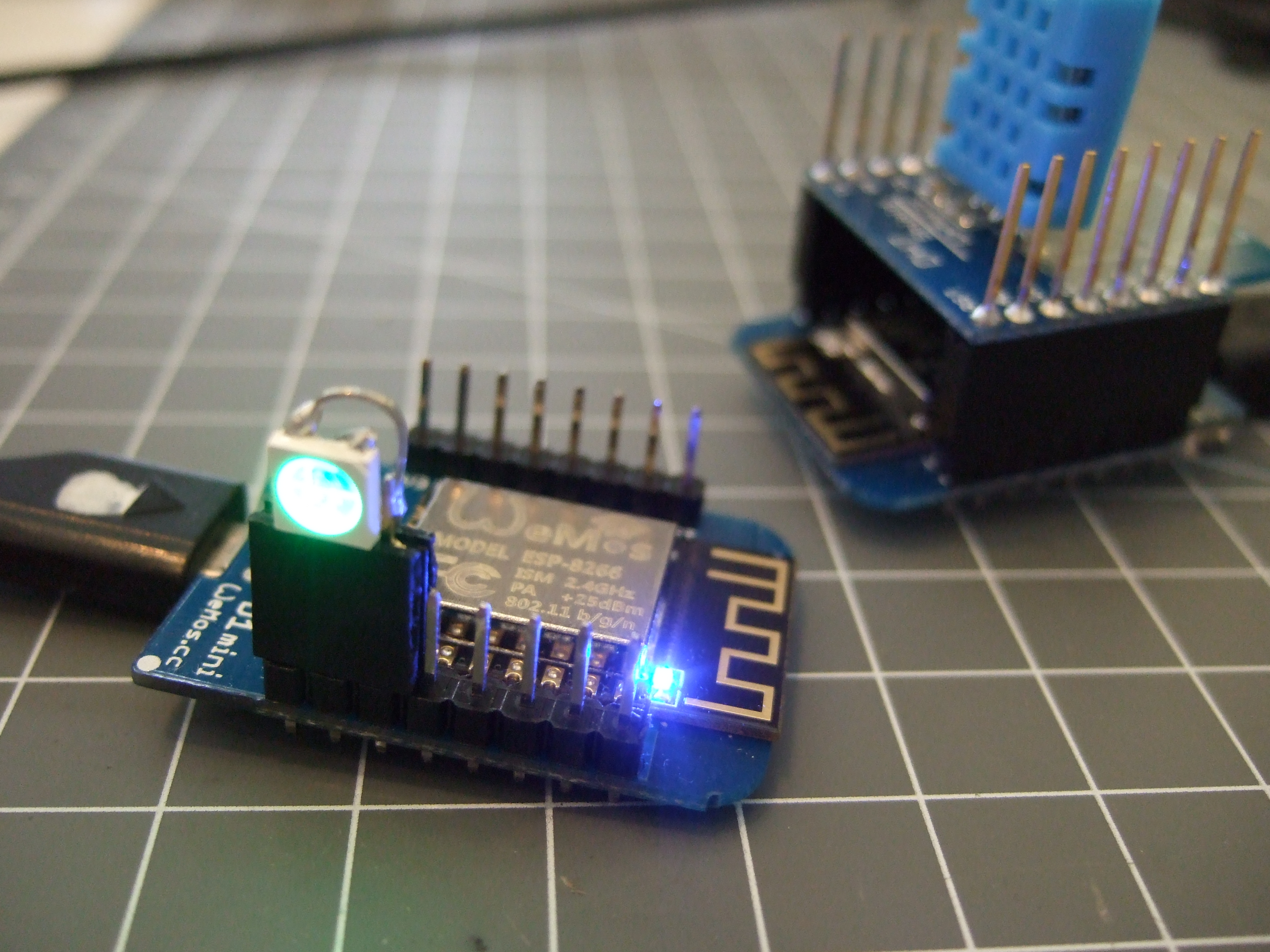
DSCF8443For hardware, we’re using a WeMos D1 Mini because they’re really cute, and absolutely dirt cheap, but basically any ESP module will do. For instance, you can do the same on the simplest ESP-01 module if you’ve got your own USB-serial adapter and are willing to jumper some pins to get it into bootloader mode. If you insist on a deluxe development board that bears the Jolly Wrencher, we know some people.

NodeMCU: Getting the Firmware

We’re using the NodeMCU firmware because it’s quick and easy to get running. But you’re not stuck with NodeMCU if you want to go it alone: MQTT has broad support. [TuanPM] ported over an MQTT library to the native ESP8266 SDK and of course there’s espduino, a port for an Arduino-plus-ESP combo. He also ported the MQTT module to NodeMCU that we’ll be using today. Thanks, [TuanPM]!

Continue reading “Minimal MQTT: Networked Nodes” →

Reinventing VHDL Badly

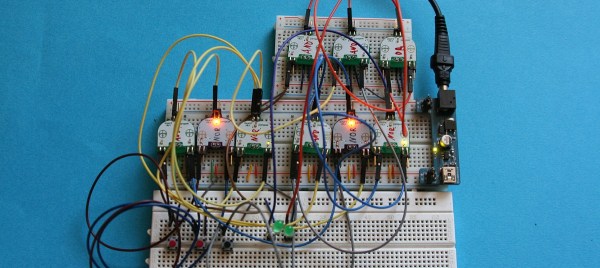
A few years ago, Philip Peter started a little pet project. He wanted to build his own processor. This really isn’t out of the ordinary – every few months you’ll find someone with a new project to build a CPU out of relays, logic chips, or bare transistors. Philip is a software developer, though, and while the techniques and theory of building hardware haven’t changed much in decades, software development has made leaps and bounds in just the past few years. He’s on a quest to build a CPU out of discrete components.

Search the Internet for some tips and tricks for schematic capture programs like KiCad and Eagle, and you’ll find some terrible design choices. If you want more than one copy of a very specific circuit on your board, you have to copy and paste. Circuit simulation is completely separate from schematic capture and PCB design, and unit testing – making sure the circuit you designed does what it’s supposed to do – is a completely foreign concept. Schematic capture and EDA suites are decades behind the curve compared to even the most minimal software IDE. That’s where Philip comes in. By his own admission, he reinvented VHDL badly, but he does have a few ideas that are worth listening to.

Continue reading “Reinventing VHDL Badly” →

Meet Up With Hackaday This Saturday In San Mateo

We’ll be at Bay Area Maker Faire and we want to have a beer with you on Saturday night.

Two years ago we headed off to the Bay Area Maker Faire and thought we’d invite friends and acquaintances to congregate at a bar on Saturday night. Anyone who’s been to the Faire (or been through a harrowing weekend of working a booth) knows that a bar stool and frothy beverage are a great way to recuperate. The turnout was amazing, we easily filled up O’Neill’s Irish Pub with that first meetup, and the Hackaday BAMF Meetup was born. Last year we packed it to the seams. This year we’re planning for an even bigger turnout that will go late into the evening.

I’ve only ever heard one complaint about this event; the band is too loud. This year O’Neill’s doesn’t have a band lined up so everything seems to be coming up roses. Come hang out with us! If you RSVP we’ll buy your first beer. Bring your stories, your easily transported hacks to show off, and have fun with the eclectic and enthralling community that turns out for this, the greatest meetup on earth.

Hackaday Letter from the Editors

If this is the first you’ve heard about this year’s meetup, you should subscribe to our weekly newsletter. Every week, a Hackaday Editor writes about what’s been going on that week, and shares a few of the most interesting posts from the past seven days. You can sign up for it in the sidebar to the right or with that signup link I just shared. If you’d like to know what you’re getting yourself into, here’s the most recent newsletter which we sent out on Friday. It’s a mini Hackaday delivered to your mailbox.

Hackaday Links: May 15, 2016

The Hackaday Overlords (or Hackaday family) are running a series of AMAs on SupplyFX. What is SupplyFX? It’s a social network for EEs. Who’s in the first AMA? [Brady Forrest], the guy who runs Highway1, a Bay Area hardware accelerator. They’re the accelerator responsible for the lustworthy Keyboardio, and the startup that is purely mechanical and has shipped zero lines of code, CoolChip. If you want to talk about hardware startups, [Brady] is your man. The AMA is tomorrow, May 16th, at 13:00 Pacific.

Makerbot is dead, or at least they will be soon. Whatever. Nothing of value was lost. Lulzbot, on the other hand, is going gangbusters. They saw eight hundred percent growth over the last two years. and $15M in revenue in 2015. They did this all with open source hardware and software, and using 3D printing in a manufacturing context. They’re the jewel of the Open Hardware movement, and a shining example of what Free Software can do.

The current generation of software defined radios started with the ubiquitous TV tuner dongles, and quickly graduated to the HackRF. You can only get so much bandwidth out of a USB 2.0 socket, and the newest and bestest SDR is the LimeSDR. They’re about halfway through their crowdfunding campaign (and halfway funded), and have finally changed out the USB A connector to a USB micro B connector. Good choice.

The ESP8266 is quickly becoming the go-to device for when you want a cheap way to put a sensor on the Internet. The only problem is programming it. No problem – here’s a bunch of Lua scripts that do 90% of everything. Need to read a PIR sensor? Light up a few LEDs? Put the data from a temperature and humidity on the Internet? There you have it.

The Vintage Computer Festival West is back on this year. We’ve gone to VCF East in New Jersey for a few years now, and had a few occasional outings to the southeast and midwest Vintage Computer Festivals over the years. This is the first time the west coast has had a Vintage Computer Festival in several years. It’s in Mountain View, on August 6th and 7th. Yes, that’s the same weekend as DEF CON.

E3D, makers of fine hot ends and 3D printer paraphernalia, have released a new kind of filament. It’s called Edge, it’s based on PET, and it prints as easily as PLA, with better mechanical properties than ABS. A few sample prints made from Edge were at this year’s Midwest RepRap Festival, and the Edge’s bridging ability is crazy. You need a heated bed for Edge and it’s sensitive to moisture, but it has some very interesting properties that can be cleverly exploited.

In other filament news, Colorfabb released a filament to print clear parts. Yes, that’s very weird. Clear parts require 100% infill, meaning it will use a lot of filament. It’s still very advanced wizardry, and I’m very interested in seeing the first print of a sanded and polished convex lens.

Holy Crap it’s the 3D printing edition of the links post. [Prusa] just released the latest version of the i3. It’s now bigger: 250x210x200mm build volume. The heated bed – [Prusa] was one of the first to experiment with PCB heated beds – is now vastly improved when looking at it through a FLIR. The Mk. 42 heated bed doesn’t have a hot center or cool corners. PEI sheet removes the need for blue painters tape, glass, aqua net, or glue sticks. The printer has self-test capabilities. The mechanics of the printer, especially the Z axis, are improved. [Prusa] will be selling this as a kit for ~19000 Czech Crowns or $699 USD, but he’s RepRap to the core. Buy a spool and start printing your next printer.