HaD Links – Quakepocalypse Edition: August 23, 2011

Well, if you hadn’t noticed the news there has been a little bit of a shakeup on the east coast. I just arrived home after being evacuated due to a 30 second rumble the likes of which has not been felt on the east coast in something like 114 years. In lieu of the not so devastating but earth shaking event we thought we’d put together a few earthquake related links for you.

Earthquake-proof Wine Rack

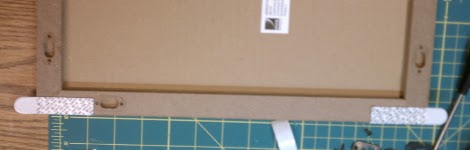
First off instructables user [jofish] has a quick remedy if earthquakes are constantly destroying all the wine on your wine rack. He researched some existing commercial products and simply copied them by stapling cheap O rings to the front of the rack. We assume the back of the wine rack is secured to the wall as well.

Vertical Seismometer

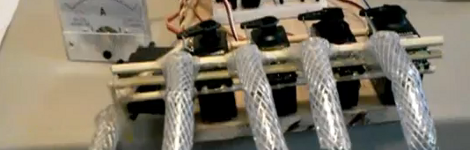
Next up is a vertical seismometer from [Mike] over at mikesense.com. This was in response to a slightly more threatening 7.2 earthquake he experienced in Baja California last year. A vertical seismometer measures the movement of a weight either electronically or mechanically, and then damps the motion of the oscillation by a magnet or some other means. This particular design is known as the AS-1 developed by [Jeff Batten]. Matt’s page has links to everything you’d need to know including build videos.

Predict Seismic Activity with Hard Drives

If you are looking for some non-conventional ways of tracking seismic activity we have a pair of articles that detail earthquake tracking using your disk drive’s accelerometer. [Michael Stadler] realized the potential for all these sensors and released a program that creates a peer-to-peer network compiling data from the sensors. We are not too comfortable with the prospect of somebody tracking every time we drop or kick (or drop-kick) our laptops but 2500 users in Asia downloaded the software in ’06. The second article details an effort lead by IBM to monitor the fixed hard drives in server racks which generally remain far more stationary.

Simple DIY Earthquake Simulator

Finally for those of you who want to cause (miniature) earthquakes, we dug up this MTU project using plywood, an electric drill, rubber bands and some bearings to fabricate a DIY shake table (PDF warning). We are sure there are tons of improvements that can be made but this is a pretty fun project if you have a bunch of CNC parts lying around (we wish we did).

Hackaday Links: July 31, 2011

Indestructible earbuds

We’re still waiting for our [Lt. Uhura] style earbuds. But until then, can we interest anyone in a set that will stand up to some abuse?

Solder Pot Scavenger

[Felicitus] says we should get a solder pot and use it to scavenge for parts. His method looks pretty easy and it’s cheaper than buying a rework station for this purpose.

Smartphone cooling

Turn all your hacking skills loose to beat the heat. That’s what [Stephanie] did when she added iPhone control for an oscillating fan.

Tunes calculator

Graphing equations and crunching numbers wasn’t enough for [Drew]. He went and figured out how to make his TI-84+ play music off of a thumb drive.

Geek-chic

Don’t let anyone out-geek you at company parties. Beef up your arsenal with this resistor color-code necktie. And yes, you can wear it with a T-shirt!

Component Storage Roundup

It’s been suggested that the first self-replicating computer virus was a single IC that eventually expanded into multiple plastic component storage boxes. Organizing components by their values is a huge PITA as well. Here’s some solutions we’ve found:

Photo Boxes

[Mathew] sent in his organization scheme that uses 4×6 photo boxes. Better get those boxes while they’re hot – we can’t remember the last time we used film.

Use a binder

This instructables uses binders for storage. Good for passives, but unless someone can find anti-static bags for a binder, we’ll keep our ICs separate.

The only way to organize resistors

[Johannes] stores his resistors on a sheet of styrofoam. The grid has the first color band on the left side and the second color band on the top. Extremely, extremely clever. We’re wondering why we Radio Shack didn’t come up with this in the 70s. The grid could be laid out on a log scale, though.

If Susan is lazy, why does she do all the work?

[D.C. Boyce] hacked up a couple of lazy susans, built frames out of 2x4s and mounted plastic component drawers on them. The result is probably more space than we’ll ever need. To keep things simple, he wrote a database program to keep track of everything.

Hackaday Links: July 24, 2011

Plasma speakers

Apparently if you run AC and DC currents through a welding torch flame you can use the resulting plasma as a loudspeaker. [Thanks Cody]

Power metering

The Google Power Meter API is no longer in development but that didn’t stop [Pyrofer] from finishing his metering hardware. It uses a reflectance sensor to read the meter instead of using clamp-based current sensing.

Music videos from inside the instrument

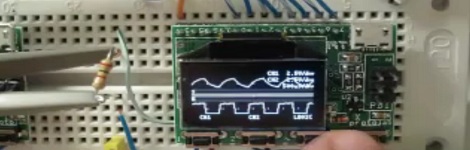
Filming from inside of a guitar creates the camera effect seen above which looks like the waveform you’d see on an oscilloscope. [Thanks Philleb]

Hidden messages in audio files

GhostCoder lets you encrypt and hide audio files within other audio files. The thought is, you can piggyback your own data into Torrents that are circling the interwebs.

2×4 Chair

If you’re skilled with a Skill saw you can make a chair out of one 2 by 4. You can see the pattern you’ll have to cut out from the board in the image above, wow!

Hackaday Links: Tuesday, July 19th

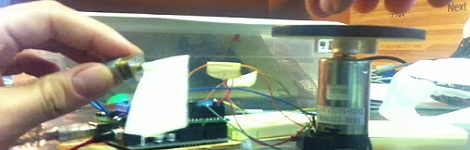
Here’s another “useless machine” variant.  The trick to this one is that it has dual “fingers” and can work either way. Which way it turns off is selectable via a switch on the side, and the fingers can both be turned on to “fight” each other. Check out the video here.

This video depicts the assembly of a Gameboy MAME-style cabinet. For those wanting to try something like this, this video may fill you in on some of the required assembly techniques, such as how to put decals on the side of your cabinet.

This video featuring the “Autonomous Ultimate Wall-E” shows this robot’s navigational skills around the house.  Additionally, it has some nicely actuated arms.

The Verbalizer is a microphone designed to be used with Google’s voice search. It’s also designed with Arduino compatibility in mind and is open-source. Could be a good tool for your next hack.

These clever multimeter probes were built using pogo pins used in electrical test equipment. The springs inside of these pins help keep them planted firmly on the test point in question and reportedly gives a very good connection.

Hackaday Links: Saturday, June 18th

Tripod CNC Machining Setup:


Here’s a strange “tripod” device using the EMC software package generally used for CNC machining.  In this case it looks like something that (when scaled up) might control a sky-cam-like device that one would see at football games.

The Off-Grid Container House:


Project to make an off-grid container house.  Pretty crazy idea, but definitely not developed yet. This seems like a cool idea, so hopefully this guy will come through. It may give you some other ideas, so check it out. Pizza in a cup anyone?

Iphone Window Pocket


Iphone window pocket – This Instructables article shows how to make a “window” in your pants for your Ipod. The combination of bad style and nerdiness gives a great first impression every time. Not sure how it works with the capacitive touch screen, but it should be good for viewing at least.

The Multiple AC Unit Experiment


Here’s someone who’s done some experimenting with using a central AC unit with several window units. Not bad, considering he documents shaving about 1/3 off his power bill.  Maybe it could inspire something even better!

Incredible CNC “hexapod” Milling Center


Finally, this machine isn’t exactly a “hack”, but a professionally designed machining center. It uses a machining setup similar to a delta robot. Six linear actuators are coordinated to allow this CNC robot to move in five degrees of freedom with incredible speed.

Hackaday Links: Monday June 13

Tim wrote in to tell us about this simple hack where he replaced the stock button lights with some really cool Blue LEDS on an ’87 BMW. He uses some capacitors, to achieve the effect that it takes a bit for the charge to drain out so the lights stay on for a bit after being turned off.  The lights themselves look really nice, so check out the pic.

Here’s an awesome coffee Table built using a large electrical board. It definitely would look good in anyone’s den, although it most likely has a low wife approval factor (WAF). This is actually based on a “motherboard wall that HAD covered before, but the “coffee table” form probably looks even better.

Finally, after the break is a video of someone washing an interactive art exhibit. Not sure if it qualifies as a hack, but it looks pretty cool to see lights following someone around when he’s washing the screen/window.

Continue reading “Hackaday Links: Monday June 13”