World’s Largest Telescope Stopped By LED

Earlier this year a simple indicator LED brought the Keck 1 telescope, a 370 tons mass, to a halting stop. How exactly did an LED do this? Simple: it did nothing.

As it so happens, [Andrew Cooper] was just about the leave the summit of Mauna Kea (in Hawaii) when his radio instructed him otherwise: there was an issue. Upon returning, [Andrew] was met by a room of scientists and summit supervisors. “Yeah, this was not good, why are they all looking at me? Oh, h%#*!” The rotor wasn’t moving the telescope, and “no rotator equals no science data.” After being briefed on the problem, [Andrew] got to work. Was it a mechanical issue? No: manual mode worked quite fine, also indicating that the amplifiers and limit switches are functional as well.

Jumping from chip to chip, [Andrew] came across an odd voltage: 9.36V. In the CMOS [Andrew] was investigating, this voltage should have High (15V) or Low (0v) and nowhere in between. Judging by the 9.36V [Andrew] decided to replace the driving IC. One DS3632 later, nothing had changed. Well, maybe is one of the loads pulling the line low? With only two choices, [Andrew] eliminated that possibility quickly. Likely feeling as if he was running out of proverbial rope, [Andrew] remembered something important: “the DS3236 driving this circuit is an open collector output, it needs a pull-up to go high.”

Reviewing the schematic, [Andrew] identified the DS3236’s pull-up: an LED and its current limiting resistor. While the carbon composition resistor was “armageddon proof,” [Andrew] was suspicious of the LED. “Nick, can you get me a 5k resistor from the lab?” Hold the resistor on the pins of the chip and the amplifiers immediately enabled.

[Andrew] summarizes things quite well: “yes… One of the world’s largest telescopes, 370 tons of steel and glass, was brought to a halt because of a bad indicator LED”. It stopped things by doing nothing, or rather, by not turning on.

We love it when we get troubleshooting stories, and if you share our interest in problem-solving, check out this broken power supply troubleshooting or learn what could go wrong with I2C.

Edit: Keck 1 is one of the largest optical telescopes in the world. Thanks to [Josh] for noticing our error.

Hacking A Metallurgical Microscope

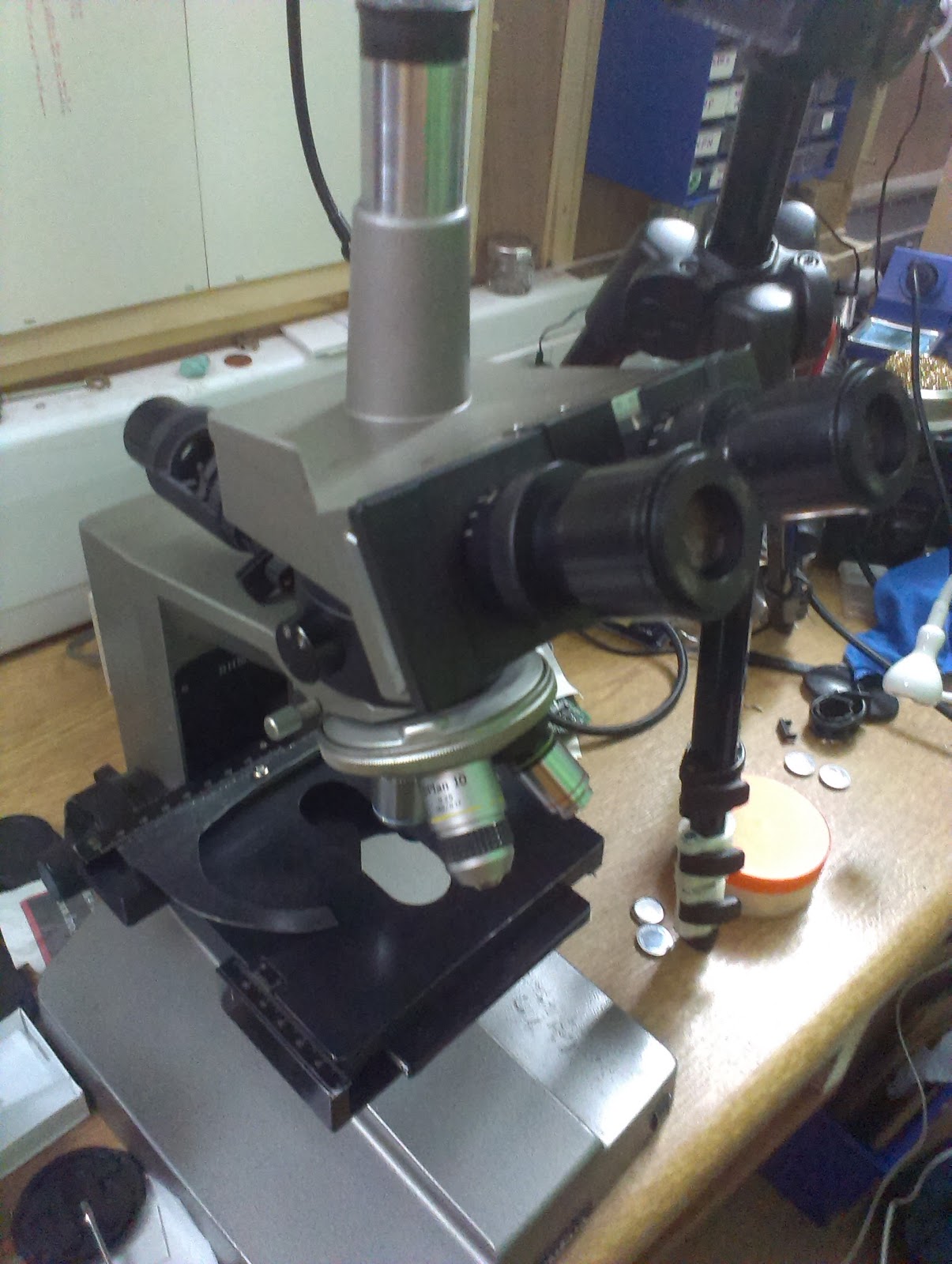
[Amen] wanted to inspect ICs on the PCBs for suitability for reuse, so he bought a metallurgical microscope that illuminates from above rather than below, since it normally looks at opaque things. It has a working distance of 0.5 mm and 10 mm, which isn’t a lot of room to solder.

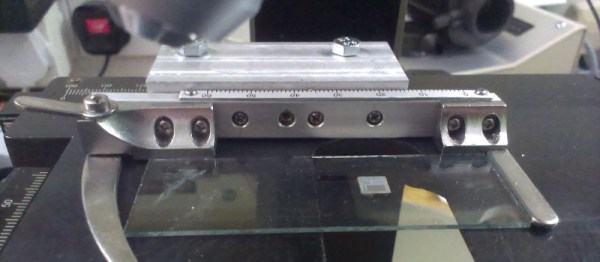
The microscope didn’t come with a slide tray, so [amen] found a cheap one on eBay. Needing a connector block, he melted down some food trays into an ingot, which he then milled down into a block shape, drilled, and used to attach the slide tray to the microscope.

The thing came with a manual XY table, which the operator adjusts by turning knobs. It’s fine for most basic applications but it’s also a pain for more complicated projects, like tiling together a huge photo of a die. [amen]’s currently working on a powered XY based on a DVD drive’s stepper assemblies.

If you’re looking for more microscope projects, read up on the hacked inspection microscope and a Pi Zero ‘scope we previously published.

Teletype Machine Resurrected

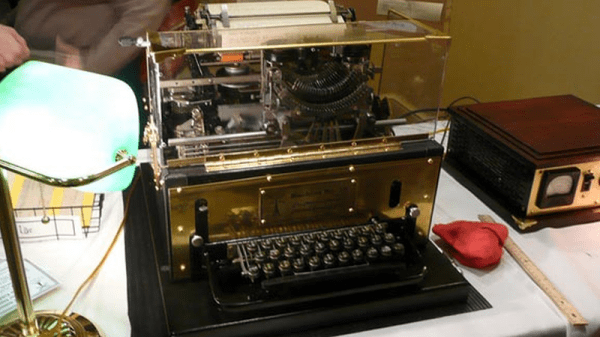
A teleprinter is, at its heart, an automatic typewriter.  It’s electrically controlled and has some smarts to be able to decode an incoming message and has something that will move the keys.   These printers have been in use since the late 1800’s and [AethericLtd] have refurbished an old 1930’s design and given it a bit of steampunk flair.

As is common with older mechanical devices that have been sitting for extended periods of time, the first thing this machine needed was a bath. The machine was separated into its three main parts and soaked in a degreasing solvent. The keyboard was the dirtiest, so it got an overnight soak. Since little of the mechanism was electrical, most of it could be submerged which helped with the cleaning.

The next step in the restoration was lubrication. In order to do a proper job, the manuals (which were available online) were consulted and synthetic motor oil used for lubrication. Once all the hundreds of parts were oiled, [AethericLtd] started working on the wiring. The original wiring in this machine was called Deltabeston – a type of wire by General Electric which uses asbestos insulation. To play it safe, that wire was left alone. The selector magnet required only 4 volts to pull up, but 4 volts wasn’t enough to run the machine. The power supply used was a 120 VDC, 200 mA supply through a 2 KΩ, 10 W resistor.

Once everything was back together and working, [AethericLtd] could take machine out and show it off. The website describes not only the restoration process but also the setup, how to connect to the machine and how to communicate with the machine. Great work! If you are interested in these machines, there have been a few Teleprinter projects on the site before: this one has been modified to connect to a modern modem, and this one prints out tweets.

Continue reading “Teletype Machine Resurrected”

OLED Hacked Power Bank

In a feat of over-engineering, [Everett Bradford] hacked his power bank to add power monitor via an OLED display to show live current, voltage, temperature, and capacity information. The idea came when he learned about the INA219 chip. The INA219 is a current shunt and power monitor IC with an I²C or SMBUS compatible interface. The device is able to monitor both shunt voltage drop and bus supply voltage, with programmable conversion times and filtering. A programmable calibration value, combined with an internal multiplier, enables direct readouts of current in amperes. An additional multiplying register calculates power in watts.

With impressive miniaturization skills, [Everett] dissembles the Xiaomi Mi power bank and manages to add a custom power monitoring module and an OLED display. Not only that, he replaced the 4 LEDs that were the battery level indicators and actually consume more amps than his board plus the display. While active, the board consumes about 8mA. In sleep mode, it consumes less than 30µA.

The 32×64 OLED display and the custom-made circuit was assembled and tightly fitted into the original case. The power bank now gives readings of the battery charge level in a small graph, numeric current input/output, voltage and temperature. The seamless integration of the display into the power bank makes it look like something that could perfectly have come from a store. This is not your typical DIY power bank nor a gigantic 64 cells power bank. It is a precise and careful modification of an existing product, adding value, functionality, and dare I say it, style: an awesome hack!

We can see [Everett] process in the following video:

Continue reading “OLED Hacked Power Bank”

Mini Drill Made From A Motor

We love this hacked-together mini drill by [BuenaTec] that uses a DC7.2V 10K-RPM motor with a 1/8” Dremel chuck added on. Power is supplied by a USB-A cable with the data wires cut off, with a switch controlling the voltage and a rectifier diode protecting the USB port or battery pack from back voltage from the motor.

The drill isn’t very powerful, only able to bore holes in PCBs, plastic, and similar soft materials. However, you could see how just a couple more components could make it even more robust — maybe a speed controller and voltage booster? Even so, we appreciate this bare-bones, ultra-low budget approach — only the barest essentials are included, with the components held together with hot glue and solder. Also, no one is allowed to complain about their soldering iron after viewing this video.

For more projects involving motors, read up on this brushless motor made from 3D-printed parts and this guide to hand-winding quadcopter motors.


Monstrous USB Power Bank

At some point, cleaning out the spare parts bin — or cabinet, or garage — becomes a necessity. This is dangerous because it can induce many more project ideas and completely negate the original purpose. [Chaotic Mind], considering the pile of  batteries he’s collected over the past decade, decided that instead of throwing them out, he would recycle them into a grotesque USB power bank.

Inside the bulk of this power bank are an eye-popping 64 18650 Lithium Ion cells, mostly collected from laptop batteries, and wired in a parallel 8×8 pattern with an estimated capacity of over 100,000mAh(!!).  The gatekeeper to all this stored energy is a two-USB power bank charger board from Tindie.

Ah — but how to package all this power? The handy man’s secret weapon: duct-tape!

Continue reading “Monstrous USB Power Bank”

Playing Mario On An Oscilliscope

Any display can be connected to a microcontroller and used as a display if you know the protocol to use and have enough power in your micro. Sometimes, an odd display is used just “because it’s there.” This seems to be the case for Reddit user [phckopper], who has used a STM32 and a PS2 joystick to play a version of a Mario game on an oscilloscope.

There’s not many technical details but [phckopper] lets us know that the rendering is done using the SPI on the STM, transferred via DMA, which is synchronized to two saw-tooth waves that are fed in to the X and Y axes of the oscilloscope.  The Z axis, which controls the brightness of the dot, is fed from the MOSI. By making the oscilloscope range all over the screen, similar to the way a CRT’s gun does, [] is able to draw sprites, rather than vector graphics. The display has a resolution of 400×400 and each sprite is 16×16. The input is from a PS2 joystick connected to [phckopper]’s PC, with the information communicated over UART using a simple protocol.

We don’t get to see much of the game in the video after the break, but it’s a pretty impressive job nonetheless, especially when you realize that [phckopper] did this project when he was just sixteen! There are a couple of other oscilloscope projects here at Hackaday, like this one, a great version of pong played on the ‘scope, or this one, showing off some great graphics.

Continue reading “Playing Mario On An Oscilliscope”